Brand activations in London: the showroom-first playbook
By Faura ·

For a showroom-hosted brand activation in London, book a trade-facing space with proper specification infrastructure and an on-site event manager already assigned. That combination determines whether a launch converts into specification decisions or simply generates footfall.
Three things to secure first:
- Availability: confirm the showroom date against your own launch window and any trade calendar clash.
- Technical spec: check lighting CRI, workbank capacity, and rig points before you commit.
- On-site management: get a named event manager scheduling appointments, not just a keyholder.
Book six to eight weeks out minimum, with a two-to-three-week promotional run-in. Where possible, anchor your date near London Design Week, Clerkenwell Design Week, or Decorex so trade visitors are already in London and looking.
Pro Tip: Ask any prospective venue how many consultations, not just visitors, their last hosted event produced. Footfall without pacing is just a busy room.
Key Takeaways
Showroom-hosted brand activations succeed when specification infrastructure, on-site pacing, and calendar timing are locked in before promotion begins.
| Point | Details |
|---|---|
| Book with lead time | Secure a venue six to eight weeks out and align the date with Decorex, London Design Week, or Clerkenwell where possible. |
| Budget beyond hire fees | Production, staffing, and sample logistics typically outweigh the base venue cost, so ask for a full breakdown upfront. |
| Confirm insurance and licensing early | Public liability cover, alcohol licensing, and rigging risk assessments need sorting before setup week, not during it. |
| Target outreach over broad reach | A focused list of relevant designers and architects with a clear RSVP outperforms mass invitations for trade events. |
| Measure consultations, not footfall | Track specification meetings booked and 30-day follow-up conversion rather than visitor headcount. |
| Faura offers the ready-built model | Faura’s Westminster showroom offers space to present schemes to clients, with procurement, logistics and delivery handled by one team. |
Table of Contents
- What drives the cost of brand activations in London
- How do you choose the right brand activation partner in London?
- What does a brand activation in London typically cost?
- What legal and licensing checks do London events require?
- How should you promote a London brand activation to the right audience?
- How do you measure whether a brand activation worked?
- Faura: a Westminster showroom built for hosted activations
- What actually makes the guest journey work
- Frequently asked questions
- Sources
What drives the cost of brand activations in London
Three variables set the budget, and none of them is the venue hire fee people assume dominates.
The first is production complexity. A launch built around scenic design, bespoke lighting states, and AV drawn from the product’s own design language costs more than a static display, but it also converts better, because guests read the room as an extension of the brand rather than a rented hall with your logo stuck on.
The second is staffing. On-site pacing, whether that’s a single host managing appointment flow or a full showcalling team for a multi-room launch, adds up faster than most designers expect. A well-run event needs someone whose sole job is guest journey, not someone splitting attention between hosting and troubleshooting.
The third is sample and stock logistics: delivery, insurance, and storage for anything on display. Furniture and lighting brands often underestimate this line, particularly when pieces need to arrive from overseas suppliers or return to a warehouse afterwards.
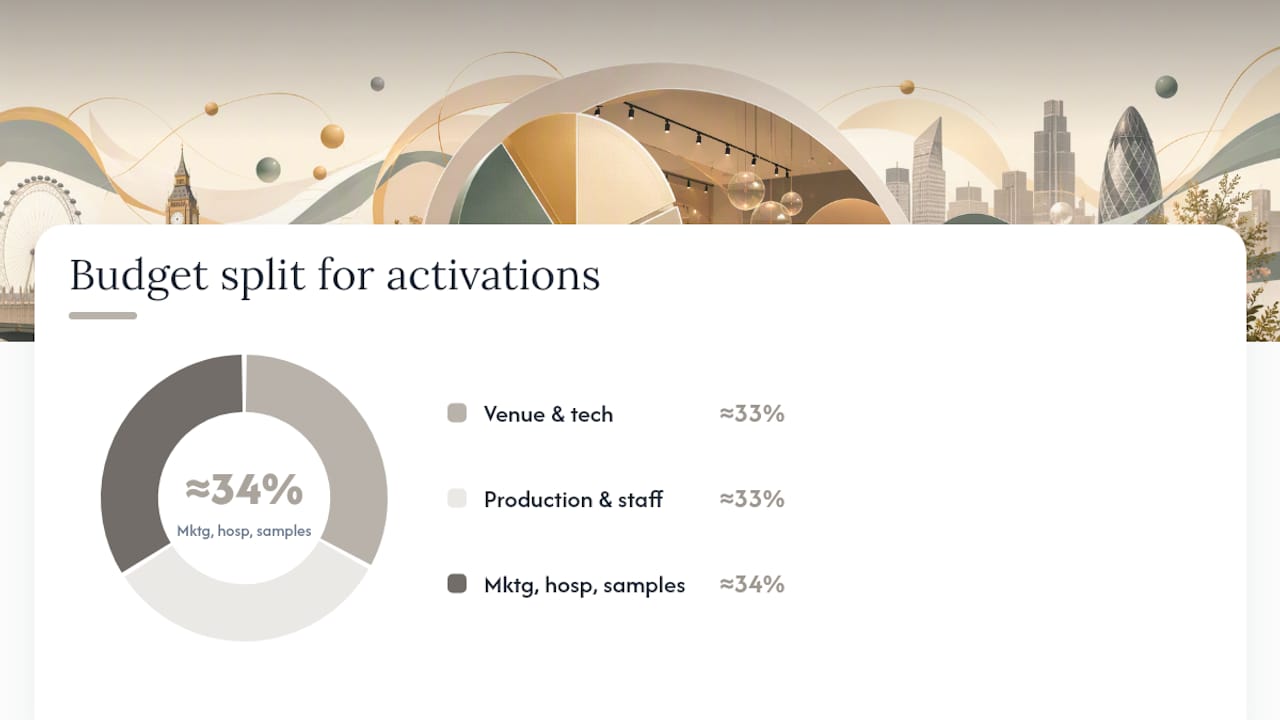
As a planning starting point, divide the budget between venue and technical hire, production and staffing, and marketing, hospitality and sample logistics. Brands that skip the marketing third usually end up with a beautifully lit room and nobody in it.
How do you choose the right brand activation partner in London?
Experience with your specific category matters more than a broad portfolio. A partner who has run consumer pop-ups isn’t automatically equipped to handle a trade specification event, where the guest journey is about decision-making, not spectacle.
Look for three things when vetting a showroom or production partner:
- A track record of hosted trade events, not just retail launches, since the pacing and follow-up mechanics differ substantially.
- Named client references you can actually contact, ideally other designers or brands who’ve launched through the same space.
- Technical fluency, meaning the venue or partner can speak confidently about lighting, sightlines, and hero-moment placement without deferring every question to a separate contractor.
Portfolio breadth is a weaker signal than most guides suggest. A venue that has hosted 200 varied brand events tells you less than one that has hosted 20 events specifically for interior brands or designers, because the guest expectations, appointment structure, and follow-up needs are entirely different in the trade context. Ask what percentage of past activations were trade-facing rather than public-facing, and ask how many resulted in confirmed specification meetings afterwards. That single question filters out venues that only measure success in attendee headcount.
What does a brand activation in London typically cost?
Costs vary enormously by scale, but three tiers give a useful reference point. A compact sample-display event in a shared showroom slot, covering a few hours with light staffing, tends to sit at the lower end of the spectrum. A half-day or full-day hosted launch with dedicated technical support and catering sits considerably higher. A multi-day residency-style activation, spanning several appointment slots across a week, costs more again but spreads the investment across many more qualified conversations.
Hidden costs catch designers out more often than the headline hire fee. Insurance for displayed stock, especially high-value furniture or lighting pieces, is frequently quoted separately. Out-of-hours access charges apply if you need early setup or late breakdown, which most technical installs require. Storage between events, if your activation runs across several days, adds a line many budgets miss entirely. Catering and hospitality, while often treated as an afterthought, can materially affect how long guests stay and how many consultations you actually complete.
The most reliable way to avoid surprises is asking any venue for a full cost breakdown before booking, not just the base hire rate, and confirming in writing what is included in technical support versus billed as an add-on.
What legal and licensing checks do London events require?
Any event serving alcohol needs licensing consideration, whether that’s the venue’s existing premises licence covering your event or a Temporary Event Notice if the showroom doesn’t hold a suitable licence for your date and format. Confirm this at booking stage, not the week before.
Public liability insurance is non-negotiable for any hosted event with external guests on the premises, and most reputable showrooms will ask to see your certificate alongside their own cover. If you’re bringing contractors to install scenic elements or lighting rigs, check they carry their own liability cover too, since responsibility can otherwise fall back on you as the commissioning party.
Health and safety compliance covers fire egress, capacity limits, and safe rigging for any suspended or wall-mounted display elements. A venue with proper technical delivery capability will already have risk assessments for common production elements like lighting rigs and freestanding display walls, which saves you commissioning a separate assessment from scratch.
Fire safety and capacity limits are usually set by the building itself, so confirm your guest numbers against the venue’s certified capacity before you finalise invitations, not after. Data protection also applies if you’re capturing guest details for lead follow-up. Have a clear, brief privacy notice at sign-in and store contact information properly rather than on a loose paper list.
How should you promote a London brand activation to the right audience?
London’s design trade audience responds to specificity, not broad reach. A targeted list of 150 relevant designers, architects, and procurement contacts will outperform a generic mailer to thousands every time, because the guest journey only works if the right people show up ready to specify.
Direct outreach through existing trade relationships remains the strongest channel. Showrooms with established designer networks, like a residency-based space with regular footfall, can extend an invitation to genuinely interested visitors rather than cold contacts. Email invitations with a clear RSVP and appointment slot booking work better than open-door events for trade audiences, since designers are managing project schedules and want a defined time commitment.
Press and trade media outreach matters most in the weeks immediately before and after major calendar moments. Timing a launch to coincide with Decorex, which runs 11 to 14 October 2026 at Olympia London, or London Design Week in March, puts your activation in front of an audience already primed to look at new product. Social content works as a supporting layer, particularly behind-the-scenes material showing installation and material detail, but it rarely drives trade attendance on its own. Treat it as reinforcement for people who’ve already received a direct invitation, not as the primary channel.
How do you measure whether a brand activation worked?
Footfall is the weakest metric available, yet it’s still the one most commonly reported. A room full of visitors who never book a follow-up consultation has produced activity, not results.
The metrics worth tracking:
- Confirmed specification meetings booked during or immediately after the event.
- Sample requests logged against specific projects, not just general interest.
- Follow-up conversion rate, meaning what percentage of captured leads turn into an actual client meeting within 30 days.
- Repeat visit rate for designers who return to the showroom outside the event itself.
Post-event debriefs should happen within 48 hours, while pacing notes and guest feedback are still fresh. A simple structure works well: what worked in the guest journey, where did people stall or disengage, and which conversations need immediate follow-up versus a longer nurture. Lead follow-up itself needs a deadline. Contacts not actioned within a week of a launch event lose most of their momentum, and a designer who had a genuine conversation with you at the event deserves a response before they’ve moved on to the next showroom appointment.
Faura: a Westminster showroom built for hosted activations
Faura’s trade showroom in Westminster is a trade-only showroom and residency where visits are by appointment and designers can present schemes to clients. It exists as a working London base for designers who’d rather spend their time specifying than sourcing.

Faura offers space at the residency to present schemes to clients, alongside samples, technical files and a materials library; ask the team directly what event support is available. Designers with a trade account work with a library of over 200 brands, with procurement, logistics and delivery handled by one team. That’s the practical difference between a rented room and a working showroom partner. One requires you to build every process from scratch; the other already has the infrastructure running.
Designers working with Faura can book appointments and use space at the residency to present schemes to clients. If you’re weighing up a launch date against Decorex, London Design Week, or Clerkenwell, check current showroom availability and get a straight answer on what’s included before you commit a date.
What actually makes the guest journey work
Most briefs obsess over the hero product and forget the ninety seconds before a guest reaches it. Entrance sightlines matter more than almost anything else in the room. If a visitor can see the hero display the moment they walk in, they arrive with intent rather than wandering into it by accident.
Appointment pacing prevents the single biggest failure mode in showroom events: decision fatigue. Back-to-back consultations without breathing room produce distracted conversations. Space appointments at proper intervals and guests actually engage with material detail instead of skimming past it.
On the technical side, prioritise high-CRI lighting and genuine workbank space over decorative flourishes. A trade specification event needs surfaces where finishes can be handled and compared, not just admired from a distance. Brief your production partner on rig points and power access early, since retrofitting AV into a room without pre-planned capacity is where budgets quietly balloon.
A trade specification event and a private client launch need different journeys entirely. The first rewards depth and comparison; the second rewards atmosphere and story. Whichever you’re running, capture leads properly at the door and follow up within days, not weeks.
Frequently asked questions
What counts as a brand activation in London for interior designers? It typically means a showroom-hosted event, such as a product launch, curated sample display, or trade preview, run from a London venue with specification facilities rather than a generic event space.
How far ahead should I book a showroom for a launch? Aim for six to eight weeks minimum, with a two-to-three-week promotional window before the event itself to build attendance among the right trade contacts.
Do I need my own insurance if the venue already has cover? Usually yes, particularly for displayed stock. Confirm what the venue’s policy covers versus what you or your contractors need to insure separately.
Is Decorex or London Design Week better for a launch? It depends on your audience. Decorex is a trade event for the luxury interiors industry, held in October, while London Design Week in March concentrates specifically on showroom-based trade visits.
What’s the biggest mistake designers make when planning a hosted event? Underinvesting in appointment pacing. A packed guest list with no structure to the visit produces footfall without the specification conversations that actually justify the cost.
Sources
Register for Decorex (11 to 14 October, Olympia London), check the London Design Week calendar, or explore Clerkenwell Design Week listings before fixing your date.
- Decorex returns: the industry’s most anticipated luxury interior design showcase
- How to build a product launch event around your product
- Showroom design that sells: complete guide for retail brands
- London Design Week
- Clerkenwell Design Week
- Product launch event