£100bn UK Design Market: 6 to 12 Month Entry Roadmap for Designers
By Faura ·

£100bn UK Design Market: 6 to 12 Month Entry Roadmap for Designers
Entering the UK design market is viable for most independent designers and firms, and the fastest route depends on your model: product brands should pursue a trade showroom presence, manufacturers need B2B distribution, and service studios can move fastest through agency partnerships or hybrid freelance teams. Your first three actions: establish a UK presence or appoint a local agent, prepare two or three case studies reframed for British briefs, and secure a trade account or showroom pilot. Start by consulting Design Council, GOV.UK’s design sector guidance, and Faura for practical next steps.
TL;DR:
- The UK design market is valued at £100 billion, with digital, UX, and sustainability sectors experiencing the fastest growth, especially in financial services and public procurement.
- Entry is encouraged through local partnerships such as showrooms, trade accounts, or appointing UK agents, rather than immediate full company formation or leasing.
- Preparing UK-specific collateral, understanding procurement rules, and securing a pilot project or trade account are critical steps to winning initial briefs within the first six months.
- A London showroom, particularly via residency models like Faura, can significantly shorten sourcing and specification times without the overhead of building a standalone presence.
- Avoid common pitfalls such as underpricing, superficial localization, and neglecting procurement requirements, which can delay or prevent successful market entry.
Table of Contents
- How big is the UK design market, and where is the opportunity?
- Why is 2026 a good moment for design market entry?
- What legal and business setup do you need before trading?
- Which market entry route fits your business model?
- How do you win your first UK brief?
- What skills and portfolio depth do UK clients expect?
- Where can you find funding and public tender opportunities?
- What does a realistic 6 to 12 month entry timeline look like?
- How does a London showroom shorten the path to market?
- Three mistakes that slow UK market entry
- Ready to open your London trade account?
- Sources
- FAQ
How big is the UK design market, and where is the opportunity?
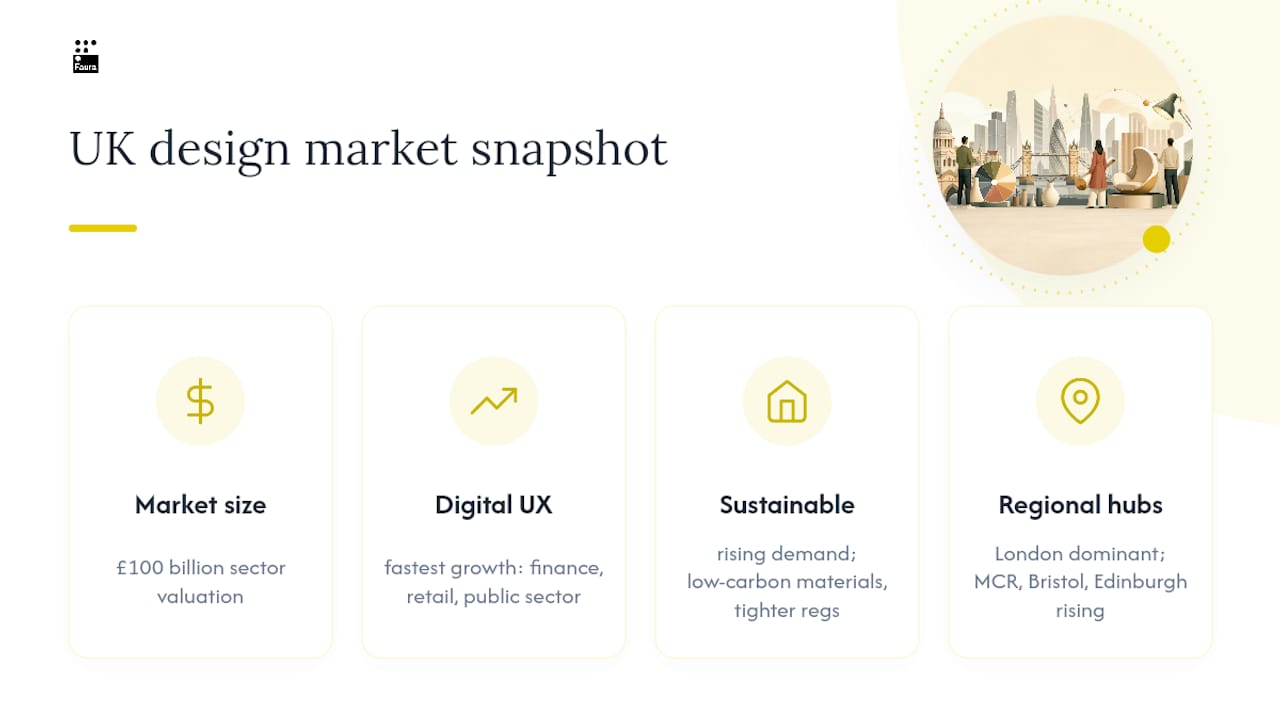
The UK design sector is officially valued at £100 billion, according to the Gov launched to strengthen the industry. That figure alone should reframe how you think about market entry: this isn’t a niche craft trade, it’s a sector the government now treats as comparable to retail or finance in economic weight.
Design Council has documented design’s rise as a major contributor to the UK economy, and its reports increasingly frame design capability as a national asset rather than a support service. The World Design Organisation’s mapping of the UK’s design economy corroborates this scale, offering sector valuation and employment estimates that help you judge where the real demand sits.
The fastest-growing pockets aren’t where most entrants assume. Digital and UX design has expanded fastest as financial services, retail and public-sector bodies digitise services. Sustainable interiors and specification work has grown alongside tightening building regulations and client demand for lower-carbon materials. Public-sector commissioning has also opened up, driven by government interest in embedding design earlier in procurement and R&D processes.
Geographically, London remains dominant, home to the highest concentration of studios, showrooms and specifiers. But regional hubs, particularly Manchester, Bristol and Edinburgh, have built genuine design economies of their own, often with lower overheads and less saturated client pools. If your budget doesn’t stretch to a London base immediately, a regional foothold with strong digital visibility can still put you in front of UK specifiers.
Why is 2026 a good moment for design market entry?
Government-led reform is actively reshaping the landscape you’d be entering. The GOV.UK consultation is seeking to strengthen protections and support across the design sector, with implications for how design work gets commissioned and how intellectual property gets treated. For entrants, that signals a market moving toward clearer rules rather than the ambiguity that has historically deterred overseas firms.
Design Council’s programmes push public bodies to treat design as a measurable capability, embedded in R&D and procurement rather than bolted on at the end of a project. That shift benefits anyone who can walk into a pitch with evidence, not just aesthetics. If you can quantify outcomes, you compete on stronger footing than firms relying purely on portfolio appeal.
On the private side, demand is shifting too. Sustainability requirements and digital transformation budgets are generating new commercial briefs across retail, hospitality and workplace design. Clients aren’t just asking “does this look good”; they’re asking whether a scheme reduces energy costs, meets accessibility standards, or integrates with existing digital infrastructure. Entrants who build that language into their pitch from day one tend to convert faster than those still selling on style alone.
What legal and business setup do you need before trading?
Before you take a single UK brief, get the structural basics right. The U.S. Commercial Service’s UK market entry guidance recommends local adaptation and distributor relationships as a baseline for any overseas entrant, and that principle applies just as much to a solo designer as to a manufacturer.
Your first decision is structure. Trading as a sole trader is quick and low-cost but exposes personal assets to liability. A limited company shields personal assets and often reads as more credible to corporate clients and public-sector buyers, though it carries more administrative overhead. If you’re not ready to establish a UK entity, appointing a UK agent or distributor lets you test the market with lower upfront commitment.
Practical setup checklist:
- Register your business structure with Companies House if incorporating, or register as self-employed with HMRC if trading as a sole trader.
- Check VAT registration thresholds and understand reverse charge rules if you’re invoicing UK clients from overseas.
- Arrange professional indemnity insurance, typically expected by architects, developers and corporate clients before they’ll commission you.
- Arrange public liability cover if you attend sites, showrooms or client premises.
- Review UK registered design protection for original products, and understand basic copyright rules that apply automatically to creative work.
- Take specialist legal advice on IP filing if your business depends on protecting a signature product or pattern.
None of this needs to happen simultaneously, but it needs to happen before your first invoice, not after.
Which market entry route fits your business model?
Choosing the right route often matters more than the quality of your portfolio, because the wrong structure slows everything else down. Four routes cover most entrants:
- B2B distribution and trade accounts. Manufacturers and product brands typically appoint UK distributors or open direct trade accounts with specifiers. This suits businesses with established production but limited UK relationships, trading some margin for faster market access.
- Residency or showroom model. A trade showroom base, such as Faura’s residency in Westminster, gives designers a London presence without the overhead of leasing and fitting out a standalone showroom. It accelerates specification because clients and products sit in one place.
- Agency expansion or acquisition. Larger studios sometimes acquire or merge with a UK firm to gain instant credibility and client books. It’s faster than organic growth but expensive and harder to control culturally.
- Freelance and hybrid models. Solo designers and small teams often use UK-based subcontractors or associates to establish local presence quickly, without committing to a full office before demand is proven.
The right choice usually comes down to capital and timeline. If you need revenue within three months, residency or subcontracting routes beat acquisition every time.
How do you win your first UK brief?
Winning that first brief comes down to how well you translate what you already do into what UK specifiers expect to see.
Showrooms and trade buyers want tangible proof before conversation, not after it. Bring physical samples where possible, alongside specification sheets that state lead times, pricing structure and compliance data clearly. Vague material descriptions get filed and forgotten.
Localisation matters more than most overseas entrants expect. Every piece of client-facing collateral should use British English rather than American spelling, prices should be quoted in GBP, and payment terms should reflect standard UK trade practice, often 30 days net for established accounts. The U.S. Commercial Service specifically flags language and cultural adaptation as a common stumbling block for entrants who otherwise have strong products.
Partnership routes accelerate access considerably. UK agents, contractors and procurement consultancies already hold relationships with the buyers you’re trying to reach, and working through them shortens the sales cycle. If public-sector work interests you, understanding cost transparency frameworks like NRM2 cost estimating helps you speak the language procurement teams expect.
Prioritise your channels rather than chasing all of them at once:
- Architects and specifiers for ongoing project pipeline.
- Developers for volume-driven, multi-unit specification work.
- Corporate procurement teams for workplace and hospitality contracts.
- Digital product teams if your practice includes UX or service design.
Pro Tip: Send a specification pack before you ask for a meeting. UK specifiers routinely shortlist based on documentation quality alone, so a well-prepared PDF often earns you the conversation that a cold pitch would not.
What skills and portfolio depth do UK clients expect?
UK clients, particularly architects and corporate procurement teams, consistently favour depth over breadth in a portfolio. The National Careers Service sets out typical routes into design roles and the qualifications employers look for, and that expectation of demonstrable process carries into freelance and studio hiring too. Two or three detailed case studies showing research, iteration and measurable outcome will outperform a portfolio padded with a dozen thin projects.
Skills in highest demand in 2026 include UX research, service design, sustainable specification, and the ability to collaborate across disciplines rather than work in creative isolation. Clients increasingly expect designers to speak fluently about carbon impact, accessibility standards and digital integration alongside aesthetics.
For hiring, three models dominate:
- Contractors and freelancers, useful for testing UK demand before committing to fixed costs.
- Part-time UK hires, who add local market knowledge and relationship access.
- Remote teams, which keep costs down but require stronger project management to bridge time zones and client expectations.
Recognised qualifications, including entry-level awards from bodies like AIM Qualifications, still carry weight with corporate and public-sector clients who need to justify procurement decisions internally.
Where can you find funding and public tender opportunities?
Public money and tax relief are more accessible to design businesses than many entrants assume, but only if you document your work correctly from the outset.
Grant and innovation funding exists across regional development agencies and sector-specific schemes, often tied to sustainability, digital innovation or export growth. Eligibility criteria shift regularly, so check current schemes directly rather than relying on secondhand summaries.
R&D tax credits apply to genuine design innovation, not routine project work, and HMRC expects clear documentation of the technical uncertainty you resolved. If your practice regularly develops new materials, processes or digital tools as part of client work, this is worth investigating early, since retrospective claims are harder to substantiate than contemporaneous records.
Public tenders that include design work appear through central and local government procurement portals. Before bidding, prepare:
- Evidence of past project value, ideally quantified rather than purely descriptive.
- Compliance documentation, including insurance certificates and accreditations.
- A clear cost breakdown, structured in a way procurement teams can evaluate against other bidders.
Design Council’s emphasis on embedding design capability in procurement means public bodies are actively looking for suppliers who can prove outcomes, not just aesthetics.
What does a realistic 6 to 12 month entry timeline look like?
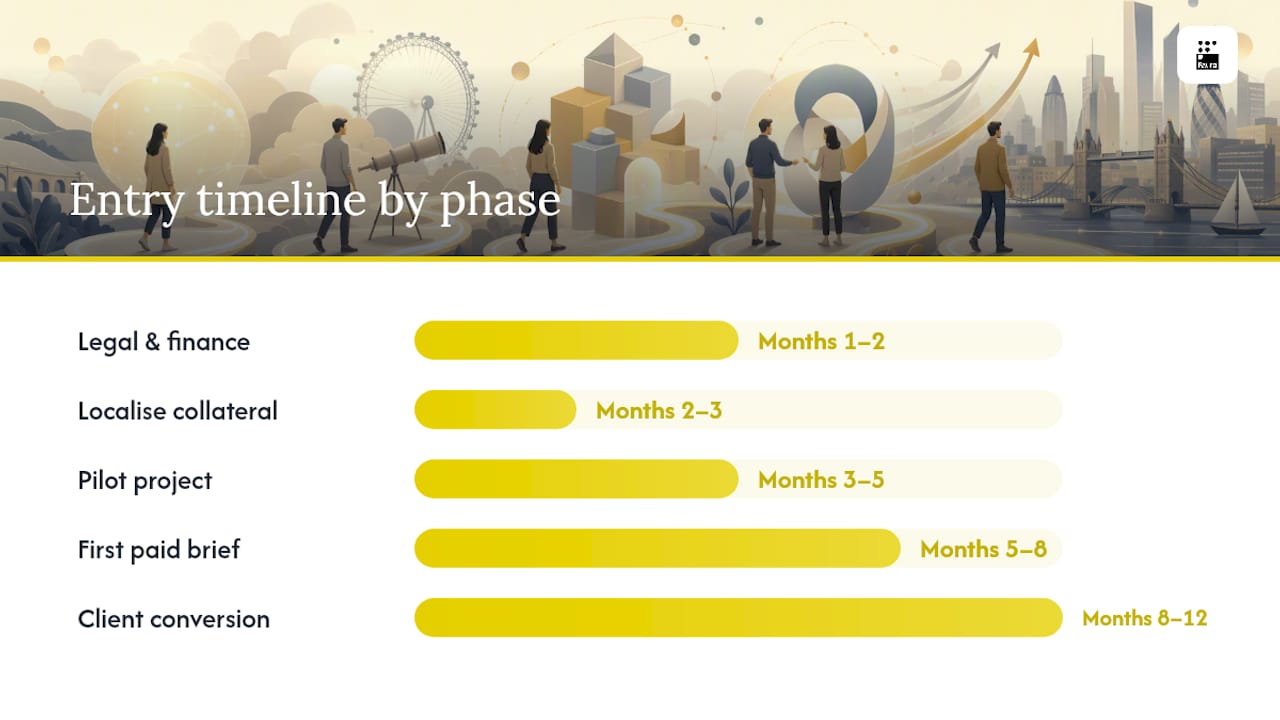
A structured approach beats an improvised one every time. Career changers and small teams generally do best with legal and financial setup first, followed by a short pilot project that generates real evidence for trade buyers, rather than trying to run both simultaneously.
- Months 1 to 2: Register your business structure, arrange insurance, and complete VAT registration if required.
- Months 2 to 3: Localise all client-facing collateral into British English and GBP pricing; open initial trade account conversations.
- Months 3 to 5: Run a pilot project, ideally through a showroom presence or subcontracted UK team, to generate a case study with UK-specific outcomes.
- Months 5 to 8: Pursue your first paid brief using pilot evidence; begin building specifier relationships in your priority channel.
- Months 8 to 12: Convert early clients into repeat business and expand trade account terms based on demonstrated reliability.
Budget across four buckets: legal and financial setup, samples or showroom access, marketing and localisation, and staffing or contractor fees. Costs vary widely by business type, so build your own estimate against actual quotes rather than a generic figure.
Track early traction against three markers: your first paid brief, the number of specifiers actively engaging with your work, and whether you’ve secured proper trade account terms rather than one-off retail pricing.
How does a London showroom shorten the path to market?
A curated trade showroom materially reduces sourcing time by centralising samples and supplier contacts in one place, cutting out weeks of scattered supplier outreach. Faura’s residency model in Westminster works on exactly this principle, giving designers entering the UK a working base without the cost of building one from scratch.
The residency model typically represents a large number of curated brands and serves clients internationally, giving entrants access to an established procurement network rather than building supplier relationships from zero. Concretely, that model shortens the path to a first specification because:
- Designers can present schemes to clients in a neutral, professional showroom space rather than a temporary office.
- Procurement terms are negotiated once, at the residency level, rather than brand by brand.
- Sourcing and supplier coordination sit outside the designer’s own workload, freeing time for actual project execution.
For entrants without an established London network, this kind of shared infrastructure often replaces months of independent relationship-building.
Three mistakes that slow UK market entry
The three most avoidable mistakes I see are underpricing to compete on cost alone, treating localisation as cosmetic rather than structural, and ignoring procurement rules until a tender is already lost.
Underpricing signals inexperience to UK buyers more than it signals competitiveness. Superficial localisation, swapping a currency symbol without adjusting terms or spelling, gets noticed by specifiers who work with international suppliers daily. And procurement rules, particularly around documentation and compliance, eliminate more bidders than quality of design work ever does.
Test small before committing hard. A single pilot project, run through a low-commitment route like a showroom or subcontractor, tells you more about UK demand than months of market research. For designers weighing a London base without wanting to overcommit, Faura offers a way to test the market with lower risk than a standalone lease.
— Eugene
Ready to open your London trade account?
Faura works as a base for independent designers, not a service you have to fit around. The residency gives you trade account access, a curated product library from over 200 brands, and space to host private clients directly in Westminster, all without the overhead of running your own showroom or chasing suppliers individually. That’s the practical advantage over building a London presence from scratch: procurement terms are already negotiated, sourcing time drops, and you keep your focus on the design work itself.
If you’re weighing whether a London base makes sense for your practice, start with the residency page for interior designers to see current trade account terms, or explore the full trade offering to understand how procurement support works in practice. Booking a visit is the fastest way to judge fit before committing.
Sources
- United Kingdom market entry strategy — U.S. Commercial Service
- Gov
- Design Council report (press release / report excerpt)
- Mapping the UK’s design economy — WDO
- Graphic designer job profile — National Careers Service
FAQ
Is it hard to enter the UK design market as an overseas designer?
Entry is achievable with the right preparation. The main barriers are localisation, documentation and building specifier relationships, not demand, given the sector’s £100 billion valuation.
Do I need a UK company to sell design services in Britain?
Not immediately. You can appoint a UK agent or trade through a showroom residency while testing demand, though a limited company often improves credibility with corporate and public-sector clients.
What insurance do UK design clients expect me to hold?
Most architects, developers and corporate clients expect professional indemnity insurance as standard, alongside public liability cover if you visit sites or client premises.
How much does a showroom presence cost compared to leasing my own space?
Faura does not publish fixed pricing for residency or trade account terms; current rates are available directly on the residency page.
What is the fastest way to get my first paid UK brief?
A pilot project run through an existing trade relationship or showroom base, paired with two or three strong case studies reframed for UK briefs, is typically the fastest path to a first paid commission.