Keep 5 Years' Records: UK Fabric Fire Rules for Trade Suppliers and Designers
By Faura ·
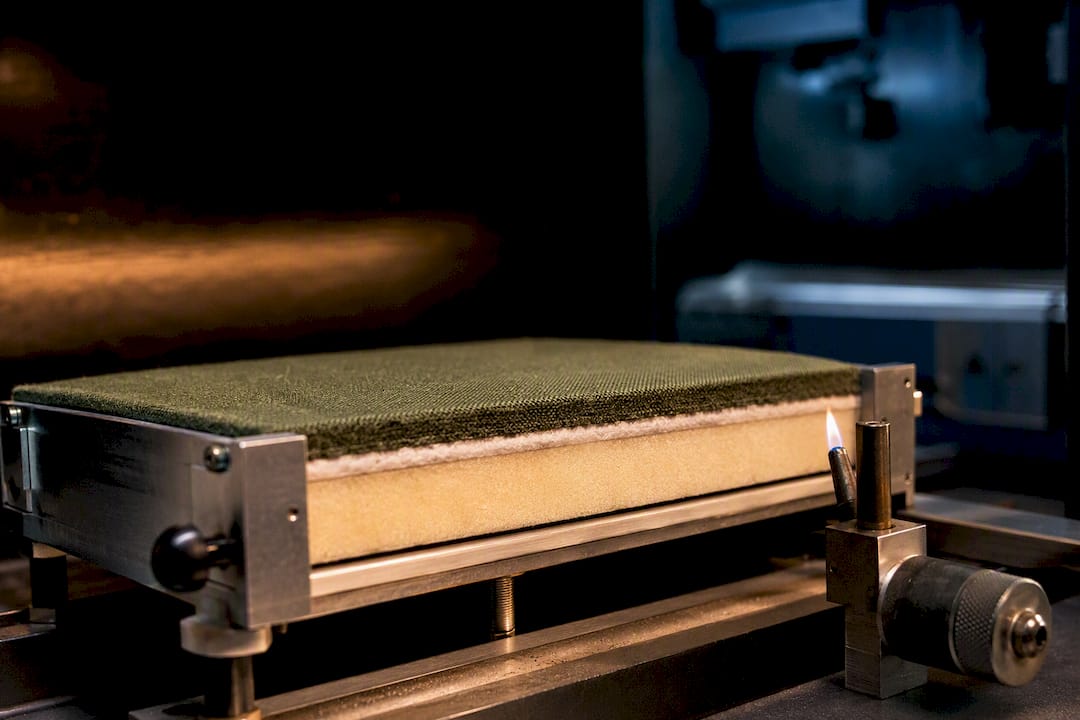
Every supplier, manufacturer and retailer of domestic upholstered furniture in the UK must comply with the Furniture and Furnishings (Fire) (Safety) Regulations 1988, as amended in 2025. That means testing and certifying fabric composites, fitting a permanent label, and keeping five years of records. Check your current stock and supplier certificates before your next order lands.
TL;DR:
- Suppliers must verify and retain composite test certificates for fabric, foam, and interliner combinations, as certificates are specific to exact material combinations.
- Only fabrics with at least 75% natural fiber can qualify for Schedule 3 interliner exemptions, which require separate ignition testing.
- Non-compliance risks include product recalls, legal liabilities, and enforcement actions by local authorities or trading standards.
- The 2025 amendments took effect on 30 October 2025, so check that labelling and supplier paperwork reflect the current rules.
- Upholstery fabric testing under building fire safety codes relates separately to wall linings and requires distinct classification, not covered by crib 5 certificates.
Table of Contents
- Which fabric fire regulations items in the UK cover
- What do BS 5852, Schedule 3 and BS EN 13501 actually test?
- What labelling and records must you keep?
- How do you build compliance into daily operations?
- When Approved Document B applies instead of BS 5852
- What’s changing in the fire regulations timeline?
- What happens if you don’t comply?
- Faura’s view on compliant sourcing for designers
- Where to check the primary rules yourself
- Sources
Which fabric fire regulations items in the UK cover
The Furniture and Furnishings (Fire) (Safety) Regulations 1988 apply to domestic upholstered furniture: sofas, armchairs, dining chairs with upholstered seats, headboards, and loose covers sold with or for that furniture. Reupholstery counts too, so a workshop refitting an old frame with new fabric takes on the same testing and labelling duty as a manufacturer starting from scratch.
A handful of items sit outside scope, and the exclusions regularly catch people out:
- Sleeping bags and bedclothes, including duvets and pillowcases
- Curtains and carpets
- Furniture made before 1 January 1950
- Loose covers for mattresses
The “first supplier” is whoever first supplies the item within the UK, whether that’s a domestic manufacturer, an importer bringing stock in from overseas, or a retailer selling furniture under its own brand. That business holds the primary duty to test, certify, and retain the compliance file, regardless of where the fabric was woven or the frame assembled.
What do BS 5852, Schedule 3 and BS EN 13501 actually test?
BS 5852 is the ignition test at the heart of UK upholstery fire safety. It measures how a fabric and its filling resist a smouldering cigarette and, for the more demanding crib tests, a small flaming source (crib 5 being the toughest commonly specified). Crucially, the test result belongs to the composite, meaning the exact combination of cover fabric, interliner (if used) and filling foam tested together. Swap any one component and the certificate no longer applies.
Pro Tip: Never assume a fabric that passed on one foam automatically passes on another. If your supplier changes foam grade, ask for a fresh composite test certificate before you ship a single unit.
The Schedule 3 interliner exception lets manufacturers use a fire-resistant interliner behind a standard fabric instead of treating or replacing the cover itself, but only when that cover fabric is mainly natural fibre by weight. Synthetic-rich or fully synthetic fabrics do not qualify for this route. Schedule 3 also specifies the exact ignition resistance test rig and sample requirements the interliner composite must pass.
- BS 5852: cigarette and crib ignition tests for upholstery composites
- Schedule 3: interliner ignition resistance test for fabrics with ≥75% natural fibre
- BS EN 13501-1 / BS 476: surface spread of flame classifications for wall linings, not upholstery
- BS 7177: relevant to mattresses, not upholstered seating fabric
BS EN 13501-1 and the older BS 476 measure something entirely different: how a material contributes to fire spread across a surface, which matters for wall linings and fixed panels, not loose or fixed upholstery. A crib 5 certificate on a sofa fabric tells you nothing about whether that same fabric is safe to upholster onto a headboard panel treated as a wall lining in a commercial scheme.
What labelling and records must you keep?
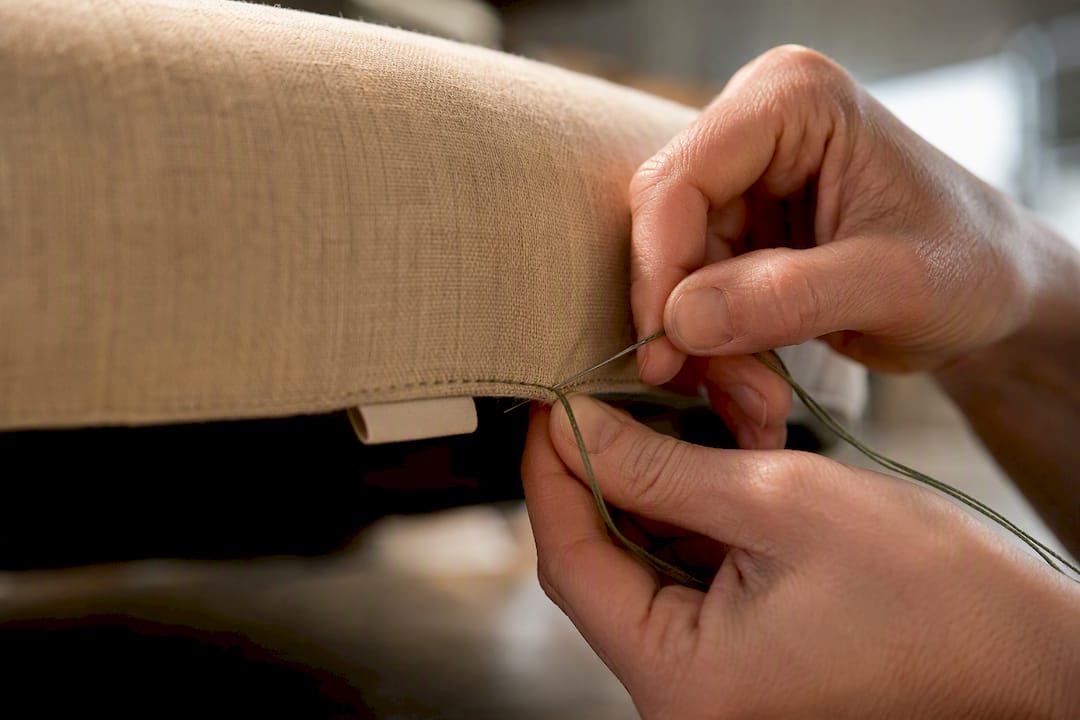
Every new item of furniture within scope needs a permanent label, sewn or fixed securely into the item (commonly under a seat cushion or on the frame), stating that it meets the 1988 Regulations and giving basic compliance information. The first supplier is responsible for fitting it, even where manufacturing has been outsourced.
Behind the label sits a documentation trail. Keep:
- The composite test certificate for the exact fabric, foam and interliner combination sold, showing scope, sample reference and test date
- A batch mapping record linking certificates to specific production runs or shipments
- The interliner specification sheet, where Schedule 3 is used
- Test house contact details, for verification if a certificate is queried
- A dated supplier declaration confirming the first UK supply date
Industry guidance, including the FIRA flammability guide, stresses the importance of keeping complete documentation. First suppliers must retain this file for five years.
How do you build compliance into daily operations?
Compliance works best as a routine, not a scramble before an audit. Start with supplier onboarding: before placing an order, ask every fabric or furniture supplier for their current composite test certificates, confirm who holds first-supplier status in the UK, and require batch traceability as a contract term rather than a favour.
- Request certificates covering the exact fabric weight, colourway and foam combination you intend to sell
- Confirm whether an interliner is being used and check the fabric’s natural fibre content against the 75% threshold
- Build labelling into your production line sign-off, not as an afterthought before dispatch
- Train sales and online listing staff to check that product descriptions match the compliance file before a product goes live
Pro Tip: Keep one indexed folder per fabric range, not per order. When a trading standards officer asks for evidence, being able to hand over one file per SKU rather than digging through years of invoices makes the difference between a five-minute visit and a formal investigation.
Designers commissioning bespoke upholstery through a trade account should ask the same questions of their fabric house before specifying a composite for a client project.
When Approved Document B applies instead of BS 5852
Upholstery testing under the 1988 Regulations has nothing to do with building fire safety in commercial or public spaces. Approved Document B governs internal wall and ceiling linings in buildings, and it’s steering specification away from legacy BS 476 national classes toward BS EN 13501-1 Euroclass ratings, with circulation spaces in most buildings requiring Class B-s3,d2 or better.
- A fabric with a valid crib 5 certificate for upholstery has no automatic standing as a wall lining or fixed panel material
- Wall-mounted headboards, acoustic panels and fixed screens in commercial schemes need their own BS EN 13501 or BS 476 classification for the installed composite
- Always confirm classification requirements with building control or the project’s fire officer before specifying fabric for anything beyond loose furniture
Treat upholstery compliance and building lining compliance as two separate certificates for two separate purposes, even when the same fabric roll is involved.
What’s changing in the fire regulations timeline?
The 2025 amendment to the Furniture and Furnishings Regulations, published on 30 April 2025 and in force from 30 October 2025, removed the display-label requirement, excluded certain baby and children’s products from scope and extended the time limit for enforcement proceedings. Suppliers should expect further clarification rather than a wholesale rewrite in the near term.
- Approved Document B carries amendments running through 2026 and 2029, phasing out reliance on BS 476 national classes in favour of BS EN 13501
- Transitional arrangements mean projects started close to a change date may fall under either the old or new requirement, so check with the Building Safety Regulator or local fire officer before committing to stock
- Build testing lead times and up-to-date certificate warranties into supplier contracts now, rather than discovering a gap when an order is already in production
What happens if you don’t comply?
The Office for Product Safety and Standards sets national policy, while local Trading Standards teams carry out inspections and enforcement on the ground, typically starting with a request to see your compliance file. Persistent or serious breaches can lead to product recalls, sale restrictions, and prosecution.
Failing the 1988 Regulations also feeds directly into wider liability exposure under the General Product Safety Regulations and the Consumer Protection Act, since a fire-related injury claim will point straight back to missing or invalid test certificates.
- Keep a written recall procedure ready before you need it, not after
- Check product liability insurance covers the specific furniture categories you sell
- Maintain the five-year traceability file as your first line of defence in any dispute
Faura’s view on compliant sourcing for designers
Compliance gaps in upholstery rarely come from bad fabric. They come from missing paperwork somewhere between the mill, the workshop, and the client’s living room. A curated trade showroom structure can make this easier, provided certificates, batch numbers and first-supplier declarations are checked as part of how the product library is built, not an afterthought bolted on for a single order.
For independent designers, the practical advice is to work with showrooms and suppliers who can produce a composite certificate on request, before a fabric ever reaches a client’s sofa. Ask the question early, and you avoid a difficult conversation on site.
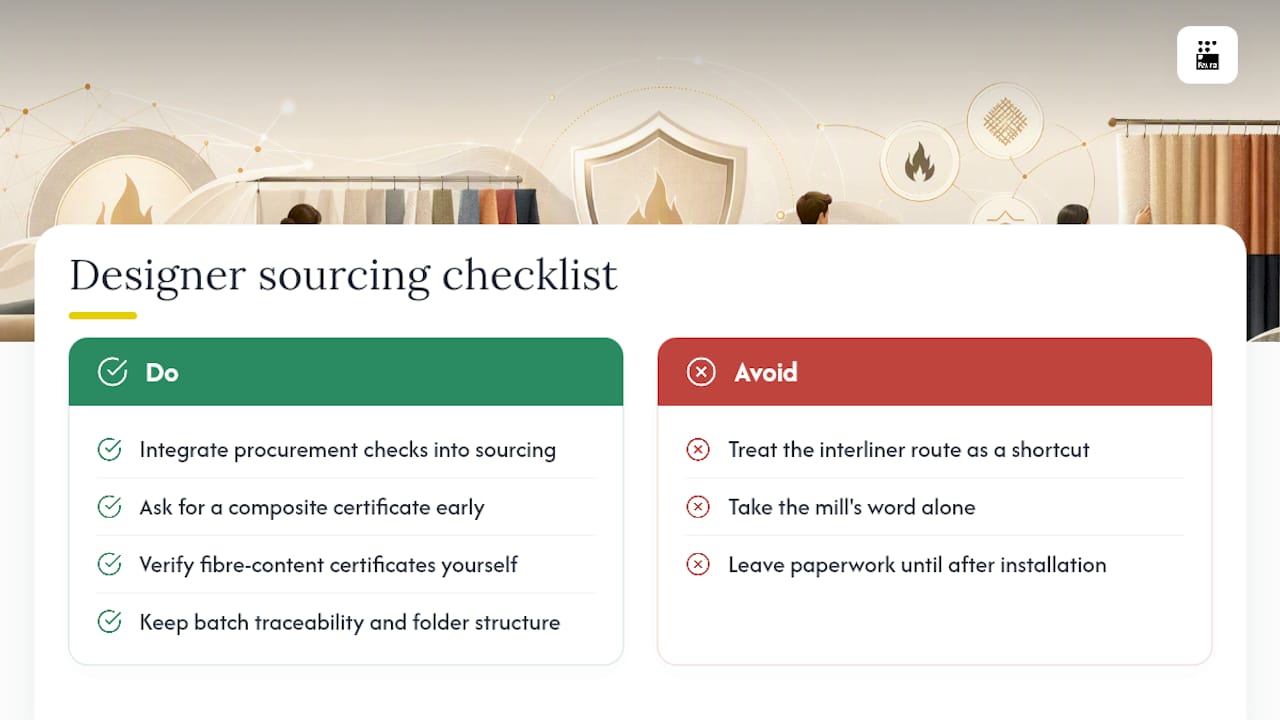
The regulatory detail matters less than the discipline behind it. Most manufacturers already know what BS 5852 requires; the ones who fail an inspection are usually the ones who can’t lay their hands on the right piece of paper fast enough. That’s not a fabric problem, it’s a filing problem, and it’s entirely fixable with a decent folder structure and a supplier who takes the same view.
Where the industry gets this wrong is treating the interliner exception as a shortcut. Schedule 3 exists for genuine natural fibre fabrics that would otherwise need chemical treatment, not as a loophole to dodge testing altogether, and inspectors are increasingly alert to fabrics marketed as “natural” that sit just under the 75% threshold. If you’re specifying an interliner route, verify the fibre content certificate yourself rather than taking a mill’s word for it.
If you’re building or refreshing a fabric range and want procurement support that already builds compliance checks into sourcing, Faura’s Westminster showroom works with trade clients across over 200 brands; ask the team for the relevant certificates and technical files for any product you specify.
Where to check the primary rules yourself
- Furniture and Furnishings (Fire) (Safety) Regulations 1988 (as amended) and the 2025 amendment
- Legislation and the FIRA flammability guide for practical templates
- BSI and accredited UK test houses for correctly scoped BS 5852 and BS EN 13501 test methods
Sources
- Furniture and Furnishings (Fire) (Safety) Regulations 1988 (as amended)
- Furniture and Furnishings (Fire) (Safety) Regulations 1988 — Schedule 3
- Amendments to Approved Document B: Fire safety (AD_B_2029_amendments.pdf)