Beat Six Month Delays: FF&E Procurement Process for Designers
By Faura ·
Beat Six Month Delays: FF&E Procurement Process for Designers
FF&E procurement is the structured process of specifying, sourcing, ordering and installing furniture, fixtures and equipment for a project, run from the brief through to handover. It follows a fixed sequence: specification, tendering, sample approval, purchase orders, logistics and installation. Because bespoke and imported items routinely carry long lead times, procurement has to run alongside construction, not after it, or the whole programme slips.
TL;DR:
- FF&E procurement must begin early, ideally 12 to 18 months before project completion, due to long lead times for imported and bespoke items.
- A detailed FF&E schedule with item specifications, costs, and lead times serves as the main reference for tracking and avoiding delays or budget overruns.
- Proper sample approvals, mock-up rooms, and supplier bid comparisons are critical to prevent costly errors and ensure consistent quality across units.
- Managing logistics with long-lead items first and building buffers for customs delays is essential to keep installation on schedule.
- Using trade showrooms and procurement support services can significantly cut sourcing and approval times, especially for larger or high-risk projects.
Table of Contents
- What is the FF&E procurement process, and why does timing matter most?
- Planning and budgeting: scope, BOQ and the FF&E schedule
- Specification, sourcing and tendering: RFx, samples and mock-up rooms
- Procurement, purchase orders and order management
- Logistics, freight, warehousing and lead-time sequencing
- Installation, snagging, documentation and handover
- Common risks and mitigation: lead times, quality failures, and budget overruns
- Risk management strategies specific to FF&E procurement
- Quality control and inspection procedures during procurement and delivery
- Stakeholder communication and coordination throughout the procurement process
- Payment terms and financial management related to FF&E procurement
- Sustainability and environmental considerations in FF&E procurement
- Faura perspective: how a trade showroom and procurement support accelerates designer workflows
- Practical offer: how to engage Faura for procurement support and showroom hosting
- Sources
- FAQ
What is the FF&E procurement process, and why does timing matter most?
FF&E, short for furniture, fixtures and equipment, covers everything loose that gets fitted into a finished shell: sofas, casegoods, lighting, artwork, mirrors, rugs, even the small-wares in a hospitality kitchen. The hotel FF&E procurement process that Stoch Hotel Consulting describes maps closely to what independent designers face on any residential or commercial project: brief and brand standard, specification and schedule, budget and value engineering, tender and bid leveling, samples and mock-up, purchase orders, logistics, then install, snag and handover.
Each of those stages functions as a gate. Skip one, or compress it to save time, and the risk simply moves downstream, usually landing on-site in the form of a defect, a delay or a budget overrun nobody planned for. The single biggest driver of failure across all of it is timing. Designing Buildings notes that lead times for bespoke or imported items regularly exceed six months, which means procurement decisions made in month one of a project often determine whether month nine goes smoothly. Treat FF&E as an afterthought to the construction programme, and it becomes the thing that holds the whole project hostage.
Planning and budgeting: scope, BOQ and the FF&E schedule
Every procurement decision traces back to one document: the FF&E schedule, sometimes called the bill of quantities (BOQ). It needs to be detailed enough that a supplier could quote from it without a phone call, and structured enough that you can track every item from specification to installation. A well-built FF&E schedule acts as the single source of truth for the entire project team, client included.
Build the schedule around these fields as a minimum:
- Item code, room location and quantity required, so nothing gets double-ordered or missed
- Model number, finish, dimensions and material specification
- Target unit cost, landed cost estimate and approval status
- Lead time estimate and required on-site date
Landed cost, not factory price, is what belongs in the budget. That means freight, duty, insurance, storage and installation labour sitting alongside the unit price, plus a contingency line of around 10 to 15% for damage, reorders and currency movement on imported goods. For larger projects, hotel procurement guidance recommends starting the schedule 12 to 18 months before opening, a window worth borrowing even for residential and boutique commercial work, where clients often underestimate how early sourcing decisions need to lock in against a construction programme and responsibility matrix.
Specification, sourcing and tendering: RFx, samples and mock-up rooms
A specification that leaves room for interpretation is where budget overruns start. Every line on the schedule needs enough detail that three different suppliers would quote the same item, not three variations of it.
Work through specification and tendering in this order:
- Write the specification with exact dimensions, finish codes, material tolerances, fire and safety ratings, and warranty terms.
- Prequalify suppliers on production capacity, export experience, financial stability and reference projects before inviting bids.
- Issue a formal RFQ or RFP that demands like-for-like responses, so pricing, lead time and payment terms can be compared fairly.
- Request physical samples for every finish and material before approving production quantities.
- Build a mock-up room for multi-unit projects, hospitality schemes and any repeated joinery package, and get client sign-off before mass production starts.
The sample and mock-up stage is not a formality. It is the last practical checkpoint before a mistake gets replicated across dozens or hundreds of units. As Stoch Hotel Consulting’s procurement guidance points out, a mock-up room is often the last practical gate standing between a minor specification error and a costly rectification programme.
Pro Tip: Photograph and date every approved sample, then keep it on-site during production inspections. “Approved by the client” means nothing months later if nobody can prove what was actually signed off.
Procurement, purchase orders and order management
Once samples are approved, commercial discipline takes over. This is where bid leveling earns its place: comparing suppliers purely on quoted unit price misses freight, lead time and risk, which is exactly why the strongest bids often lose to a slightly pricier one with a shorter, more reliable delivery window.
A proper bid-level comparison scores each supplier against:
- Landed cost, including freight and duty, not just factory price
- Lead time from PO issue to ready-for-shipment
- Payment terms and deposit requirements
- Warranty length and after-sales support
- Financial stability and delivery track record
Building that comparison matrix into a simple scoring sheet turns supplier selection into something defensible, rather than a gut call based on whoever presented best.
Once a supplier is awarded, the purchase order needs to lock in delivery dates, inspection milestones, payment stages and penalty clauses for late shipment. Production monitoring follows: shop drawing approval, factory photos at key build stages, and a pre-shipment inspection before goods leave the factory floor. Skipping that inspection is how expensive on-arrival defects end up discovered on-site, weeks after the container has already left port.
Logistics, freight, warehousing and lead-time sequencing
Getting goods designed, made and approved is only half the job. Getting them to site in the right order, at the right time, is where many otherwise well-run projects unravel.
Some categories are structurally slower than others. Bespoke joinery, upholstered seating with specified fabric runs, and anything shipped from overseas factories routinely sit at the long end of the lead-time curve, while stocked lighting and accessories can often be turned around in weeks.
Lead times for bespoke or imported FF&E frequently run past six months, and practitioners consistently identify lead-time management as the single most common failure point on design and construction projects.
Practical sequencing steps worth building into every project plan:
- Order long-lead items first, even before final finishes are locked on shorter-lead categories
- Choose Incoterms deliberately; a supplier quoting ex-works shifts freight risk and cost onto you, while DDP shifts it back
- Consolidate shipments where possible to reduce freight cost, but not at the expense of missing an install date
- Warehouse goods close to site when construction isn’t ready, rather than accepting a delayed factory dispatch
- Build a buffer of two to four weeks into the install date for customs delays and damage-related reorders
Installation, snagging, documentation and handover
Installation should follow a room-by-room or floor-by-floor sequence agreed with the site team, never a “deliver everything and sort it later” approach.
- Confirm site readiness (clean, secured, climate-controlled where needed) before goods arrive.
- Sequence installation by area, starting with rooms furthest from the loading point.
- Run a joint walkthrough with the contractor and client to compile the snag list, then set a fixed close-out date for defects.
- Assemble the handover pack: warranties, care and maintenance manuals, spare parts lists and a full asset register with serial numbers and locations.
Installation logistics deserve as much planning as procurement itself. Delivery and assembly sequencing, as one guide on office furniture installation notes, often determines whether a fit-out finishes on schedule or drags into snagging week after week.
Common risks and mitigation: lead times, quality failures, and budget overruns
Three failure modes account for most FF&E problems: schedules broken by lead time, quality issues that surface after mass production, and budgets that erode through uncontrolled change.
Lead time overruns happen because procurement gets treated as sequential to construction rather than parallel to it. The fix is structural: order long-lead items the moment specifications are locked, and build in buffer stock for high-risk categories.
Quality failures usually trace back to a skipped or rushed sample stage. Insist on physical approval before volume production, every time, regardless of programme pressure.
Budget overruns tend to come from late-stage value engineering done under panic rather than by design.
- Approve alternates against the original specification’s performance criteria, not just its look
- Multi-source critical items so one factory delay doesn’t stall the whole schedule
- Use local alternates for damaged or delayed pieces rather than waiting for a reorder
- Stagger deliveries and stage storage so late items don’t block an otherwise-ready install
Pro Tip: Keep a shortlist of local, faster-turnaround alternates for your three or four highest-risk specified items before you need them. Sourcing a substitute during a live delay costs far more time than sourcing one in advance.
Risk management strategies specific to FF&E procurement
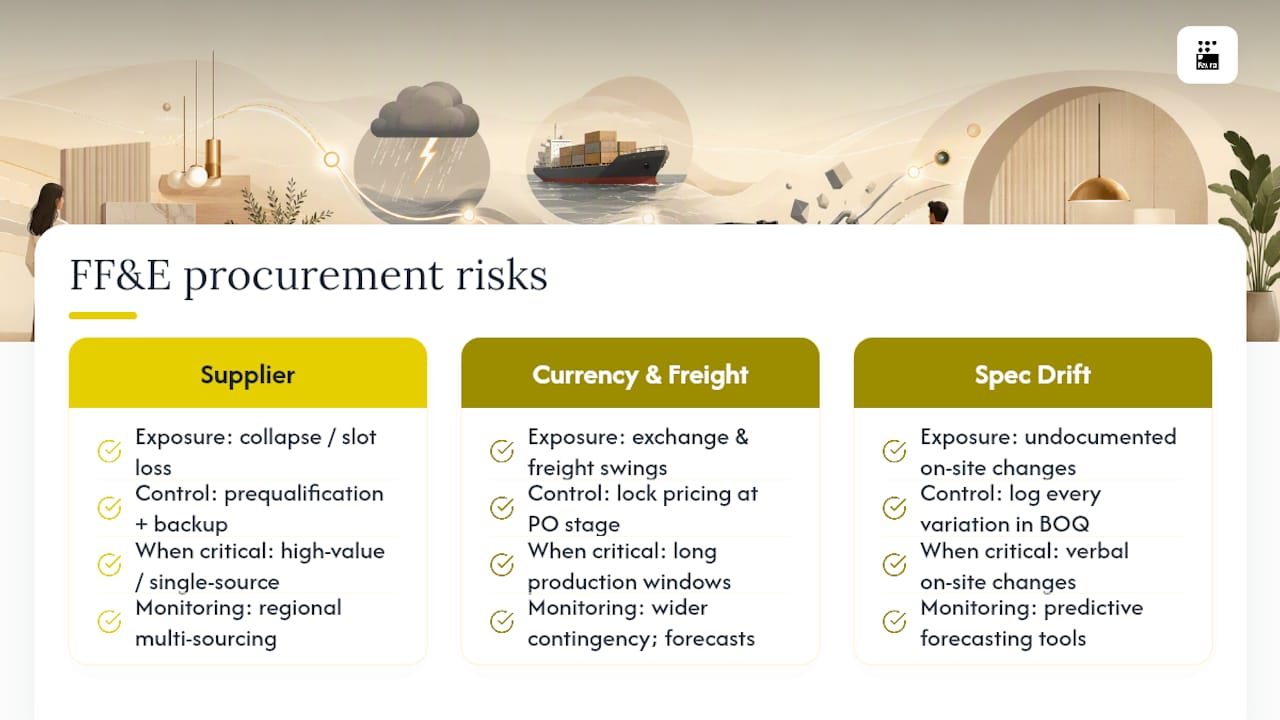
Risk in FF&E procurement clusters around three exposures: supplier failure, currency and freight volatility, and specification drift. Each needs a distinct control, not a single generic contingency line.
Supplier failure, whether financial collapse, capacity overload or a missed production slot, is the hardest to recover from late in a project. Prequalification catches most of it before a PO is even issued, but for high-value or single-source items, holding a backup supplier relationship in reserve is worth the modest cost of maintaining it. Strategic sourcing guidance for 2026 points to regional resilience through multi-sourcing as one of the clearest ways to reduce exposure to a single factory or region going dark.
Currency and freight cost swings hit hardest on projects with long production windows and imported goods. Locking pricing at PO stage, rather than at final invoice, protects the budget from exchange-rate drift over a six-to-nine-month production cycle. Where that’s not possible, build the contingency line wide enough to absorb a realistic swing rather than a token 2 or 3%.
Specification drift is the quiet risk: small changes agreed verbally on-site that never make it back into the master schedule. Every variation, however minor, needs to be logged against the same BOQ used for tendering, or the document stops being a reliable source of truth. Predictive forecasting tools are increasingly used to flag when a category’s lead time or cost is trending against plan, giving project teams earlier warning than a manual spreadsheet review typically would.
Quality control and inspection procedures during procurement and delivery
Quality control in FF&E procurement operates at four checkpoints, and missing any one of them shifts the cost of failure further down the line, where it’s always more expensive to fix.
The first checkpoint is the sample stage, covered earlier as a specification gate. The second is shop drawing approval, where dimensional and material details get confirmed against the schedule before cutting begins. The third is in-production inspection: factory photos at defined build milestones, ideally including close-ups of joinery, welds and finish application, not just a finished-product shot.
The fourth, and most commonly skipped under time pressure, is pre-shipment inspection. A third-party inspector or a nominated project representative checking goods before they leave the factory catches defects that are cheap to fix at source and expensive to fix on-site. Once an item has cleared customs and arrived at a UK site, a finish defect or dimensional error often means a full reorder rather than a repair.
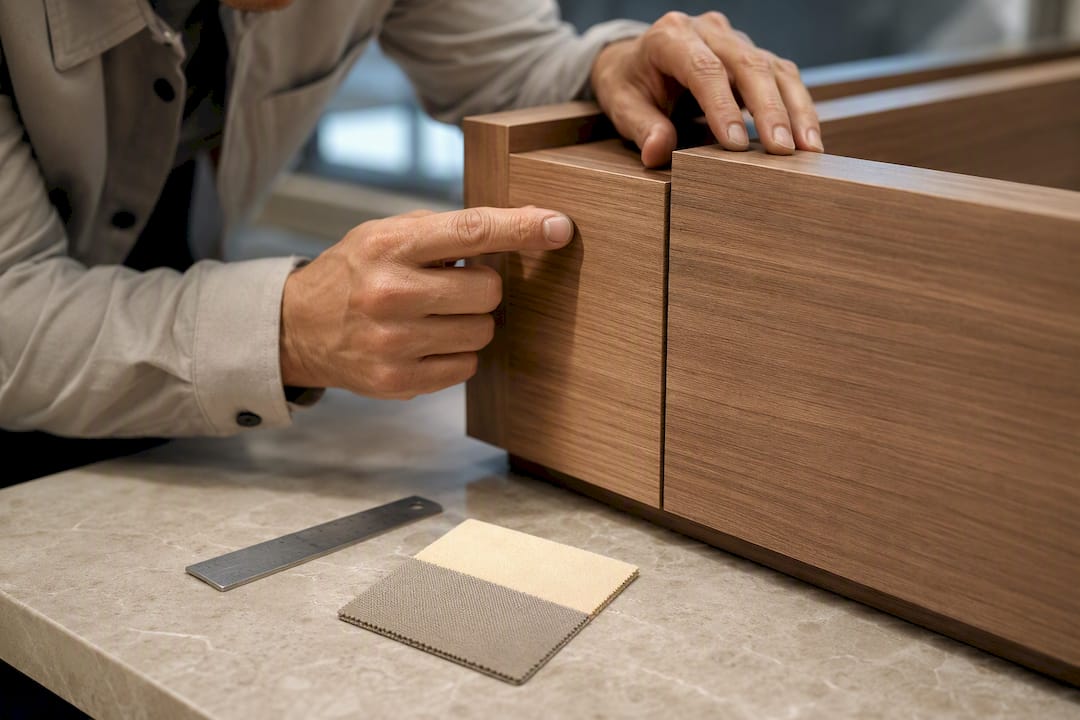
Document every inspection stage with photographs, dated sign-offs and a named approver. When a dispute arises months later over who approved what, a written trail is the only thing that resolves it quickly. For projects with repeated units, such as multiple identical rooms or workstations, inspect a statistically meaningful sample rather than relying on the first unit alone; early-batch quality doesn’t always hold across a full production run.
Stakeholder communication and coordination throughout the procurement process
FF&E procurement touches more people than almost any other part of a design project: the client, the main contractor, multiple suppliers, freight forwarders, and often a separate installation crew. Coordination failures between these groups cause more delays than most single supplier issues.
The main contractor needs visibility of the FF&E delivery schedule well before goods arrive, because site readiness (power, flooring, wall finishes, climate control) has to align with install dates. A delivery arriving to an unfinished space doesn’t just sit idle; it often needs re-storing, which adds cost and risk of damage.
Clients need structured decision points, not open-ended updates. Build sign-off moments into the schedule for sample approval, mock-up review and any value-engineering alternates, and get each one confirmed in writing before production proceeds. A responsibility matrix, agreed at project kickoff and naming who approves what and by when, prevents the common scenario where a delay gets blamed on “waiting for approval” when nobody was actually told they were the approver.
Suppliers need a single point of contact from your side, not three different people asking the same question through different channels. Weekly status updates on long-lead items, even a short one-line email, surface slippage early enough to act on it. For multi-supplier projects, a shared tracking sheet showing PO status, production stage and expected ship date keeps everyone working from the same information rather than reconciling conflicting spreadsheets after the fact.
Payment terms and financial management related to FF&E procurement
Payment structure on FF&E orders is a risk-management tool as much as a commercial one. Standard terms for custom or imported goods typically run as a deposit on order confirmation, a second payment on completion of production (often confirmed by the pre-shipment inspection), and a balance on delivery or installation.
Paying the full amount upfront removes any leverage to enforce quality or timing, and paying only on delivery is rarely something a supplier producing bespoke goods will accept, given their own material and labour costs are committed early. A deposit of 30 to 50% is common for custom work, with the balance split between production completion and delivery.
Tie each payment milestone to a physical checkpoint, not a calendar date. Releasing the production-stage payment only once shop drawings are approved and factory photos confirm progress protects against paying for goods that are behind schedule or built incorrectly.
Currency exposure matters on any order placed with an overseas factory. Where the project budget is set in pounds sterling but the PO is priced in another currency, agree whether the price is fixed at order or floats with exchange rates, and build the contingency line to reflect that decision. Track committed spend against the FF&E schedule in real time, because a schedule that shows budget only against ordered items, rather than against everything specified, will consistently understate exposure until it’s too late to correct cheaply.
Sustainability and environmental considerations in FF&E procurement
Sustainability in FF&E procurement now sits inside the commercial decision, not alongside it. Clients increasingly ask for material provenance, certification and end-of-life information as standard specification fields, not optional extras.
Practical steps worth building into the specification and tendering stages: request FSC certification or equivalent for timber-based items, ask suppliers for material composition and recyclability information on upholstery and textiles, and factor shipping distance into sourcing decisions where a comparable local or regional alternative exists. Strategic sourcing frameworks for 2026 increasingly embed sustainability criteria directly into RFx documents rather than treating them as a separate checklist, scoring suppliers on environmental credentials alongside price, lead time and quality.
Sourcing locally where quality and cost allow also happens to serve the lead-time problem: shorter supply chains mean shorter shipping times and fewer customs touchpoints, both of which reduce risk on the critical path. It’s one of the few decisions in FF&E procurement that satisfies a sustainability goal and a scheduling goal at the same time, rather than trading one against the other.
Faura perspective: how a trade showroom and procurement support accelerates designer workflows
Sourcing time is the hidden cost in FF&E procurement, the hours spent chasing samples, comparing quotes and hosting clients for approvals nobody budgeted for. Faura’s showroom puts curated brands, trade terms and physical samples in one Westminster location, which shortens the supplier search and sample-approval loop considerably. Private client hosting and operational back-office support then take the administrative weight off the designer, leaving more time for the actual design work.
— Eugene
Practical offer: how to engage Faura for procurement support and showroom hosting
Faura works as a working London base for the parts of FF&E procurement that eat the most time: sourcing, sample access and client meetings. Designers can obtain trade terms and procurement support across a large curated library of brands, plus access a showroom for hosting private clients through sample and mock-up decisions rather than juggling multiple supplier visits. Full fit-out sourcing support extends beyond furniture into finishes and specification, useful on larger projects where procurement admin threatens to outpace design time.
Not every project needs a full procurement partner. A small residential job with a handful of suppliers can often be managed in-house with a well-built schedule. Larger fit-outs, hospitality projects or anything with tight lead-time exposure benefit from the trade support and sourcing network a dedicated showroom provides. If that sounds like your next project, book an appointment at Faura’s trade showroom to see how procurement support and residency access could fit your workflow.
Sources
- The hotel FF&E procurement process, step by step — Stoch Hotel Consulting
- Designing Buildings — Lead times for construction
- Strategic Sourcing 2026: FF&E Procurement with AI, Resilience & Sustainability — ProProcurement
FAQ
What is FF&E in procurement?
FF&E stands for furniture, fixtures and equipment: the loose, non-structural items fitted into a finished space, from seating and casegoods to lighting and small-wares, sourced and installed through a dedicated procurement process.
What are the main steps of the FF&E procurement process?
The typical sequence runs through brief and specification, budgeting, tendering and bid leveling, sample and mock-up approval, purchase order and production monitoring, logistics, and installation with snagging and handover.
What is the 80/20 rule in procurement?
It’s a prioritisation principle suggesting roughly 80% of spend or risk concentrates in around 20% of items, meaning long-lead, high-value FF&E pieces deserve disproportionate early attention compared with low-cost accessories.
What are the 5 P’s of procurement?
Definitions vary across industries, but a commonly used version covers price, product, place, people and process, reflecting the commercial, logistical and relational factors that shape a procurement decision.
How early should FF&E procurement start on a project?
For larger schemes, procurement guidance recommends starting the schedule and supplier engagement 12 to 18 months before completion, driven largely by lead times on bespoke and imported categories.
How can designers reduce sourcing time in FF&E procurement?
Working through a curated trade showroom, such as Faura’s Westminster base, cuts the time spent chasing individual suppliers by consolidating samples, brand access and procurement terms in one location.