Pro Forma vs Invoice: A VAT Guide for UK Design Studios
By Faura ·


A pro forma invoice is a non-binding preview of a sale; it has no legal or accounting weight and creates no VAT liability. A regular invoice is the formal, final demand for payment that enters your accounts and, where VAT applies, your tax records. Confuse the two on a return, and you risk a rejected input VAT claim or an unwanted back-dated liability.
TL;DR:
- Pro forma invoices are non-binding estimates used before a sale, while proper invoices are final, legally enforceable documents that confirm the transaction and VAT obligations.
- Incorrectly mixing the two, such as using the same numbering sequence or showing VAT on a pro forma, can trigger audit issues and harm VAT reclaim claims.
- VAT liability arises at the tax point: usually delivery or completion, or earlier if payment is received or a VAT invoice is issued; pro formas cannot support input VAT recovery under HMRC rules.
- Properly distinguishing and promptly converting paid pro formas into tax invoices with separate numbering sequences prevents audit gaps and maintains accurate records.
- Using a clear disclaimer and separate templates for pro formas and invoices helps avoid mistakes that lead to VAT rejections and audit penalties.
Table of Contents
- Pro forma invoice vs invoice: how the two documents actually differ
- What is an invoice and what does it need to show?
- What is a pro forma invoice and when should you send one?
- VAT and accounting implications you cannot afford to skip
- A practical checklist for issuing both documents correctly
- Common mistakes that cause VAT and audit headaches
- The one-line rule worth pinning to your process document
- How Faura handles pro formas when sourcing for clients
- Sources
Pro forma invoice vs invoice: how the two documents actually differ
The confusion usually starts because the two documents look almost identical. Same layout, same line items, same totals. The difference sits underneath, in what each document is legally permitted to do.
A pro forma is a quote dressed up to look like a bill. It tells a buyer what a sale would cost if they went ahead, and it’s commonly used to secure sign off before work starts. A standard invoice is issued once goods are delivered, services rendered, or an agreement finalised, and it obliges the buyer to pay. That obligation is what triggers accounting entries and, for VAT registered businesses, tax consequences.
| Dimension | Pro forma invoice | Regular invoice |
|---|---|---|
| Purpose / timing | Sent before a sale is confirmed, as an estimate or quote | Sent after delivery or agreement, demanding payment |
| Legal / accounting status | Not legally binding; not recorded as revenue or an expense | Legally enforceable demand for payment; enters accounts receivable/payable |
| VAT reclaimability | Cannot be used to reclaim input VAT | Required for input VAT reclaim under HMRC’s record keeping rules |
| Typical uses | Customs declarations, letters of credit, advance deposit requests, client approval | Final sale confirmation, bookkeeping, tax filing |
| Numbering & labelling | Separate series, clearly marked “PROFORMA” | Sequential invoice numbers, VAT number where applicable |
A few practical consequences fall out of that table:
- If a buyer pays against a pro forma and you never issue a proper invoice, you have no valid VAT document, and neither party can support their return with it.
- Showing VAT on a pro forma without following up with a tax invoice within 30 days of payment or supply leaves a gap HMRC may query during a records check.
- Mixing the two numbering sequences (say, using the same running number for both) creates gaps that look like missing invoices during an audit.
- Pro formas genuinely earn their keep in a narrow set of cases: customs declarations for goods with no sale attached, letters of credit, and advance payment requests. Even then, once money changes hands, a tax invoice still has to follow.
The rule of thumb worth pinning above your desk: a pro forma previews a transaction; an invoice records one.
What is an invoice and what does it need to show?
An invoice is the final commercial record of a sale and the document that formally requests payment. Once issued, it becomes part of your accounts, sitting in accounts receivable for you and accounts payable for your customer, and it’s the piece of paper (or PDF) an auditor or tax inspector will ask to see if a transaction is ever questioned.
For a VAT registered business, an invoice has to carry specific information to count as a valid tax invoice. The exact fields HMRC expects to see include:
- A unique, sequential invoice number
- The date of issue and the date of supply, if different
- Your business name, address, and VAT registration number
- The customer’s name and address
- A clear description of the goods or services supplied
- The quantity and unit price of each item
- The VAT rate applied to each line, and the total VAT charged
- The total amount payable, including VAT
Miss the VAT number or the sequential numbering, and the document may not qualify as a valid tax invoice at all, which matters enormously if your customer wants to reclaim the VAT they’ve paid you. That reclaim only works with a valid tax invoice in hand. Bookkeeping software from providers like Sage, QuickBooks, or Xero will typically enforce sequential numbering automatically, which is one less thing to get wrong manually.
What is a pro forma invoice and when should you send one?
A pro forma invoice is a preliminary document that mirrors an invoice’s format without carrying its legal weight. Think of it as a detailed, formal quote. It tells a buyer exactly what a transaction will cost, itemised in the same way a final invoice would be, but it doesn’t commit either party to anything and it isn’t entered as revenue or an expense in your accounts, as QuickBooks explains.
Because it looks so close to the real thing, labelling is what keeps a pro forma out of trouble. Best practice, echoed by providers including Sage, is to:
- Print “PROFORMA INVOICE” clearly at the top, not tucked into small print
- Add an explicit line such as “This is not a tax invoice” so nobody mistakes it for one
- Use a distinct numbering series, for example PRO-2026-001, so it never overlaps with your real invoice sequence
- Include the same level of detail as a final invoice (items, quantities, prices, estimated totals) so it’s genuinely useful as a quote
Where does a pro forma earn its place? Four scenarios come up repeatedly:
- Customs and international shipments. When goods move across borders without a completed sale, such as samples or temporary imports, customs authorities often want a pro forma to establish declared value.
- Letters of credit. International buyers arranging trade finance frequently need invoice-format detail before the real sale is confirmed.
- Advance payment or deposit requests. A pro forma sets out what’s owed before work begins, useful in bespoke or made-to-order trades.
- Client sign off. Before committing to a custom order, a client may want to see the full costed breakdown in something more formal than an email.
In every one of those cases, once payment or supply actually occurs, a proper invoice still has to follow.
VAT and accounting implications you cannot afford to skip
HMRC’s position is unambiguous: a pro forma invoice does not create VAT liability, and it cannot be used to support an input VAT claim, because it isn’t a tax invoice under HMRC’s internal guidance. That single fact is the reason the distinction matters far more than it might first appear.
A pro forma invoice is not a valid VAT document. Only a proper tax invoice, correctly numbered and dated, supports a business’s right to reclaim input VAT on a purchase.
VAT liability arises at the tax point, which is usually when goods are delivered or services completed, but is brought forward if payment is received or a VAT invoice is issued first; a VAT invoice issued within 14 days after supply can also set the tax point. If a customer pays a deposit against a pro forma, that payment can itself trigger a tax point. The fix isn’t to retype the pro forma with VAT added; it’s to issue a genuine tax invoice referencing the pro forma and recording the payment received, as QuickBooks recommends.
Bookkeeping discipline matters just as much as the tax point rules. HMRC guidance says pro formas should be clearly marked ‘this is not a VAT invoice’ and cannot be used to reclaim input tax, so keep them outside the sales and purchase ledgers until a tax invoice replaces them. And once a tax invoice has been issued, you cannot simply reissue or edit the pro forma to fix an error. Corrections go through a credit note against the original tax invoice, keeping your sequential numbering intact and your audit trail clean.
Three habits keep this workable in practice:
- Never let VAT figures appear on a pro forma without a large, visible disclaimer that it is not a tax invoice.
- Keep pro forma and invoice numbering in entirely separate sequences, so a missing invoice number is never mistaken for an administrative gap.
- Convert every paid pro forma into a tax invoice before the accounting period closes, not months later when the VAT return is already filed.
A practical checklist for issuing both documents correctly
Getting this right doesn’t require new software or complex processes, just a consistent sequence every time money or goods change hands.
- Draft the pro forma first, if a preview is needed. Include full item detail, estimated totals, and the “not a tax invoice” disclaimer.
- Use a separate numbering series for pro formas (PRO-2026-001, for example) so it never collides with your invoice sequence.
- Get sign off or a deposit against the pro forma if that’s the agreed process.
- Issue the tax invoice once goods are delivered, services completed, or payment is confirmed, referencing the original pro forma number for traceability.
- Record the tax invoice in your accounts as the actual sale, applying VAT correctly at the tax point.
- Use a credit note for any refund, discount, or correction after the tax invoice is issued, never a reissued pro forma.
Pro Tip: Set up your pro forma template in a different colour or header style to the invoice template. It sounds trivial, but a visual cue prevents accounts staff from mistaking one for the other during a busy month end.
Common mistakes that cause VAT and audit headaches
The same handful of errors come up again and again, and each has a quick fix.
- Same template for both documents. This is an easy slip to make. Fix: build two distinct templates from the start.
- Showing VAT on a pro forma. Risks a rejected reclaim if a customer tries to use it. Fix: strip VAT figures or clearly mark them as estimates only.
- Overlapping numbering sequences. Creates apparent gaps in your invoice run. Fix: separate series, checked monthly.
- Never converting a paid pro forma. Leaves a transaction with no valid tax record. Fix: convert to invoice the same day payment lands.
- Editing an issued tax invoice. Breaks the audit trail. Fix: issue a credit note instead.
The one-line rule worth pinning to your process document
Get the labelling and the sequence right, and almost every downstream problem disappears on its own.
| Takeaway | Why it matters |
|---|---|
| A pro forma previews; an invoice records | Only the invoice creates accounting and VAT consequences |
| Never let VAT appear unqualified on a pro forma | Prevents mistaken input VAT claims |
| Keep numbering series separate | Avoids audit-flagged gaps in your invoice sequence |
| Convert paid pro formas to tax invoices promptly | Keeps your VAT return accurate and your books clean |
| Corrections go through credit notes, not reissued pro formas | Preserves the audit trail HMRC expects to see |
The one-line rule for any sales or accounts team: if money or VAT is involved, it needs a proper invoice, not a pro forma. Everything else in this guide is detail supporting that single sentence, and it’s worth checking back against HMRC’s own guidance whenever a genuinely unusual transaction comes up.
— Faura Editorial
How Faura handles pro formas when sourcing for clients
Bespoke, made-to-order furniture is exactly the territory where pro formas earn their keep. When a designer commissions a custom piece through Faura’s trade procurement service, a pro forma sets out the specification and estimated cost before the brand confirms production, giving the client something concrete to approve.
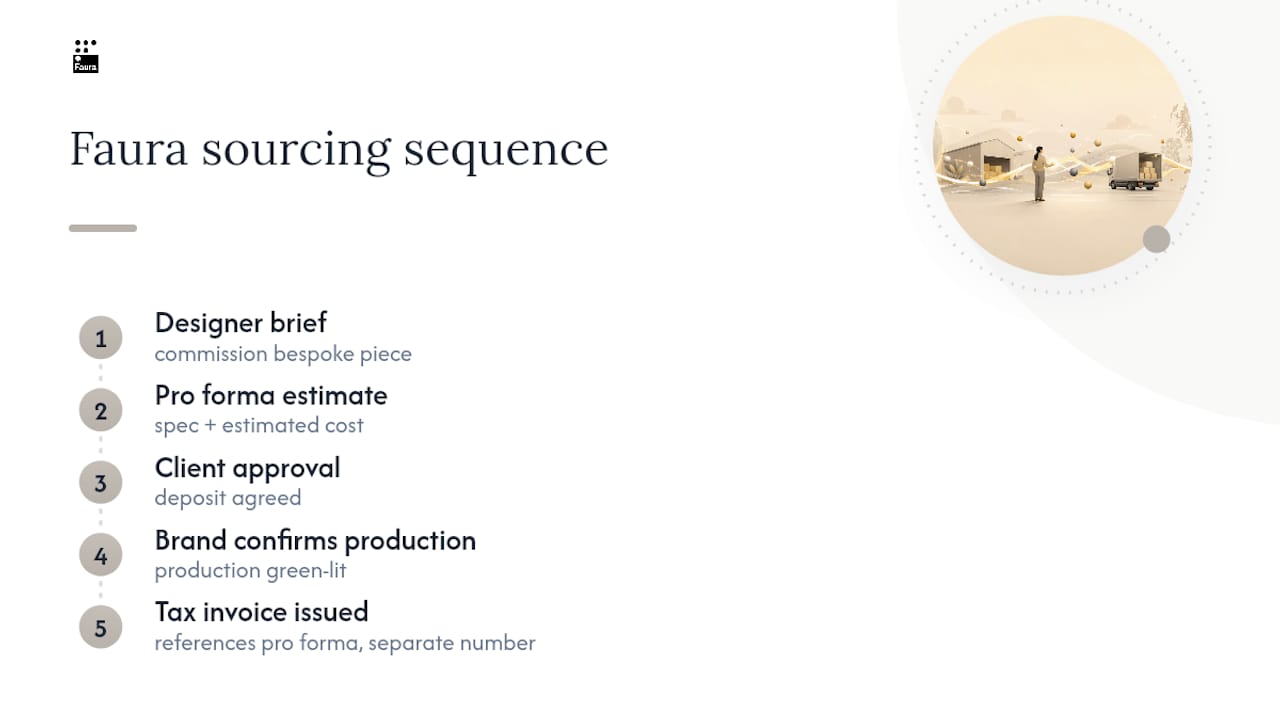
Once an order is confirmed, the tax invoice should reference the pro forma so nothing gets lost between sourcing and delivery. That handoff, from estimate to invoice, is one of the operational details designers rarely think about until a client asks for a VAT breakdown. Keeping the two documents distinct, with separate numbering, is what makes procurement across over 200 brands auditable rather than a filing headache.