Procurement Fees in UK Interior Design: Models and Audit Trails
By Faura ·

A procurement fee, sometimes called an FF&E handling fee, pays for the design team’s sourcing, ordering, and delivery management on furniture, fixtures, and equipment. Expect somewhere between 6% and 20% of item trade cost, with the 10 to 20% band most commonly reported across UK residential projects. Fees are usually structured as either a percentage, a fixed sum, a capped percentage, or a variable model, and a transparent designer will show you exactly which one applies before you place a single order.
TL;DR:
- Procurement fees typically range from 6% to 20%, with 10% to 20% being most common in UK residential projects, and reflect actual sourcing and management work.
- Fees are often based on trade prices or retail prices, with trade discounts passing through to the client, and should be clearly disclosed before ordering begins.
- Different fee models exist, including percentage, fixed, capped, and variable, with the choice impacting risk and transparency depending on project scope.
- Costs for small or bespoke projects often lie at the higher end of the scale, while large-scale hotel FF&E packages tend to see lower percentages due to economies of scale.
- Insisting on transparent documentation, clear scope, and a third-party procurement account can prevent disputes and provide clarity about actual costs.
Table of Contents
- What a procurement fee actually covers
- Percentage, fixed, capped or variable: which fee model fits your project
- What procurement fees look like in real pounds
- How the money actually moves: invoices, TPMA and audit trails
- Negotiating a fair, transparent procurement fee
- How Faura reduces the procurement burden for designers
- Where procurement disputes usually start, and how to end them
- Do procurement fees differ across markets
- The transparency gap that’s actually the problem
- Want procurement terms you can actually see through?
- Sources
What a procurement fee actually covers
A procurement fee isn’t a markup dressed up in polite language. It’s payment for a genuine body of work that sits behind every item that arrives on site looking exactly as specified.
Consider what happens between a designer choosing a sofa and that sofa landing in the client’s living room. Someone has to confirm the specification against the room dimensions, request trade pricing, negotiate lead times, place the order, track production, chase couriers, inspect the item on arrival, and coordinate the installation team. On a single project, that might mean managing 40 or 50 separate line items, each with its own supplier, timeline, and potential for something to go wrong.
The operational workload typically includes:
- Specification checking and confirming stock or lead times with suppliers
- Requesting and comparing trade quotes across multiple vendors
- Placing orders and tracking production or shipping schedules
- Inspecting goods on arrival and managing returns or damage claims
- Coordinating delivery windows and on-site installation
There’s a commercial risk element too. When a designer orders on your behalf, they’re often the ones absorbing the fallout if a supplier goes bust, a shipment arrives damaged, or a fabric run is discontinued mid-project. Trade discounts vary by brand, and how much of the discount is passed to the client should be agreed and disclosed rather than disappearing into an undisclosed markup. You should still expect to see supplier invoices, or at minimum a clear breakdown showing trade price, fee, and total.
Pro Tip: Ask your designer whether procurement fees are charged on the trade price or the recommended retail price before the project starts. The two bases produce very different totals on a large order.
Here’s a realistic scenario. A designer sources a full furniture package for a three-bedroom renovation: sofas, dining furniture, lighting, and soft furnishings across 12 suppliers. Coordinating that alone easily consumes 15 to 20 hours of admin time, before accounting for a damaged headboard that needs replacing or a lighting order delayed by six weeks. A procurement fee is what makes that time and risk commercially viable for the designer to take on, rather than leaving the client to manage 12 supplier relationships.
Percentage, fixed, capped or variable: which fee model fits your project
Four models dominate how designers charge for procurement. Each shifts risk and reward differently between you and your design team.
- Percentage-based fees. The most common structure. The designer charges a set percentage, commonly 10 to 20%, of either the trade price or the RRP. It scales naturally with project size, but on a high-spend project it can produce a fee that feels disproportionate to the actual admin involved.
- Fixed fees. A flat sum agreed upfront, regardless of how much is ultimately ordered. This works well when the scope is well defined early, giving both sides cost certainty, though it can undercompensate the designer if the project scope grows significantly.
- Capped fees. A percentage model with a ceiling, so the fee never exceeds an agreed amount even if the total spend rises. This is often the best middle ground for clients who want protection from runaway costs while still letting the designer benefit from sourcing efficiently.
- Variable fees. The designer retains a portion of any savings they negotiate below the standard trade rate, effectively rewarding them for negotiating harder on your behalf. It aligns incentives well but requires more disclosure to stay transparent.
Percentage models are often used for larger, multi-room projects where the volume justifies scaling the fee with spend. Fixed and capped fees tend to be applied to smaller or single-room jobs or projects with tight budget ceilings. Variable models are more common in bespoke or high-value residential work, where a designer’s negotiating relationships with suppliers can meaningfully shift the final price.
Pro Tip: Whatever model you agree, get the fee base written into the contract in plain terms, “12% of trade price net of any supplier discount”, not “our standard procurement rate”. Ambiguous wording is where most disputes start.
What procurement fees look like in real pounds
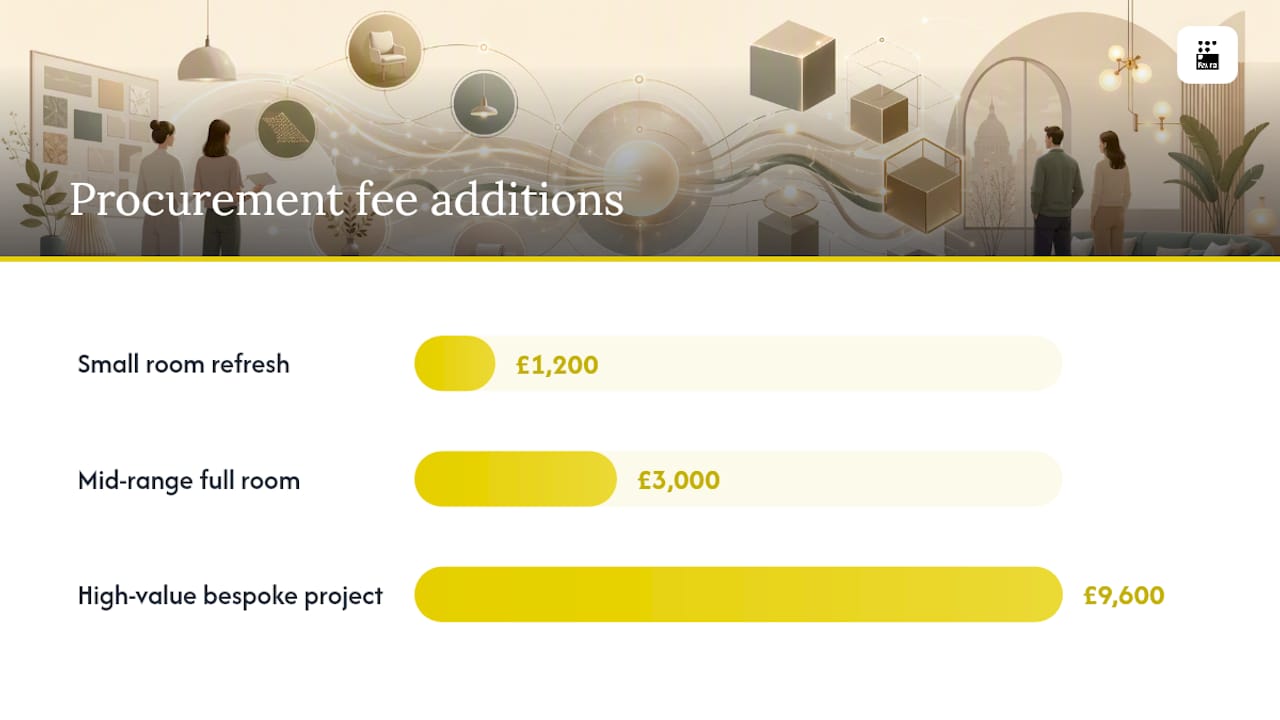
Fee percentages mean little until you see them applied to an actual budget. Reported bands generally cluster into three tiers: 6 to 10% at the lower end, 11 to 15% in the middle, and 16% or higher on smaller or highly bespoke projects. The 10 to 20% range captures most UK residential work, though hotel-scale FF&E packages often settle at 3 to 6% thanks to the economies of scale that bulk ordering brings.
Three quick examples show the spread:
- Small room refresh — £8,000 of trade-price furniture at a 15% fee adds £1,200, bringing the total to £9,200 before VAT.
- Mid-range full room — £25,000 of trade goods at a 12% fee adds £3,000, taking the total to £28,000 before VAT.
- High-value bespoke project — £120,000 of trade goods at an 8% fee adds £9,600, for a project total of £129,600 before VAT.
Where the designer is VAT-registered, VAT is usually charged at the standard rate on both the goods and the procurement fee, so build that into the budget from the outset rather than treating it as a late surprise. Delivery and installation are usually itemised separately from the procurement fee, since they’re supplier or logistics charges rather than design admin. Costs typically excluded from a procurement fee include customs duties on imported pieces, specialist installation such as bespoke joinery fitting, and storage charges if goods arrive before the site is ready. Ask for these to be listed as separate line items so the procurement fee itself stays easy to verify.
How the money actually moves: invoices, TPMA and audit trails
Where the cash flows matters as much as the percentage charged. An increasing number of designers use third-party or managed procurement accounts to route client funds directly to suppliers, providing clear audit trails and reducing their exposure to holding client money.
This structure gives you a clean audit trail: every payment to every supplier is visible, VAT is reconciled by a neutral party, and the designer never holds a large sum of client money in a personal or business account. Industry guidance increasingly treats holding significant client funds as poor practice precisely because it removes that separation.
There are alternative structures worth understanding:
- Client pays suppliers directly, with the designer invoicing separately for their fee. This gives you maximum visibility but adds admin, since you’re managing multiple supplier relationships yourself.
- Designer acts as agent, ordering on your behalf and passing through supplier invoices with the fee added transparently.
- Designer acts as principal, buying goods themselves and reselling to you, which can obscure the original trade price unless invoices are shared.
Whichever structure applies, ask for a documentation checklist covering itemised supplier invoices, a reconciliation report showing trade price against what you were charged, and confirmation of VAT treatment on each line. Opening a trade account is often the first step designers take to access these supplier relationships transparently.
Pro Tip: Insist on a third-party procurement account for any project over roughly £30,000, or for international shipments where customs and multiple currencies add complexity. The reconciliation burden alone justifies the extra step at that scale.
Negotiating a fair, transparent procurement fee
Both clients and designers benefit from settling fee structure and disclosure terms before any order is placed, not once invoices start arriving.
The main negotiation levers are scope definition, fee caps, staged payment schedules, and audit rights written into the contract. A clearly scoped agreement states exactly which categories of spend the fee applies to, so a last-minute addition of joinery or window treatments doesn’t quietly inflate the fee base beyond what was originally discussed.
Clients should ask their contract to include itemised invoices for every supplier purchase, copies of supplier receipts on request, and a reconciliation report at project completion showing trade price, fee applied, and total charged. A holdback clause, where a small percentage of the fee is withheld until snagging and defects are resolved, gives you leverage if something arrives damaged or wrong.
Designers, in turn, can justify their fee by offering:
- A written service schedule setting out response times and delivery guarantees
- Clear escalation steps if a supplier misses a deadline
- Proactive updates on lead times rather than waiting to be asked
Fixed or capped fees suit clients who prioritise budget certainty over flexibility. Variable models are more acceptable when the designer has a demonstrable track record of negotiating below standard trade rates, and when that upside is disclosed rather than assumed.
How Faura reduces the procurement burden for designers
Faura’s residency in Westminster runs on a simple premise: designers shouldn’t lose days to sourcing admin they could spend on the actual design.
The product library spans over 200 brands, giving designers trade access in one location rather than chasing individual supplier accounts across the city. Procurement, logistics and delivery are handled by one team, with one order and one invoice, and private client hosting means the commercial conversation, including fee structure, happens on neutral ground rather than in the designer’s own office.
A trade showroom that consolidates 200-plus brands under one roof doesn’t just save sourcing time. It can also simplify client paperwork, with one order and one invoice rather than a patchwork of individual supplier invoices.
For designers juggling multiple concurrent projects, or those who find fee disputes eating into client relationships, a trade membership worth considering once sourcing admin starts outweighing design time itself.
Where procurement disputes usually start, and how to end them
Most procurement fee disputes trace back to the same handful of causes. A client discovers the trade price after the fact and feels the fee was hidden rather than disclosed. A designer changes fee model mid-project without a written amendment. Or a supplier delay gets blamed on the designer when it was genuinely outside their control.
The fix in nearly every case is the same: documentation agreed before work starts, not negotiated after a disagreement. A written fee schedule, a defined scope, and a commitment to itemised invoicing resolve the majority of disputes before they escalate. Transparency around supplier receipts is consistently the single most effective way to defuse client concerns about trade discounts and markups, more effective than any particular fee percentage.
Where disputes do arise, mediation through an independent mediator offers a structured route that avoids the cost and relationship damage of formal legal action. Contracts that include an audit clause, giving the client the right to request supplier invoices at any point during the project, tend to prevent disputes reaching that stage at all. The lesson for both sides is straightforward: ambiguity is the real cost driver, not the fee percentage itself.
Do procurement fees differ across markets
UK procurement fees generally sit within the 10 to 20% band already discussed, but the picture shifts once you look beyond residential interiors or beyond Britain’s borders.
Scale changes the calculation significantly. Large hotel and hospitality FF&E packages commonly see procurement agent fees around 3 to 6%, because bulk ordering across hundreds of rooms spreads fixed admin costs over a much larger spend. A boutique residential project doesn’t get that benefit, which is part of why smaller jobs often carry proportionally higher percentages.
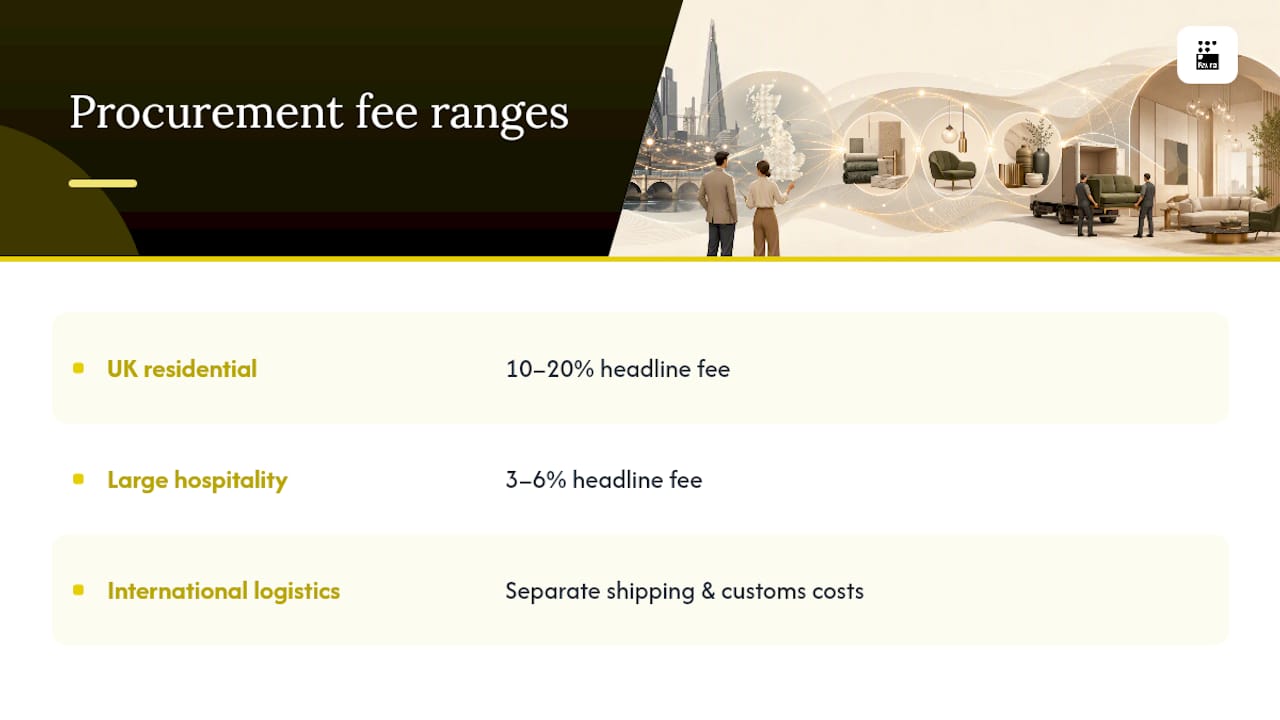
International sourcing adds its own layer of cost that sits outside the procurement fee itself. Import duties, currency conversion, and longer lead times for goods shipped from outside the UK all need separate line items rather than being folded into the headline percentage. A designer sourcing furniture from an Italian or French workshop, for instance, should disclose shipping and customs costs distinctly from their procurement fee, since bundling the two makes it difficult for a client to see what they’re actually paying for logistics versus design admin.
The practical takeaway is to judge a procurement fee against the scale and complexity of your specific project, not against a single national average, since project size influences the fair rate more than geography alone.
The transparency gap that’s actually the problem
Most of the frustration around procurement fees has nothing to do with the percentage charged and everything to do with disclosure. A 20% fee explained clearly, with supplier invoices available on request, causes far fewer arguments than a 12% fee that nobody can trace back to an actual trade price.
The conventional advice, “negotiate the lowest percentage you can”, misses the point. Clients who fixate purely on the headline number often end up with less protection, not more.
What should change first is the assumption that procurement fees are something to minimise rather than something to understand. Ask for the fee model in writing before signing anything. Ask which base it’s calculated on. Ask whether a third-party procurement account will be used. Those three questions resolve more disputes than any amount of percentage haggling ever will.
Want procurement terms you can actually see through?
Faura’s trade showroom in Westminster gives designers access to over 200 brands, with procurement, logistics and delivery handled by one team; trade terms are confirmed directly with each approved account. With one order and one invoice across brands, the fee you quote clients is easier to trace back to actual trade pricing.
- Book a visit to see the showroom and curated product library in person
- Apply online for a trade account; Faura confirms trade terms directly with each approved account
Find out more on the Faura trade page and see whether a trade account fits how you currently price procurement.
Sources
- Interior Designer Cost (UK) – Rodrigues Interiors
- Negotiating procurement fees for FF&E — DosPay
- Willow & White Interiors — procurement service terms