A sample management system that stops swatches going missing
By Faura ·


A sample management system is the combination of catalogue, storage and check-in/check-out protocol that lets a design studio find, loan and account for every fabric swatch, tile cutting and finish board it holds. This is distinct from laboratory sample-tracking software; nothing here concerns biological or chemical specimens. The single highest-impact step you can take this week is to start a check-in/check-out log and give every high-use sample a permanent label with a one-line digital record.
Before building anything elaborate, get three things in place:
- A logbook (paper or digital) that records who took a sample, which project it belongs to, and when it’s due back.
- A durable label on each sample showing brand, product name and price band.
- One searchable index, even a basic spreadsheet, that mirrors what’s on the shelf.
Faura, the trade showroom and design residency in Westminster, keeps a sample library across over 200 brands, and the same principles apply at that scale.
Key Takeaways
A sample management system succeeds when a consistent check-in/check-out protocol is paired with a minimal, correctly labelled catalogue, not when it depends on expensive software alone.
| Point | Details |
|---|---|
| Start with the habit, not the tool | Run a check-in/check-out log for two weeks before evaluating any software purchase. |
| Classify by material first | Sort samples by material type, then sub-type, then vendor or price band. |
| Label every sample fully | Include brand, product code, price band, supplier contact and acquisition date. |
| Audit quarterly | Verify labels, confirm reorder contacts, reconcile loans, and retire discontinued items. |
| Use a stash bin during active projects | Defer re-filing to a weekly task so daily creative work isn’t interrupted. |
Table of Contents
- Design a hierarchical classification for your sample library
- Building a check-in and check-out process for loans
- Storage hardware and labelling by material type
- How often should you audit your sample library?
- Which digital tracking option fits your studio?
- Faura’s approach to running a curated sample library
- Why most studios get sample management backwards
- Sources
Design a hierarchical classification for your sample library
A library only works if two people can file the same swatch in the same place without discussing it first. The most reliable structure runs from broad to specific, and it should be organised by logical material categories before anything else, because that’s how designers actually search when they’re under deadline pressure.
- Material type — fabric, tile, stone, metal, paint, wallcovering.
- Sub-type — within fabric, split upholstery from drapery; within tile, split porcelain from natural stone; within metal, split finish from hardware.
- Vendor or price band — the final sort, chosen to match how your studio actually shops (some teams sort by price point first, others by vendor loyalty).
This mirrors the hierarchical approach favoured in best-practice guides: material first, sub-category second, vendor or price third, so a new team member can locate a sample without asking where it lives.
Every label needs six fields to stay useful: brand, product code or name, trade price band, supplier contact, date acquired, and sample size. Miss the supplier contact and a beautiful swatch becomes an orphan: pretty, unusable, and impossible to reorder against.
Storage hardware should follow the material, not the other way round. Fabric belongs in hanging books or ring binders that let you flip through options quickly in front of a client. Tile and stone want shallow, flat drawers so nothing chips under its own weight. Metal finishes and hardware samples do best in small labelled trays, since they’re easy to lose in a deep bin. Paint drawdowns and finish boards work well in flat files, kept away from direct light.
Pro Tip: Sort your vendor tier last, not first. Designers browse by material and finish long before they care which supplier made it, so leading with vendor names slows down every search.
Building a check-in and check-out process for loans
Most missing samples aren’t stolen. They’re borrowed casually, moved between desks, and never logged anywhere. The fix is a minimum data set captured at the point of loan, not retrofitted later.
Check-out, minimum fields:
- Person of contact and their studio or project team
- Project code
- Date out and expected return date
- Condition notes at time of loan
- Signature or digital acknowledgement (even a tapped confirmation on a phone counts)
Check-in, in order:
- Inspect condition against the notes taken at checkout.
- Log any damage immediately, with a photo if the sample is high value.
- Update the digital record to “returned” and re-file to its exact shelf location.
- Re-label if the original tag is worn, faded or missing procurement details.
External loans, meaning samples going out to clients, contractors or courier, need an extra layer: tracked shipping, a signed return receipt, and for higher-value stone or bespoke metal samples, a deposit or credit hold until the item comes back. This costs almost nothing to run and removes the single biggest cause of disappearing inventory: no one at either end being accountable for the handoff.
Storage hardware and labelling by material type
Damage and disorganisation both come from mismatching storage to material, and the fix is largely mechanical rather than expensive.
- Fabric: hanging books for drapery weights, ring binders for lighter upholstery cuttings, kept out of direct sunlight to avoid fading.
- Tile and porcelain: flat, shallow drawers labelled with price per square metre, since that’s the figure procurement teams ask for first.
- Stone and quartz: reinforced shelving with a stated weight limit per shelf; slabs are heavier than they look and warped shelving is a recurring studio complaint.
- Metal finishes and hardware: small trays or drawer dividers, individually labelled, because loose metal samples migrate between bins faster than anything else in a library.
Labels should be durable and printable rather than handwritten, and where the budget allows, carry a QR code or barcode for future scanning. Put a matching label on both the sample and its storage slot, so a misfiled item is obvious at a glance rather than discovered during an audit. A consistent labelling standard covering product name, vendor, price and re-order details is what separates a usable library from a box of pretty offcuts.
Pro Tip: Fit fragile fabric and paper finishes with a clear protective sleeve before they go into a client-facing binder. It adds seconds to filing and saves a sample that would otherwise be replaced after one meeting.
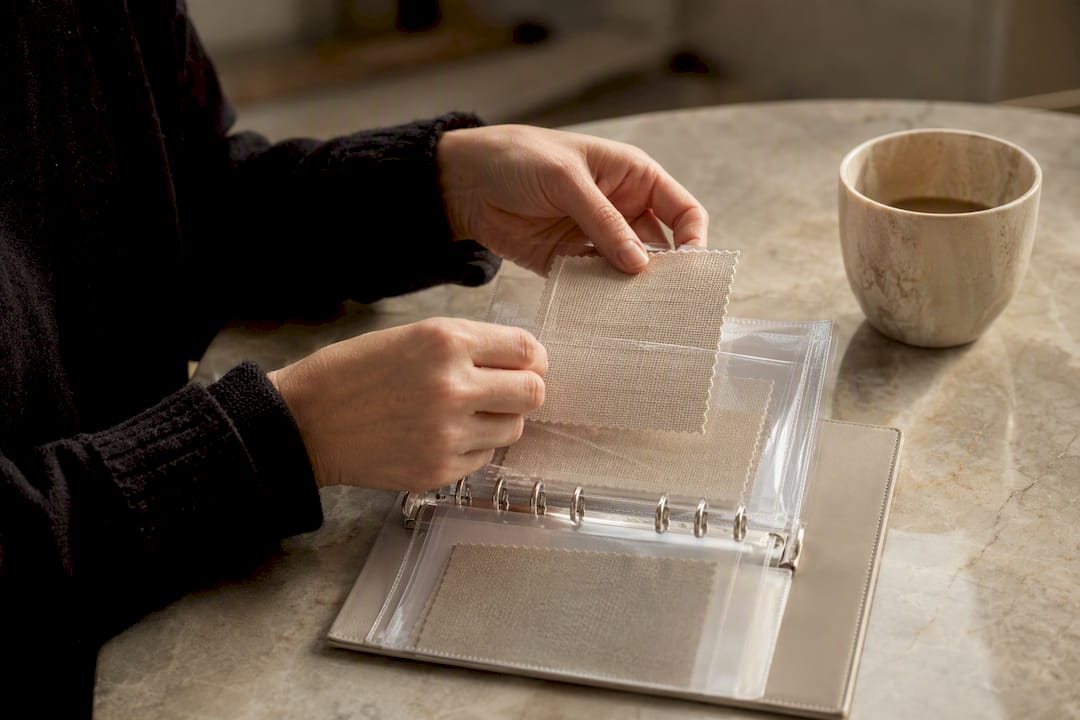
Add a clean-hands policy near any stone or matte-finish samples. Oils from hands are the most common cause of a “ruined” sample that was never actually damaged, just poorly handled.
How often should you audit your sample library?
Quarterly is the right cadence for most studios, and the checklist should be short enough that someone actually completes it.
- Verify every label is legible and still carries a working supplier contact.
- Test reorder links or call the listed contact to confirm the product is still in production.
- Reconcile every active loan against the check-out log and chase anything overdue.
- Flag and pull discontinued items before they mislead a specification.
Between audits, a stash or return bin does most of the daily work. Designers drop samples into it mid-project rather than stopping to re-file immediately, which protects creative momentum during an active job while a delegated weekly task, usually given to an assistant, clears the bin and updates the catalogue.
Retirement policy matters more than most studios admit. Discontinued samples left on the shelf create real specification errors further down the line, so return high-value discontinued items to the supplier, recycle or donate photo-only mood samples, and note the decision so the same product doesn’t get specified twice by mistake.
Which digital tracking option fits your studio?
A spreadsheet works for a one-person studio with under a few hundred samples. Beyond that, the lag between a physical loan and an updated cell becomes the main source of errors, and a cloud database or a purpose-built tracking tool starts to earn its cost.
At minimum, any digital system should capture: a unique sample ID, a photograph, loan history, the borrower and project it’s tied to, a return-date alert, and searchable tags by material and vendor. Mobile-first check-in and check-out removes most of the friction spreadsheets create, since staff can log a loan from the shelf rather than walking back to a desktop. Platforms such as Houzz Pro’s product library show how clipping and searchable product data can cut down on ordering physical duplicates in the first place.
Migrating from a spreadsheet doesn’t need to happen all at once:
- Label your highest-use samples for barcode or QR scanning first.
- Photograph each one against a neutral background for a consistent reference shot.
- Import your existing spreadsheet log rather than starting from zero.
- Pilot the new system with one project team for two weeks before rolling it out studio-wide.
- Train staff on the exact fields you expect them to fill in, not just the software itself.
Faura’s approach to running a curated sample library
Faura’s Westminster showroom applies the same principles at a larger scale. The residency works with over 200 brands and serves interior designers, architects, developers and contractors, which means the same catalogue has to satisfy a solo residential designer one week and a commercial fit-out team the next.
In practice, that looks like:
- Pieces and finishes can be staged ahead of appointments on request, so a designer walks in to a pre-pulled selection rather than searching cold.
- Procurement, logistics and delivery handled by one team for trade account holders, which shortens the gap between selecting a sample and placing the order.
Designers working from a curated product library rather than a personal shelf of offcuts get the benefit of Faura’s own cataloguing discipline without having to build it themselves. Studios interested in showroom access or membership can get in touch directly to discuss what that looks like for their team.
Why most studios get sample management backwards
Most advice on this topic starts with software. That’s the wrong order. A studio with no check-in discipline will lose samples just as fast with an expensive app as with a paper ledger, because the failure point is behavioural, not technological. The absence of a standardised check-in habit is the single biggest cause of lost inventory, and no amount of barcode scanning fixes a team that doesn’t log the loan in the first place.
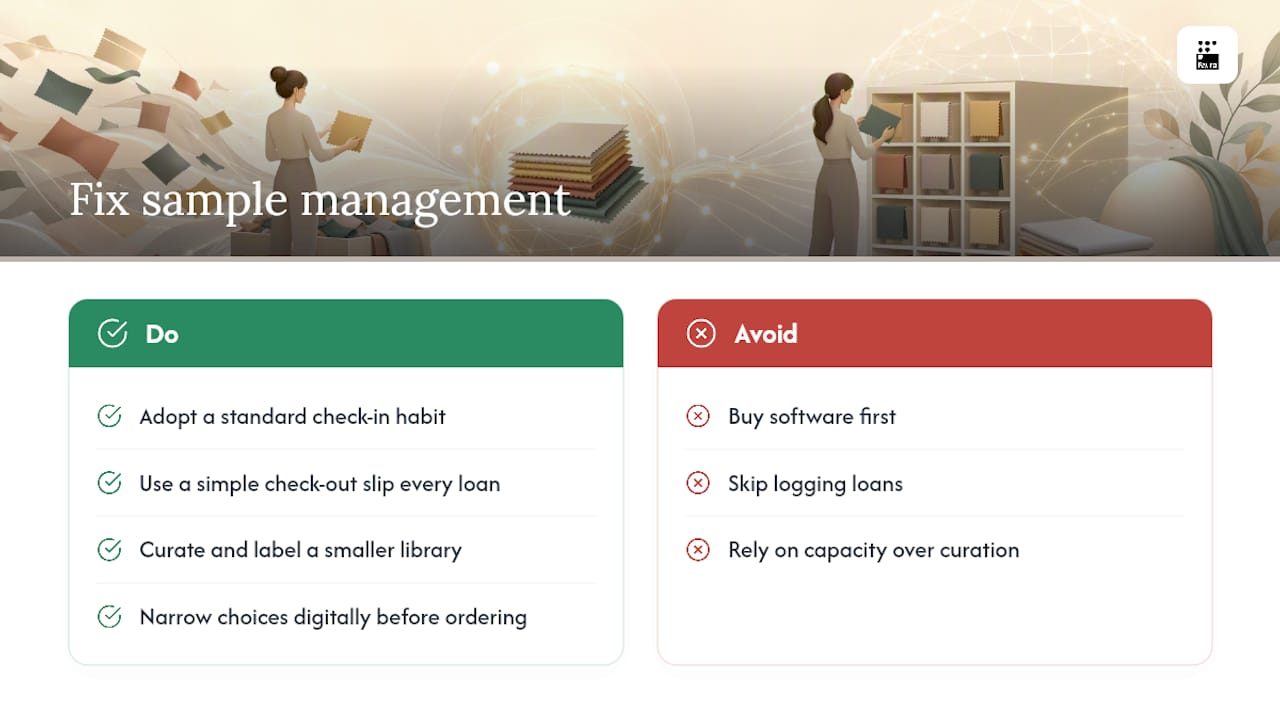
The second overlooked point: curation beats capacity. A smaller, well-labelled library that designers trust beats a sprawling one nobody has faith in. Many studios now narrow choices digitally before ordering physical cuttings, which cuts waste and keeps the shelf honest.
If you do one thing this week, don’t buy software. Write a check-out slip, however basic, and use it on every loan for a fortnight. That single habit, done consistently, outperforms most digital rollouts attempted without it.
— Faura Editorial
Sources
- How interior designers organise their fabric samples (Designers Today)
- Startup guide: organise interior design materials and files (Houzz Pro)
- How do you organise your sample library? (Business of Home)
- Interior designer’s guide to samples (IDBS)