20–40% Commission? How UK Designers Avoid VAT and Hidden Fees
By Faura ·

20–40% Commission? How UK Designers Avoid VAT and Hidden Fees
Showroom commission in the UK typically runs between 20% and 40% of the trade price, while procurement or handling fees charged separately sit closer to 10–20%, with the British Institute of Interior Design pointing to roughly 15% as a sensible benchmark for agent-model projects. Studios that buy and resell as principal, rather than acting as agent, tend to mark up by 30–35%, sometimes stretching to 50%. The number that matters more than any of these bands is whether you are trading as agent or principal, because that single distinction decides how VAT applies and whether you need to register once turnover crosses £90,000.
TL;DR:
- Commission rates between 20% and 40% reflect different service levels, with higher rates covering bespoke displays, client hosting, and returns management.
- Trade discounts passed through to clients must be clearly separated from fees, especially for VAT registration thresholds above £90,000 as principal traders.
- Tiered discounts and rebates often depend on volume, spend, or prompt payment, making it essential to verify rebate formulas before relying on projected margins.
- Use precise contract language to define whether acting as agent or principal, ensuring VAT treatment and registration requirements are correctly understood upfront.
- Faura offers transparent procurement terms and trade accounts that prioritize clarity over headline percentages, aligning with industry moves toward more straightforward contractual language.
Table of Contents
- What do typical UK showroom commission rates actually cover?
- How does the agent versus principal distinction affect VAT?
- How do tiered discounts and rebates change effective commission?
- What contract clauses protect designers on commission and fees?
- Faura: showroom representation without the guesswork
- Why headline percentages matter less than the contract behind them
- Sources
- FAQ
What do typical UK showroom commission rates actually cover?
Percentages on their own tell you very little. A 20% commission and a 40% commission can represent wildly different levels of service, so it pays to ask what each band is actually buying before comparing numbers side by side.
At the lower end, around 20%, a showroom is usually covering floor space, basic staffing during appointments, and standard insurance on displayed stock. Push towards 40% and you are typically paying for dedicated client hosting, returns handling, bespoke display builds, and a higher level of curation and introductions to designers and architects. Consignment and commission arrangements in the 20–40% range are common across UK trade showrooms, often paired with tiered wholesale pricing that rewards larger or repeat orders.
Procurement or handling fees work differently again. These are charged on top of, or instead of, a commission, and compensate the studio or showroom for project administration: chasing lead times, managing samples, coordinating deliveries, and handling the paperwork trail between supplier and client.
Certain categories consistently attract the higher end of both ranges:
- Bespoke joinery and made-to-order furniture, where lead times and quality control add real administrative burden
- Stone, surfaces and kitchen specification, which usually involves multiple site visits and supplier coordination
- High-value lighting and AV integration, where installation oversight extends well beyond a simple sale
None of these figures are fixed by regulation. As Alto Accounting notes, there is no single industry-standard percentage, and most studios blend design fees, procurement fees, markups and project management into a combination that reflects the actual scope and risk of the job.
How does the agent versus principal distinction affect VAT?
This is the point in any showroom or procurement negotiation where good intentions meet HMRC’s rulebook, and it is worth getting right before you sign anything.
- Agent model. You pass the trade discount through to your client and charge your fee separately, calculated on the trade price exclusive of VAT. The client’s purchase from the supplier is the taxable supply, not your fee, and HMRC’s agency indicators at VTAXPER36820 and VTAXPER39000 are explicit that any discount you obtain must be passed back to the principal, not quietly retained.
- Principal model. You buy the goods yourself and resell them, meaning the full sale value counts as your taxable turnover, not just your margin. Cross £90,000 in a rolling twelve-month period and VAT registration becomes mandatory, which changes your pricing and your client’s costs overnight.
- The trap in the middle. A studio that keeps part of a trade discount while claiming to act as agent risks HMRC reclassifying the arrangement as principal trading retrospectively, with all the turnover consequences that follow.
Here is where the maths gets uncomfortable. If you are trading as principal and that £10,000 becomes VAT-inclusive turnover you cannot fully offset, the effective margin you keep can be meaningfully smaller than the headline percentage suggests, particularly once VAT-registered and unable to recover input tax on certain costs. Whichever model you choose, keep client money and disbursements in clearly separated bookkeeping, and decide your VAT registration point before you need it, not after an HMRC letter arrives.
How do tiered discounts and rebates change effective commission?
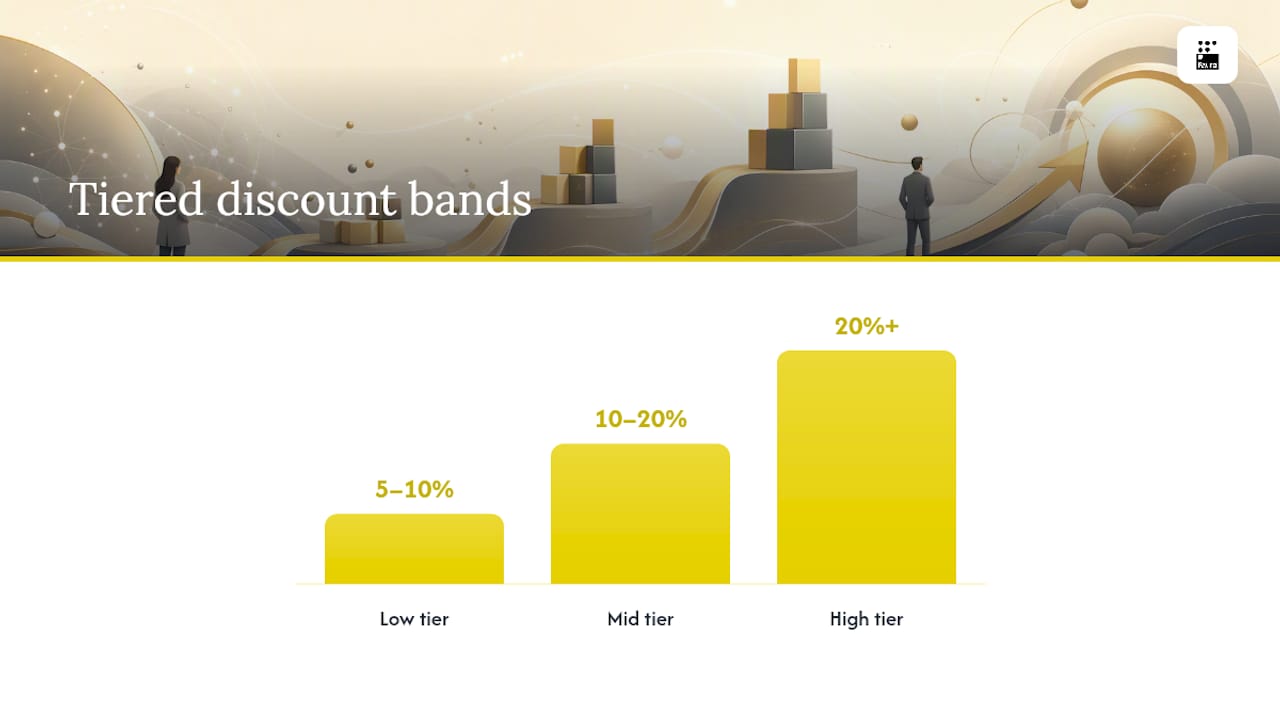
Headline commission rates are rarely the whole story once tiered pricing enters the conversation. UK trade stockists commonly structure discounts in bands, and understanding how those bands work is essential before you accept a quoted rate at face value.
- Quantity or spend tiers, where a low tier might offer 5–10%, a mid tier 10–20%, and a high tier 20% or more, with thresholds set by order volume or annual spend
- Retrospective rebates, paid only after a settlement period, which can obscure your real margin until months after the sale
- Settlement discounts, tied to prompt payment terms rather than volume
- Performance-linked incentives, such as a 12-month turnover credit that rewards consistent ordering rather than a single large purchase
The negotiation levers worth raising are minimum order values, the aggregation window used to calculate tier eligibility, published lead times, and whether exclusivity or extended payment terms are on the table in exchange for a better band.
Pro Tip: Ask any showroom or supplier to show you the rebate formula in writing before you rely on it. A verbal promise of “you’ll get to the next tier eventually” is not a number you can put in a client quote.
What contract clauses protect designers on commission and fees?
A well-drafted appointment does more work than any percentage negotiation. Get the wording wrong and even a fair rate can turn into a dispute.
- Define the role explicitly. State whether the showroom or studio is acting as agent or principal for each transaction, since mixed models on a single project are a common source of confusion.
- Fix the fee base precisely. Specify that percentages apply to the trade price exclusive of VAT, and confirm whether delivery charges sit inside or outside that base, following the practice HMRC expects for genuine agency arrangements.
- Set out invoicing, returns and insurance. Cover who invoices the client, how returns are handled, who insures stock during consignment periods, and what happens on cancellation.
- Stage payments for principal deals. Use deposits and milestone payments to fund working capital and shift manufacturing risk back to the client or supplier through clear acceptance criteria.
Watch for three red flags: undisclosed retained discounts, open-ended consignment periods with no insurance or stock control, and rebate formulas that are described verbally but never written into the agreement. For simple interior design commissions, the RIBA/BIID concise professional services contract is a useful starting template for scope and liability. Nearly all disputes in this area trace back to one missing detail: whether a fee was calculated on the VAT-inclusive or exclusive price. Get that single line right in writing and most other arguments disappear.
When explaining procurement fees to private clients, be upfront that the agent model is often cheaper for them than a principal markup, because private clients cannot reclaim VAT on goods bought and resold to them.
Faura: showroom representation without the guesswork
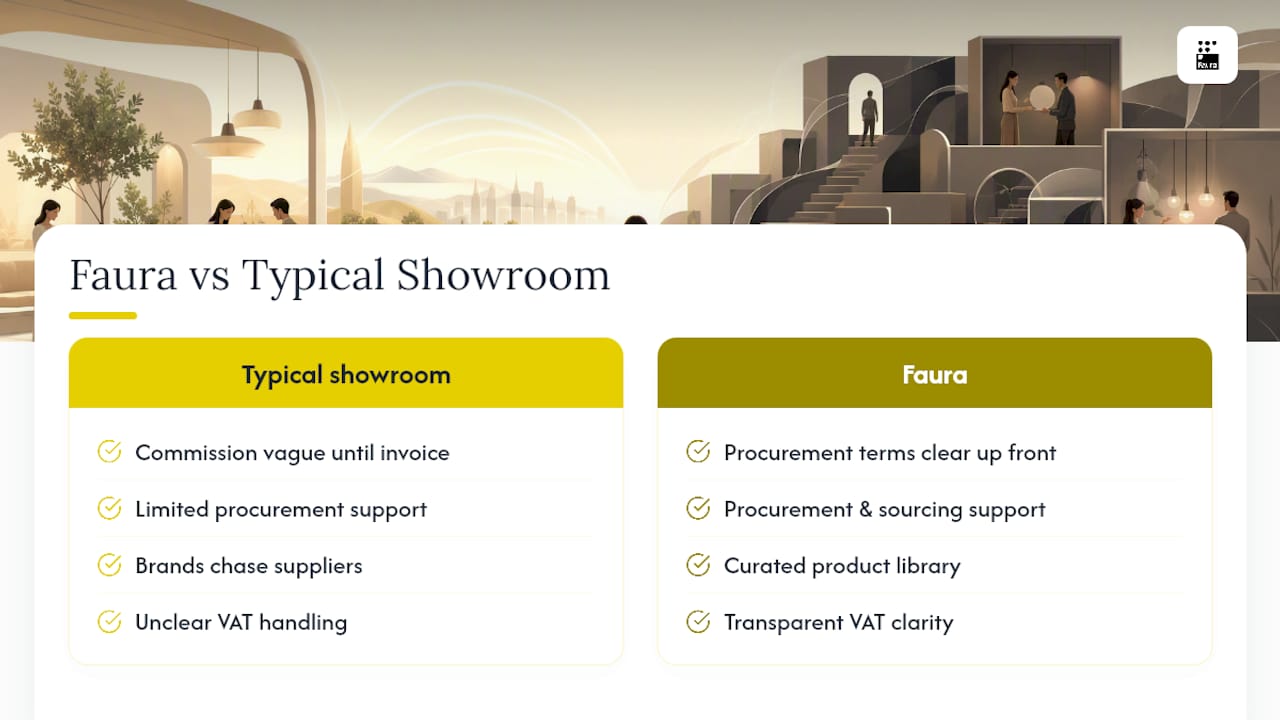
Faura operates a trade showroom and residency in London, offering trade accounts, procurement support and client hosting under one roof. Where many showroom arrangements leave commission structures vague until the invoice arrives, Faura treats designers as clients in their own right, providing procurement terms and operational back-office support to improve sourcing efficiency and VAT clarity. Its curated product library means brands and designers spend less time chasing suppliers and more time on the actual design work.
If you are weighing up showroom representation or want procurement terms set out clearly from the start, view Faura’s trade account offering or book an appointment to discuss terms directly.
Why headline percentages matter less than the contract behind them
The industry conversation around showroom commission rates fixates on the wrong number. Designers who benchmark purely on percentage are comparing headlines, not economics.
What actually protects margin is knowing, before you sign, whether you are agent or principal, and insisting that fee bases are stated against the trade price exclusive of VAT every single time. Faura’s approach of treating designers as clients with disclosed procurement terms reflects where the market is heading: away from opaque markups and towards contracts that state the fee base, the VAT treatment and the payment stages in plain language. Prioritise that clarity over chasing an extra five percentage points on paper.
— Eugene
Sources
- Professional Practice Series: FF&E | British Institute of Interior Design
- Interior designer trade discounts and VAT implications | Alto Accounting
- Best trade pricing models for UK interior designers | Trowbridge Gallery
- RIBA/BIID concise professional services contract: Interior Design Services | RIBA
FAQ
What is a typical showroom commission rate in the UK?
Consignment-based arrangements documented by Trowbridge Gallery sit within this same band.
What is the difference between an agent fee and a principal markup?
A principal buys and resells goods directly, usually marking up by 30–35%, with the full sale value counting as taxable turnover under HMRC’s agency rules.
Do I need to register for VAT as a principal?
Yes, once your turnover as principal, including resold goods, crosses £90,000 in a rolling twelve-month period, VAT registration becomes mandatory. Agents are assessed differently, since only their fee counts towards that threshold.
Does Faura charge showroom commission or procurement fees?
Faura offers trade accounts and procurement support with terms available directly through its trade pages rather than a single published percentage. Designers and brands can request specific terms when discussing representation or sourcing needs.
What contract should I use for a simple interior design commission?
The RIBA/BIID concise professional services contract is designed for straightforward commissions and covers scope, fees and liability. Larger or bespoke projects often need bespoke clauses added on top of this base template.