Sustainable Materials Sourcing: Six Steps for Specifiers
By Faura ·

Sustainable materials sourcing means selecting and qualifying material inputs, upstream through tier 2 and tier 3 suppliers, based on verified environmental and social performance rather than price alone. The single highest-impact action any procurement team can take now is mapping every material input against its supplier network, because most emissions and risk sit upstream, not in your own operations. Everything below builds out the standards, tools and timelines that map demands.
TL;DR:
- Most of a company’s emissions and risks originate upstream in the supply chain, making mapping supplier tiers essential for effective sustainable sourcing.
- Focusing solely on greener materials is insufficient; redesigning products to reduce material use and improve disassembly offers deeper sustainability gains.
- Independent verification of supplier claims and chain-of-custody documentation are crucial for reliable sustainability compliance and reducing reputational risk.
- Building capacity with blended finance and long-term agreements accelerates the availability of low-emissions materials amid expected supply shortages by 2030.
- Integrating verified sustainability data into procurement platforms through scoring templates and supplier evaluations enhances decision-making and compliance.
Table of Contents
- What sustainable materials sourcing means
- Why sustainable materials sourcing matters now
- A six-step procurement roadmap for sustainable sourcing
- Standards, certifications and what to require in tenders
- Closing the visibility gap: tools and data practices
- Financing supplier capacity for green materials
- Measuring success: KPIs, reporting and assurance
- Common challenges and how to mitigate them
- Faura’s perspective on sourcing sustainable interior materials
- Risk assessment in sustainable materials sourcing
- Integrating sustainability criteria into procurement software
- Case studies: sustainable sourcing across industries
- Training procurement staff on sustainability practices
- Legal and regulatory considerations for procurement teams
- Evaluating supplier sustainability beyond certifications
- Editorial take: why the operational detail is the point
- Sources
What sustainable materials sourcing means
Sustainable materials sourcing is not the same as “green buying.” Green buying often means choosing a recycled-content product off a catalogue. Sustainable materials sourcing is an operational discipline: it requires visibility into where a raw material originates, how it was processed, who handled it at each tier, and what that handling cost in carbon, water, and labour terms.
The scope runs deeper than most procurement teams initially assume. It covers:
- Raw material extraction — mining, forestry, agriculture, or petrochemical feedstock
- Primary processing — smelting, spinning, refining, pulping
- Tier 2 and tier 3 suppliers — the sub-suppliers your direct vendors rely on, who are usually invisible in standard contracts
- Component manufacturing — where materials become parts, finishes, or assemblies
- Product design decisions — the specifications that determine whether virgin or recycled material gets used at all
That final point matters more than it looks. Sustainable supply chain thinking from ASCM argues that sourcing decisions work best when tied to product redesign and circularity, not treated as a like-for-like material swap. Specifying a lower-carbon alternative to an existing part is useful. Redesigning the part so it needs less material, or so it can be disassembled and reused, tends to cut demand for virgin resources permanently. Procurement teams that only ever ask “what’s the greener version of X” miss half the opportunity.
Why sustainable materials sourcing matters now
The business case starts with a number that surprises most finance directors: up to 85% of a company’s ESG-related impact, and in many sectors over 90% of total emissions, sits within the supply chain rather than in direct operations, according to IBM’s supply chain sustainability research.
In plain terms: if your organisation is serious about cutting emissions, the biggest lever isn’t your own facilities. It’s what you buy and who you buy it from.
That single fact reframes procurement from a cost centre into a sustainability control point. For companies within scope of reporting frameworks such as CSRD, Scope 3 reporting is pushing this upstream visibility from “nice to have” into a compliance requirement.
There’s a second pressure building alongside compliance: scarcity. McKinsey’s analysis of sustainable sourcing projects that European demand for low-emissions materials such as green steel is projected to significantly exceed supply by 2030. Procurement teams that wait for the market to mature will find themselves competing for a shrinking pool of certified capacity, at a premium.
The upside is easier to sell internally than most procurement leads expect:
- Tender advantage — public sector and enterprise RFPs increasingly weight supplier sustainability credentials
- Customer trust — traceable sourcing supports marketing and reputational claims that survive scrutiny
- Margin opportunities — early movers can lock in supply contracts before scarcity drives prices up
A six-step procurement roadmap for sustainable sourcing
Most procurement teams get stuck because sustainable sourcing feels like a single enormous undertaking. It isn’t. It breaks into six sequential steps, each with a distinct output.
-
Build the material baseline. Map every material input against its supplier tier, and collect primary data rather than industry averages wherever possible. Product carbon footprints (PCFs) calculated from actual supplier data are far more useful for decision-making than generic emissions factors, because they reveal which specific suppliers are dragging performance down.
-
Set policy and targets. Align procurement KPIs with a recognised framework such as the Science Based Targets initiative (SBTi), so material-level decisions ladder up to a company-wide emissions trajectory rather than sitting as an isolated procurement initiative. Without this link, sustainability procurement work tends to get prioritised the moment budgets tighten.
-
Revisit specifications. This is where the circularity insight from step one pays off. Work with design and engineering to ask whether a part needs to exist in its current form at all, before asking which material should replace the incumbent one.
-
Engage suppliers directly. Certification audits alone don’t build capability. Run supplier workshops, share your material roadmap, and pilot small-volume orders of the new material before committing to full-scale switching.
-
Rebuild your procurement instruments. RFx documents, sustainability clauses, and payment incentives need updating to reflect the new criteria. Consider blended finance arrangements where a supplier needs capital to retool, and your company shares the investment risk in exchange for guaranteed supply.
-
Monitor, verify, iterate. Set a review cadence, feed verified data back into supplier scorecards, and revisit specifications annually as market capacity grows.
Pro Tip: Start step one with your top 20 materials by spend, not your full catalogue. A full baseline across thousands of SKUs takes months and burns momentum before you’ve delivered a single result.
Standards, certifications and what to require in tenders
Certifications only earn their keep when tender language turns them into enforceable acceptance criteria, not marketing decoration.
The Materials Matter Standard from Textile Exchange gives fibre and textile procurement a harmonised framework for raw material production and primary processing, useful for improving traceability and standardising content claims across suppliers who previously each reported differently. For construction and built-environment materials, BES 6001 (the Responsible Sourcing standard from BRE) certifies the supply chain management of construction products, covering everything from timber to concrete aggregates.
Beyond named schemes, tender documents should specify:
- Chain-of-custody documentation, not just a certificate at the point of sale
- Independent third-party verification, rather than supplier self-reporting
- Time-bound improvement pathways for suppliers who don’t yet meet full criteria, rather than blanket exclusion
That last point matters for high-risk material categories. L’Oréal’s responsible sourcing policy treats bio-based materials as needing full chain-of-custody tracking and a time-bound action plan, rather than relying on a single certificate as sufficient proof.
Closing the visibility gap: tools and data practices
Most procurement teams don’t have a data problem so much as a data-fragmentation problem. Procurement holds supplier contracts, engineering holds material specifications, and EHS holds compliance records, and the three rarely talk to each other.

The fix, according to industry analysis of material transition platforms, is treating a product’s full material flow, from raw input to waste, as a single searchable source of truth. Aggregating bills of materials, technical data sheets and waste records into one platform cuts the time needed to qualify a new material, because engineers and procurement stop working from different versions of the same spreadsheet.
Three broad tool categories are worth evaluating:
- Supplier marketplaces that surface pre-vetted, independently verified suppliers rather than relying on self-reported claims
- Material intelligence platforms that centralise technical data sheets, PCFs, and waste records
- Blockchain-based traceability tools, most useful for high-risk categories like bio-based or conflict-mineral materials where provenance genuinely needs an immutable record
Pro Tip: Build your scoring template around five fields you can actually verify: PCF per unit, Scope 3 intensity, certification status, origin coordinates, and production capacity. Anything beyond that tends to sit unused in a spreadsheet nobody updates.
Financing supplier capacity for green materials
Scarce green materials rarely become abundant because procurement simply asks nicer. They become abundant because someone finances the capacity to produce them, and procurement is often best placed to make that happen.
Long-term offtake agreements give a supplier the demand certainty needed to justify capital investment in new production lines. Blended finance, where your company shares early-stage investment risk alongside the supplier, works particularly well for materials requiring significant retooling, such as low-carbon steel or bio-based composites. Technical assistance contracts, where your engineers work alongside supplier staff during a transition period, often move faster than financial incentives alone.
Set expectations honestly. McKinsey’s research puts the typical realisation window for a major material transition at three to seven years, from initial negotiation through to supply actually changing at scale. That’s not a reason to delay. It’s a reason to start pilots now rather than waiting for a cleaner market.
A practical checklist for a pilot that can scale:
- Small-volume trial order with clear performance benchmarks agreed in advance
- Shared risk terms written into the contract from day one, not negotiated after problems appear
- A defined capacity milestone that triggers scale-up, so the pilot has an exit into full production rather than staying a pilot indefinitely
- Joint review points at 6, 12 and 24 months to catch problems before they compound
Measuring success: KPIs, reporting and assurance
Three metrics carry most of the weight in sustainable materials sourcing reporting: product carbon footprint (PCF) per unit, Scope 3 intensity by supplier or material category, and percentage of spend or volume sourced sustainably against your baseline.
None of these numbers are worth reporting unless they’re verified. Self-reported supplier data is a known weak point.
Independent verification consistently outperforms self-reported metrics. Procurement should treat verified PCFs and chain-of-custody documentation as a baseline requirement, not an optional add-on.
Assurance approaches worth building into your process:
- Third-party assurance reviews, conducted annually or aligned with your CSRD reporting cycle
- Batch-level traceability, particularly for high-risk material categories
- Random audit clauses written directly into supplier contracts, rather than relying on scheduled inspections suppliers can prepare for
Feed verified figures directly into tender scoring templates and procurement dashboards, so the data does double duty: satisfying external reporting requirements while actually shaping which suppliers win future work.
Common challenges and how to mitigate them
Four obstacles show up in almost every sustainable sourcing programme, in roughly this order:
- Data gaps and greenwashing — mitigate with independent verification rather than supplier self-reports; build audit clauses into contracts from the outset.
- Price and availability constraints — adopt in phases, starting with pilots on your highest-volume materials, and ask suppliers for performance commitments tied to future price stability rather than accepting today’s premium as fixed.
- Supplier resistance — capability-building programmes and shared investment (see the financing section above) work better than compliance ultimatums, particularly with smaller tier 2 and tier 3 suppliers who lack capital to retool alone.
- Regulatory ambiguity — where local rules are unclear or still forming, default to recognised standards like BES 6001 or Materials Matter, and update contract language annually as regulation catches up.
Faura’s perspective on sourcing sustainable interior materials
Interior designers face a scaled-down version of the same problem procurement teams face at enterprise level: verifying supplier claims takes time neither has to spare. A curated product library can shorten that qualification window, but designers should still request certifications, chain-of-custody documentation and lead times before specifying a piece.
Faura’s trade showroom in Westminster works with over 200 brands, giving designers a place to review samples and technical files in person rather than relying on a data sheet alone. A few practical habits worth adopting when briefing suppliers through a showroom relationship:
- Ask for chain-of-custody documentation before the meeting, not after, so the session focuses on fit and specification rather than paperwork chasing
- Use showroom sessions to physically inspect finish quality, since sustainable materials sometimes behave differently under load or light than conventional equivalents
- Request batch-level provenance data for any material claiming recycled or certified content, particularly for high-value joinery and stone
Risk assessment in sustainable materials sourcing
Sustainability risk in materials sourcing splits into three distinct categories, and treating them as one undifferentiated “sustainability risk” is where most procurement teams go wrong.
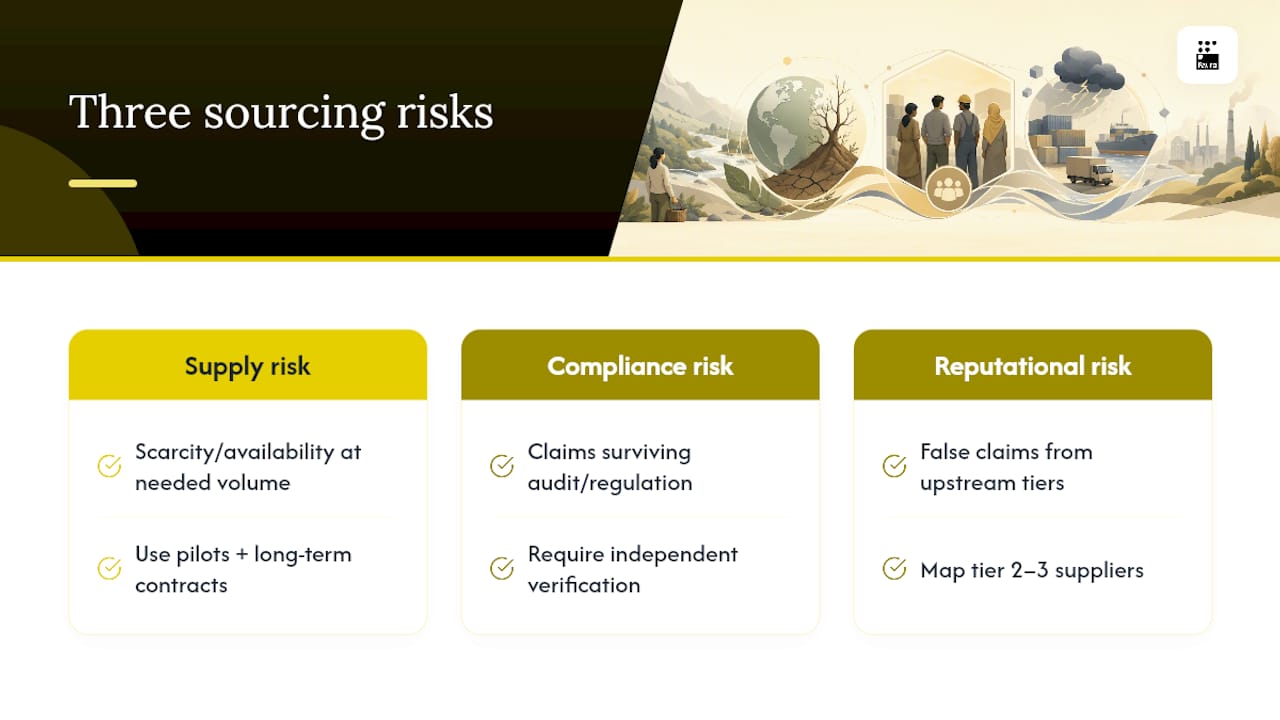
Supply risk covers the scarcity problem outlined earlier: whether a certified low-carbon material will actually be available at the volume you need, when you need it. This risk grows over time as demand for green materials outpaces production capacity, particularly in categories like green steel.
Compliance risk covers whether a supplier’s claims survive audit or regulatory scrutiny. A supplier presenting a self-issued sustainability statement carries far more compliance risk than one holding independently verified chain-of-custody documentation. Regulatory frameworks are tightening quickly, and a claim that passed scrutiny two years ago may not pass it today.
Reputational risk covers what happens if a sustainability claim later proves false, whether through a supplier misrepresentation or a downstream tier 3 issue you never had visibility into. This is precisely why tier 2 and tier 3 mapping matters: a reputational failure rarely originates with your direct supplier. It usually originates two or three tiers upstream, in a part of the supply chain nobody had audited.
A workable risk register for sustainable materials sourcing scores each material against all three categories, rather than a single composite “sustainability score” that hides which specific risk is driving the number. Materials scoring high on supply risk need pilot programmes and long-term contracts. Materials scoring high on compliance risk need independent verification before another order is placed.
Integrating sustainability criteria into procurement software
Most procurement platforms were built around price, lead time and quality. Sustainability criteria get bolted on as an afterthought, usually as a free-text field nobody scores consistently.
The fix isn’t necessarily a new platform. It’s making sustainability data structured and weighted the same way price and quality already are. That means giving PCF, Scope 3 intensity, and certification status their own scored fields in supplier evaluation templates, with defined weightings agreed by procurement leadership before a single RFP goes out.
Three integration points are worth prioritising:
- Supplier scorecards that weight verified sustainability data alongside price and quality, rather than treating it as a pass/fail gate applied separately
- RFx templates with sustainability clauses built into the scoring matrix from the start, so bidders know upfront how heavily it counts
- Contract management systems that flag renewal dates against sustainability performance, so underperforming suppliers get reviewed before renewal, not after a problem surfaces
Where budget allows, material intelligence platforms that centralise technical data sheets and PCFs (discussed earlier) can feed these scores automatically rather than relying on manual data entry from separate supplier submissions. That single change removes most of the administrative friction that causes sustainability scoring to quietly lapse after the first few tenders.
Case studies: sustainable sourcing across industries
Corporate sourcing commitments show how the roadmap plays out at scale, even though the specific material categories differ sharply by sector.
L’Oréal’s responsible sourcing policy treats high-risk material categories, particularly bio-based ingredients, with a stricter standard than the rest of the portfolio: full chain-of-custody tracking and a time-bound improvement plan rather than acceptance of a single certificate as sufficient evidence. That’s a useful model for any procurement team managing a mixed portfolio where risk varies sharply by material category, since it avoids the trap of applying one uniform sourcing standard across materials with very different risk profiles.
Construction and interiors sit closer to Faura’s own vantage point: sourcing decisions there hinge heavily on BES 6001 compliance and chain-of-custody documentation for timber and stone, categories where provenance fraud has historically been a persistent problem. The common thread across all three sectors is the same: sustainability performance improves fastest where it’s tied to an existing compliance infrastructure the sector already has, rather than built as a parallel system from scratch.
Training procurement staff on sustainability practices
A procurement team can have excellent policy and still fail at execution if the people writing RFPs and evaluating bids don’t know how to read a PCF or spot a weak chain-of-custody claim.
Effective training programmes tend to cover three layers. The first is technical literacy: teaching buyers to read a product carbon footprint, understand what Scope 3 intensity actually measures, and recognise the difference between a verified certificate and a supplier’s self-issued statement. The second is negotiation skill specific to sustainability clauses, since asking a supplier for a time-bound improvement plan requires a different conversation than negotiating on price or delivery terms. The third is cross-functional fluency: procurement staff need enough working knowledge of engineering and EHS language to participate meaningfully in the single-source-of-truth data work covered earlier.
Rotating procurement staff through short placements with engineering or EHS teams builds this cross-functional fluency faster than classroom training alone, because it exposes buyers directly to how a material specification decision ripples through to compliance and cost. Pairing junior buyers with a senior lead on their first two or three sustainability-weighted tenders also transfers judgement calls, like when to accept a supplier’s improvement plan versus when to require immediate compliance, that don’t show up clearly in written policy documents.
Legal and regulatory considerations for procurement teams
Regulatory pressure on sustainable materials sourcing is tightening across multiple fronts simultaneously, and procurement teams that treat this as a single compliance checkbox risk missing category-specific obligations.
Corporate sustainability reporting requirements, including CSRD in the European Union, require Scope 3 disclosures from in-scope companies, although the 2026 Omnibus I reforms narrowed CSRD to EU companies with over 1,000 employees and €450 million turnover. Companies within scope that are unprepared risk reporting gaps and potential penalties.
Due diligence legislation targeting specific material categories, deforestation-linked commodities, conflict minerals, and forced labour in supply chains, imposes obligations that go well beyond simple certification checks. These laws typically require documented evidence of supply chain mapping and remediation plans where risk is identified, not just a supplier attestation.
Procurement contracts themselves carry legal exposure if sustainability claims later prove false. A supplier’s misrepresentation in a tender response can expose the buying organisation to reputational and, in some jurisdictions, legal liability if that claim was used in the buying organisation’s own public sustainability reporting. This is precisely why independent verification and audit clauses matter as contractual terms, not just procurement best practice: they create a documented defence if a claim is later challenged.
Given how quickly this regulatory landscape shifts, procurement teams should build a formal annual review of contract sustainability clauses against current legal requirements, rather than treating contract language as fixed once signed.
Evaluating supplier sustainability beyond certifications
Certifications answer a narrow question well: does this supplier meet a defined, auditable standard at the point of assessment. They answer almost nothing about trajectory, resilience, or how a supplier performs under pressure.
A fuller evaluation looks at operational indicators certifications don’t capture. Trend data matters more than a single snapshot: a supplier whose Scope 3 intensity has fallen year on year for three years demonstrates something a static certificate can’t. Financial resilience matters too, since a supplier under financial strain is far more likely to cut corners on sustainability commitments when costs need trimming, regardless of what their certificate says.
Responsiveness to audit findings is one of the most reliable practical signals available. A supplier that fixes issues flagged in a previous audit within an agreed timeframe is a fundamentally different risk proposition from one that lets the same finding recur across multiple audit cycles. Building this into supplier scorecards, tracking not just certification status but audit-finding closure rates, gives procurement a forward-looking risk signal that a certificate alone never will.
Site-level engagement, whether through direct visits or, for interiors and construction materials, in-person verification at a showroom or supplier facility, remains one of the few ways to catch discrepancies between paperwork and practice. Certificates get renewed on a schedule; conditions on the ground change continuously.
Editorial take: why the operational detail is the point
Most sustainability content treats materials sourcing as a values statement: buy responsibly, demand transparency, do better. None of that helps a procurement manager sitting in front of an RFP deadline who needs to know which clause to write and which certificate actually holds up under audit.
The conventional advice fails on two fronts. It treats certification as an endpoint rather than a starting point for ongoing verification, and it ignores timing entirely. A three to seven year transition window isn’t a caveat to bury in a footnote. It’s the single fact that should shape whether a procurement team starts pilots this quarter or waits for “the market to mature,” a wait that, given the projected scarcity in materials like green steel, will cost more than it saves.
What should the reader prioritise first? Not a new platform, not a sweeping policy rewrite. Map your top twenty materials by spend, find out who your suppliers’ suppliers actually are, and start one pilot with a supplier willing to share the risk. Everything else in this roadmap, the standards, the software, the financing structures, only earns its value once that baseline visibility exists.