Contract vs Retail Furniture: A Specification Guide for Designers
By Faura ·
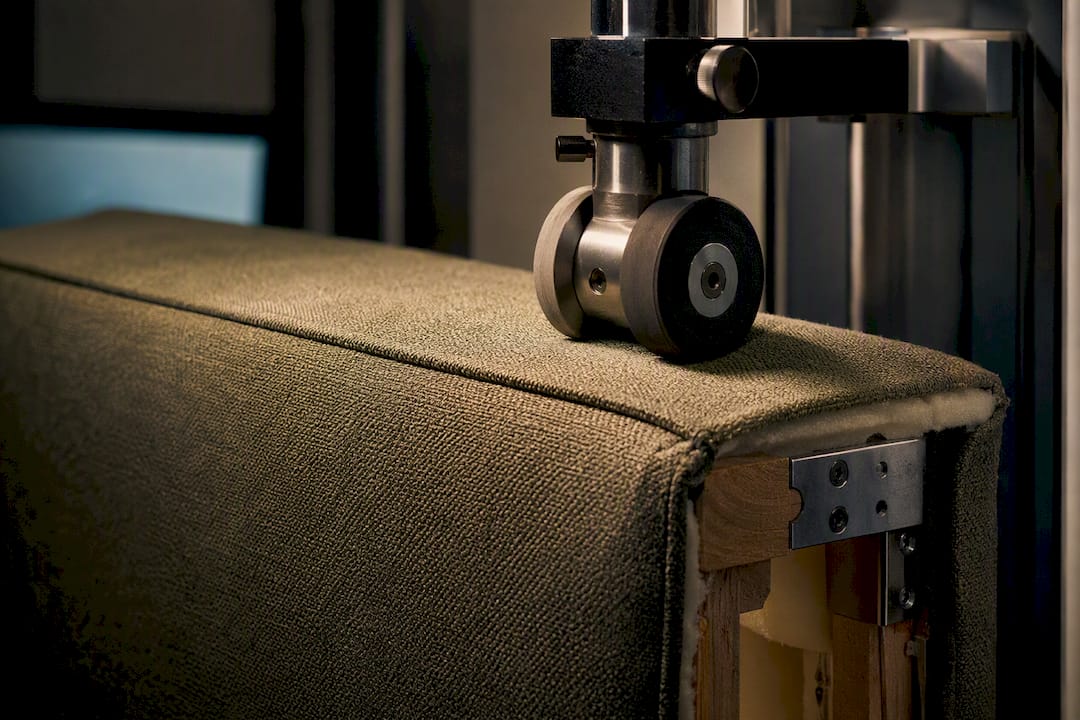
Use contract furniture wherever guests, clients, or the public will sit, and reserve retail furniture for private, low-traffic rooms where the risk of premature wear carries no safety or reputational cost. The deciding factors are use intensity, fire and cleaning regimes, and whether you can produce documented test certificates if challenged. When any of those three is in doubt, specify contract grade and keep the paperwork on file.
TL;DR:
- Contract furniture features reinforced frames and fabrics with measurable abrasion resistance, making it suitable for heavy, continuous use in public spaces.
- Always request specific test figures like Martindale or Wyzenbeek ratings and documented flammability standards, rather than relying on vague labels like “commercial grade.”
- Warranty periods for contract furniture range from 5 to 10 years and often include structural coverage, unlike residential warranties that typically last 1 to 3 years.
- Using retail furniture in a commercial setting risks liability issues, warranty voidance, and fire safety violations due to lack of proper testing and certification.
- Lead times for contract furniture can extend to 12–20 weeks with customizations, whereas retail pieces often ship within days or a few weeks, affecting project scheduling.
Table of Contents
- Contract vs retail furniture: a quick comparison
- What technical specs should you actually request?
- How do lifecycle costs and warranties actually compare?
- Where should you actually buy contract furniture?
- A one-page specifying checklist for contract-grade furniture
- What actually separates contract furniture from retail furniture?
- Do sustainability certifications matter for contract specification?
- How much do aesthetics really differ between the two categories?
- How flexible is customisation across contract and retail lines?
- What liability risks come with using retail furniture commercially?
- How do maintenance and cleaning protocols compare?
- How do lead times and ordering differ between the two?
- Faura’s perspective: reducing specification risk through the trade showroom
- Sources
Contract vs retail furniture: a quick comparison
The gap between these two categories shows up in construction, fabric performance, and paperwork long before it shows up in price. A retail sofa and a contract sofa can look identical from three metres away. What separates them is what happens after eighteen months of daily use.
Frame and joinery. Contract frames use reinforced joints, often doubled dowelling or metal corner brackets, built to withstand repeated loading from different body weights and postures throughout the day. Retail frames are engineered for a household’s typical use pattern: one or two people, moderate frequency, longer rest periods between sittings. Neither is “better” in isolation; they’re built for different load profiles.
Upholstery and abrasion. This is where the categories diverge most sharply. Contract fabrics carry measurable abrasion resistance figures, published in the UK as Martindale cycles, with higher thresholds for heavier-traffic seating. Retail fabrics rarely publish this figure at all because the manufacturer never expected anyone to ask.
Warranty terms. Contract furniture typically carries longer structural warranties, often 5 to 10 years and sometimes lifetime on frames. Residential warranties usually run 1 to 3 years and almost always exclude commercial use outright.
Aesthetics versus durability. Retail ranges move faster on trend and offer more finish variety season to season. Contract collections tend to hold a design language for longer because retooling a certified frame or requalifying a fabric for flammability is expensive and slow.
A working summary for early client conversations:
- Frame construction: contract uses reinforced joinery rated for continuous multi-user loading; retail is built for domestic frequency.
- Fabric performance: contract fabrics publish abrasion, flammability, and colourfastness data; retail fabrics rarely do.
- Warranty length: contract typically 5 to 10 years structural; retail typically 1 to 3 years, often void on commercial use.
- Typical use case: contract fits lobbies, restaurants, meeting rooms, and any customer-facing seat; retail fits private residences and back-of-house spaces with no public access.
What technical specs should you actually request?
Ask for numbers, not adjectives. “Commercial grade” on a spec sheet means nothing without a test figure attached to it.
Martindale and Wyzenbeek are the two abrasion tests you’ll encounter, Martindale dominant in the UK and Europe, Wyzenbeek more common in North American mill reports. Both measure how many rub cycles a fabric withstands before visible wear appears, but the numbers aren’t directly comparable across the two methods, so confirm which test a mill used before setting a threshold in your spec.
Abrasion thresholds by application: guest-room occasional chairs typically need 25,000 to 40,000 Martindale; restaurant and meeting seating sits in the 40,000 to 70,000 band; lobby and 24-hour seating should sit at the top of the fabric maker's heavy-contract classification.
Flammability standards are non-negotiable for anywhere the public sits. In the UK, BS 7176 is the British Standard commonly specified for upholstered seating in non-domestic settings (the fire risk assessment determines what is required), while BS 5852 provides the underlying ignition-source test methods. EN 1021-1 and EN 1021-2 (smouldering cigarette and match-flame equivalent) come up on European-sourced ranges and should be cross-checked against the UK standard rather than assumed interchangeable. Compliance can be achieved through the fabric itself, an interliner, or the finished composite. Fix which route you’re taking before production starts, because switching after cutting begins usually means re-testing from scratch.
A mill test report worth filing should include:
- Abrasion resistance figure and test method used
- Flammability certification matched to the correct standard (BS 7176, BS 5852, or EN 1021 series)
- Colourfastness to light and rubbing
- Seam slippage resistance
- Pilling resistance where relevant to the fabric type
Finishes need to be rated for the actual cleaning chemicals used on site, not a generic “wipeable” claim. A hotel housekeeping team using industrial disinfectant will strip a finish rated only for domestic wipe-downs within months, regardless of how the fabric performed on paper.
How do lifecycle costs and warranties actually compare?
Upfront price tells you almost nothing about total cost. The number that matters is annualised cost, which is purchase price divided by realistic years of service before replacement, plus any warranty-related repair costs you’d otherwise have absorbed yourself.
Contract furniture typically holds up for 7 to 10 years under daily heavy use, against 3 to 5 years for residential furniture under moderate home use. Run the maths on a hotel lobby chair: a retail piece at a lower purchase price but a 4-year realistic lifespan can cost more per year in service than a contract piece bought at a higher price with an 8-year lifespan, once you factor in the labour and disruption of replacing furniture in an occupied space.
Where does retail still make sense? Private residential projects, low-footfall back offices, and any space with no public access and a client who accepts the shorter replacement cycle. There’s no compliance argument for contract grade in a private study.
Warranty clauses worth reading in full before you spec anything:
- Commercial-use exclusions. Many residential warranties are void the moment the piece is used in a business setting, even part-time.
- Cleaning-method exclusions. Some warranties exclude damage from cleaning products or methods not listed in the care documentation.
- Structural versus fabric cover. Frame warranties and upholstery warranties often run different lengths, check both separately.
Where should you actually buy contract furniture?
Provenance matters as much as the product itself. Buy through the wrong channel and you can lose warranty cover even on a genuinely contract-grade piece.
- Manufacturer contract divisions. Most established brands run a separate contract arm with its own pricing, lead times, and documentation process, distinct from their retail line.
- Authorised dealers. Purchasing through authorised channels preserves warranty cover and guarantees access to the mill test reports you’ll need for the compliance file.
- A&D representatives. Architecture and design reps at major brands can fast-track sample requests and confirm current lead times against your project milestones.
- Trade showrooms. A trade-only showroom lets you handle finishes, request batch documentation, and compare several brands’ contract lines in one visit rather than chasing separate sales teams.
Unauthorised resellers, including some grey-market online marketplaces, can sell genuinely contract-rated stock without the accompanying test documentation, which leaves you unable to prove compliance if a client or inspector ever asks. Custom fabric orders typically add several weeks to lead time on top of standard production, so build fabric approval into your earliest project milestones, not your final ones.
Pro Tip: Ask any supplier for their most recent batch test report before placing a production order, not just the fabric’s original certification. Mills change suppliers and processes, and a two-year-old certificate doesn’t guarantee this batch matches it.
A one-page specifying checklist for contract-grade furniture
Copy this into your project documentation and adjust the figures to the space.
- Set the abrasion threshold by area. 25,000 to 40,000 Martindale for low-traffic seating, 40,000 to 70,000 for moderate use, 100,000+ for lobbies and continuous-use seating.
- Nominate the flammability standard. BS 7176 for UK non-domestic upholstery, cross-referenced against BS 5852 or EN 1021-1/-2 depending on sourcing origin.
- Request the full documentation set. Mill test report, flammability certificate for the composite (not just the fabric), seam slippage data, and structural warranty terms in writing.
- Approve a physical sample and prototype before committing to production quantities.
- Require a batch test on the actual production run, not just the original fabric certification.
- Confirm installation scope and aftercare in writing, including which cleaning products keep the warranty valid.
Pro Tip: Keep this checklist as a live document in the project file. When a client or building inspector asks why a specific chair was chosen for the lobby, you want the answer on one page, not scattered across six supplier emails.
What actually separates contract furniture from retail furniture?
Contract furniture, sometimes called commercial-grade furniture, is designed, tested, and warrantied for use in spaces the public or paying guests occupy: hotels, restaurants, offices, healthcare settings, and retail environments themselves. Retail furniture, sometimes called residential furniture, is designed and warrantied for private homes where use is lighter and less frequent.
The distinction isn’t primarily about appearance. It’s about documented performance. Reputable contract furniture is backed by third-party abrasion, flammability and structural test evidence, and manufacturers support that testing with warranties that assume heavy daily use. Retail furniture is built to a domestic use pattern and priced accordingly, without the testing overhead contract certification demands.
This is why the same-looking armchair can sit at very different price points depending on which line it comes from. You’re not paying extra for the fabric pattern. You’re paying for the abrasion certificate, the flammability composite testing, the reinforced frame, and a warranty that survives contact with the public. Understanding contract furniture in these terms, rather than as a vague quality tier, is what lets you defend a specification decision to a client who’s questioning the cost difference. It also clarifies why a beautiful retail piece can be entirely wrong for a hotel lobby regardless of how well it photographs.
Do sustainability certifications matter for contract specification?
Increasingly, yes, and it’s worth building environmental documentation into the same compliance file as your abrasion and flammability certificates. GREENGUARD certification, which verifies low chemical emissions from furnishings, has become a common request on commercial projects where indoor air quality is scrutinised, particularly healthcare, education, and corporate workplace fit-outs.
LEED credits are relevant on any project pursuing that certification, since furniture and furnishings can contribute points under materials and indoor environmental quality categories. Contract manufacturers are generally better positioned to supply this documentation because they’re already producing test reports and technical data sheets as standard practice. Retail manufacturers rarely publish emissions data because their buyers rarely ask for it.
Recycled-content disclosures and take-back or refurbishment programmes also appear more often on contract lines, partly because commercial clients (particularly corporates and hospitality groups with published sustainability targets) demand them at procurement stage. If a client’s brief includes environmental targets, ask contract suppliers for their certification portfolio early. It’s far easier to select a compliant product from the outset than to retrofit sustainability credentials onto a project that’s already specified.
How much do aesthetics really differ between the two categories?
Less than most designers expect, and the gap is closing. A decade ago, contract furniture had a reputation for looking institutional: heavy frames, safe upholstery, limited finish choice. That’s no longer the baseline.
Leading contract manufacturers now run design collaborations with recognised furniture designers and offer finish libraries nearly as extensive as their retail counterparts. What hasn’t changed is the constraint underneath the aesthetics. Every finish and fabric offered on a contract line has already cleared abrasion and flammability testing, which narrows the palette compared with retail’s essentially unlimited fabric-of-the-day approach.
Retail ranges refresh faster and chase trend cycles more aggressively, because there’s no certification cost attached to introducing a new pattern each season. That gives retail an edge on projects where the brief calls for something genuinely current or unusual, and where the space doesn’t demand contract-level performance. For a private client’s reading room, that flexibility is a genuine advantage, not a compromise. The practical answer is to treat aesthetics as a shortlist filter within the performance band you’ve already fixed, rather than starting from the look and hoping the performance data works out.
How flexible is customisation across contract and retail lines?
Contract lines generally offer more structured customisation, not less, once you understand how the system works. Most contract manufacturers maintain an approved fabric and finish library, everything in it pre-cleared for the relevant abrasion and flammability standards, so you can customise freely within that library without triggering new testing.
The limitation appears when a client wants a fabric outside that approved library. Bringing in an unlisted fabric for a contract frame usually means commissioning fresh flammability and abrasion testing on that specific combination, which adds cost and, more importantly, adds weeks to the lead time. Some manufacturers won’t accommodate outside fabrics on contract frames at all, precisely because it breaks their tested composite and voids their own warranty exposure.
Retail customisation works the opposite way. Fabric choice is close to unlimited because there’s no certification to protect, but structural customisation, such as altered dimensions or reinforced frames for higher use, is rarely offered because the manufacturer never engineered for it. The practical takeaway: if a client wants extensive fabric freedom on a piece that will see genuine commercial use, budget time and cost for requalification testing, or steer them toward the approved library instead. Neither route is wrong, but each carries a different timeline, and surprising a client with a six-week testing delay after they’ve fallen in love with an unlisted fabric is an avoidable conversation.
What liability risks come with using retail furniture commercially?
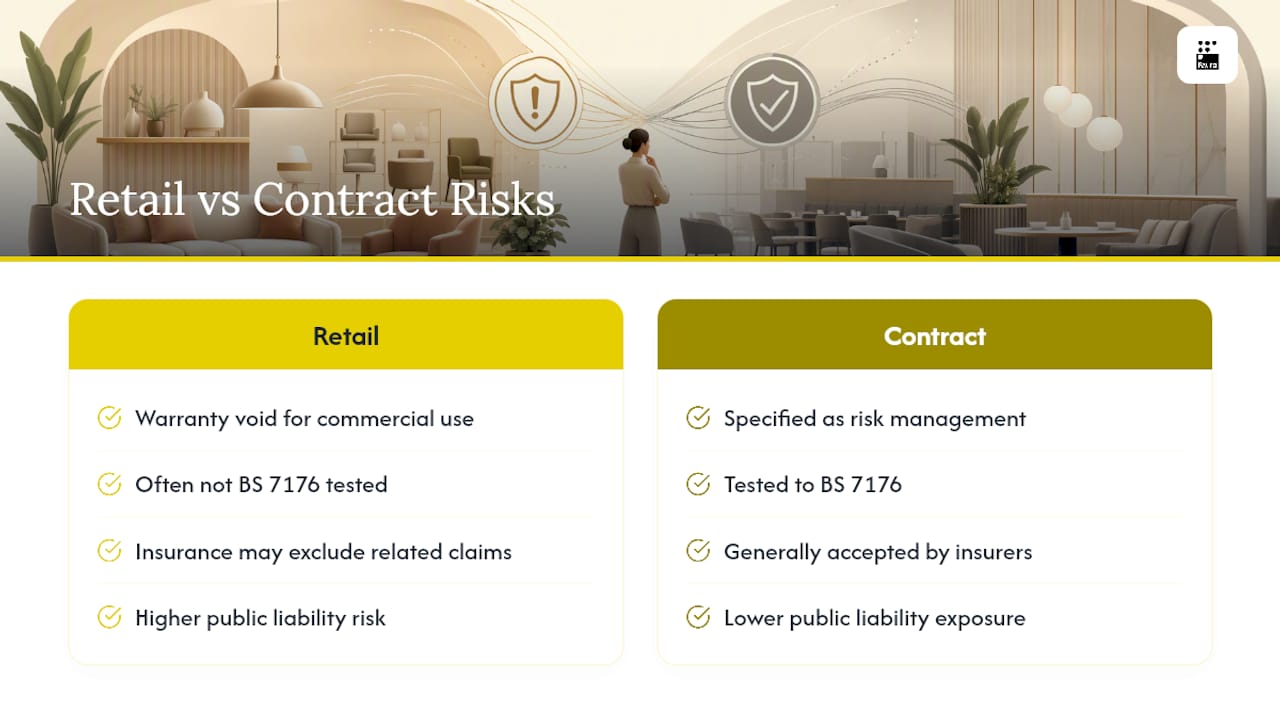
This is the risk category too many specification decisions skip past. Retail furniture used in a commercial setting typically falls outside its own warranty terms the moment that use begins, which leaves little contractual recourse if the piece fails or does not meet the fire precautions the premises require.
‘Contract grade’ functions as risk management, not simply a pricing tier, and that framing matters most exactly here. If a fire risk assessment or inspection finds seating without suitable test evidence, the operator may be required to act, and the designer who specified it faces a professional liability question that’s very hard to answer well. Insurance can also be affected: some commercial insurance policies specifically exclude claims arising from furniture that wasn’t fit for the stated commercial purpose.
Public liability is the sharper edge. A retail-grade chair frame that fails under repeated multi-user loading in a waiting room isn’t just an embarrassing replacement order, it’s a potential injury claim with the designer’s specification decision sitting in the paper trail. None of this requires imagining worst-case scenarios; it’s simply the gap between what a retail warranty promises and what a commercial environment demands of the product every single day.
The practical defence is straightforward: document the decision. If a genuinely low-traffic, non-public area justifies retail furniture, note the reasoning in the project file. If any doubt exists about traffic or public access, default to contract grade and keep the test certificates on record.
How do maintenance and cleaning protocols compare?
Contract furniture is specified alongside its cleaning regime, not after it. Fabric finishes on contract lines are typically rated against the actual chemicals and methods a commercial cleaning team will use, industrial disinfectants, steam cleaning, frequent deep cleans, because the manufacturer expects that intensity from day one.
Retail furniture is finished for domestic cleaning: occasional light wiping, mild detergent, infrequent deep cleaning. Put a retail-finished fabric into a restaurant’s daily disinfectant routine and you’ll typically see finish breakdown, colour loss, or fabric degradation within months, warranty or no warranty, because the finish was never rated for that chemical exposure.
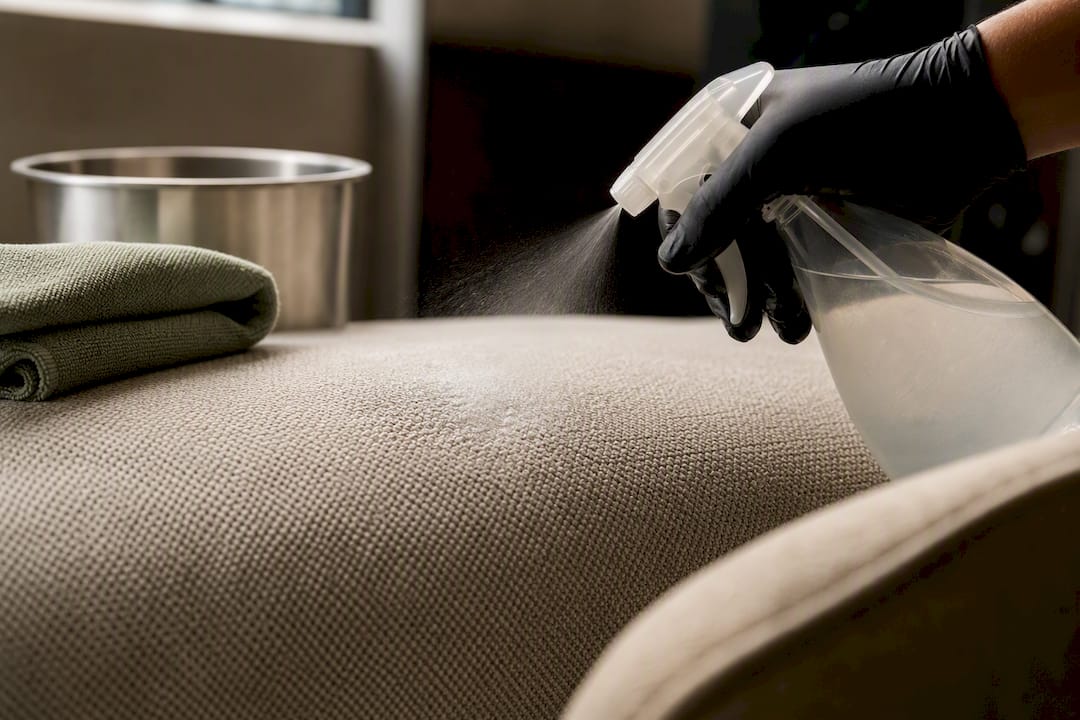
This is where housekeeping and specification teams need to talk to each other before ordering, not after. Ask the facilities or housekeeping team what products and frequency they actually use, then match the fabric finish rating to that regime rather than assuming “commercial grade” covers it automatically. Some contract fabrics require specific cleaning agents to maintain their flammability rating, using the wrong product can compromise the certified performance even if it doesn’t visibly damage the fabric. That detail rarely makes it into a sales conversation, which is exactly why it belongs on your specification checklist rather than left to assumption.
How do lead times and ordering differ between the two?
Retail furniture generally wins on speed. In-stock retail pieces can ship within days to a couple of weeks, and even made-to-order retail items rarely stretch past six to eight weeks because the fabric and frame combinations are pre-approved and mass-produced.
Contract furniture runs on a longer, more structured timeline. Standard contract items from a manufacturer’s existing range might ship in four to eight weeks. Anything involving a custom fabric, a non-standard finish, or a fabric requiring fresh flammability testing can push lead times to 12 to 20 weeks or more, particularly if the composite needs re-certification.
The ordering process itself differs too. Contract orders typically move through sample approval, then a prototype or first-off approval, then a batch test on the actual production run, before full production begins. Retail ordering usually skips straight from selection to production because the fabric and frame combination is already fixed and tested. That extra structure on the contract side is precisely why it needs to sit in your project schedule from the earliest planning stage, not bolted on once installation dates are already fixed with a client. Missing a batch-test milestone by even a week can cascade into a missed installation date on a commercial fit-out with a hard opening deadline.
Faura’s perspective: reducing specification risk through the trade showroom
Faura, based in Westminster, works with over 200 brands, which matters most at exactly the moment a spec needs proving, not just choosing. A trade showroom can help you gather test reports and technical files in one place rather than chasing individual brand sales teams separately.
Booking a showroom appointment lets you check a fabric’s cleaning performance and abrasion rating against the sample in hand, confirm delivery logistics with the brand directly, and leave with documentation rather than promises.
— Faura Editorial
Sources
- Commercial vs. Residential Furniture: Key Differences - TNT Commercial
- Choosing Contract-Grade Upholstery Fabric for Hotel Furniture - FBM Sourcing
- BS 5852 fire testing of upholstered furniture — RISE