Designer Brand Collaborations: A Guide for UK Interior Designers
By Faura ·
Designer brand collaborations turn a practice’s design authority into co-developed products, exclusive ranges and showroom representation, with royalties or commissions replacing one-off fees. The single best next step is to pick your model and draft a one-page brief before approaching any brand. A trade showroom such as Faura can then shorten the sourcing and procurement work that usually slows a launch down.
TL;DR:
- Collaborations generate ongoing revenue and build a design legacy while providing procurement leverage through showroom representation, especially for established practices.
- Four main structures exist: co-developed collections, licensing agreements, limited editions, and showroom representation, each suited to different practice sizes and stages.
- A detailed written agreement should specify scope, payment, territory, IP rights, liability, and termination, with an SKU schedule to prevent downstream disputes.
- Timelines from concept to launch depend on product complexity, with early manufacturer involvement essential to avoid major delays.
- A trade showroom can simplify collaboration by consolidating sourcing and providing a physical space for presenting work.
Table of Contents
- Why collaborate on designer brand partnerships?
- What types of designer collaborations exist?
- What contract clauses should every collaboration include?
- How long does a collaboration take from concept to launch?
- What behaviours build lasting brand-designer relationships?
- How does a trade showroom simplify collaboration?
- Where should you start your first collaboration?
- Get trade access and showroom support through Faura
- Sources
Why collaborate on designer brand partnerships?
A well-structured collaboration does three things a standalone specification job cannot: it generates repeat trade revenue through commission or royalty income, builds a design legacy you control rather than a one-off spec buried in someone else’s project, and gives you procurement leverage through showroom representation that speeds up sourcing on future jobs. Brands benefit too. The best partners restructure warehouse and customer service processes to handle smaller, bespoke orders rather than forcing designers into retail-scale minimums, a point To-The-Trade’s designer survey makes explicitly.
Collaboration isn’t always the right call, though. It makes sense when:
- You have a distinctive point of view a brand can’t replicate internally
- The brand has manufacturing capacity to match your order volumes without long delays
- Your aesthetic and client base genuinely overlap with the brand’s audience
- You can commit real time to sampling, marketing and prototype visits
Defer if the brand lacks production capacity for bespoke runs, or if the relationship exists only to trade on your name without shared creative input.
What types of designer collaborations exist?
Four structures cover most of the market, and each suits a different stage of practice.
- Co-developed collections. You design alongside the brand’s product team, typically earning a royalty on sales rather than a flat fee. This suits established practices with a recognisable aesthetic and patience for a longer development cycle.
- Licensing agreements. The brand pays to use your designs or name across a defined product range and territory. Royalties are common here because they reward designs with staying power, a view one designer sets out in BIID’s feature on brand partnerships.
- Limited edition capsules. A short run, often trade-only, with a flat fee or a small royalty and a fixed sell-through window. Good for smaller studios testing a brand relationship before committing to something bigger.
- Showroom representation. No co-design at all. The brand pays for display and introduction to your client base, or you earn commission on referred sales at a rate agreed in writing.
Smaller studios and independent makers tend to start with capsules or representation. Larger practices with design teams and a settled aesthetic can sustain co-developed lines and licensing across several seasons.
What contract clauses should every collaboration include?
Every collaboration needs a written agreement before design work starts, not after. Legal commentary on creator and brand deals is consistent on this point: informal arrangements between people who trust each other are exactly where disputes start when a brand’s direction or commitment changes.
Pro Tip: Ask for an “Attachment A” schedule listing every SKU, material and finish code covered by the agreement. It stops downstream arguments about which product the contract actually governs, a practice recommended in guidance for hiring a sales representative.
Your checklist should cover:
- Scope and deliverables: exact products, quantities and design responsibilities
- Payment structure: flat fee, royalty percentage or commission, defined clearly against qualifying orders
- Territory and exclusivity: whether representation is exclusive or non-exclusive, and where it applies
- IP ownership: who keeps the sketches, CAD files and manufacturing rights, and under what licence
- Liability and warranties: who covers product faults, returns and defects once goods ship
- Termination procedure: notice periods and what happens to unsold stock or tooling
Liability, IP, product specification, delivery and termination are the clauses most worth getting right in any professional partnership. Retain ownership of your original design files wherever possible. Practitioners who license rather than sell design rights outright tend to build the more durable, long-term collections.
How long does a collaboration take from concept to launch?
Timelines vary enormously depending on product complexity, but the sequence rarely changes.
- Discovery and brief, usually under NDA, where both sides agree scope and commercial terms.
- Design and prototyping, where sketches become CAD files and early samples.
- Sampling and revision, with physical prototypes tested against agreed acceptance criteria.
- Production, where manufacturing lead times and shipping usually cause the most slippage.
- Launch, including showroom presentation, photography and press.
Simple textiles or upholstery finishes can move from brief to production in a matter of months. Furniture requiring bespoke tooling, testing or certification takes considerably longer, and delays cluster around manufacturing capacity and shipping rather than design work itself.
Pro Tip: Involve the manufacturer during concept development, not after drawings are finalised. Early technical input on tooling and materials prevents the redesign cycles that push launches back by entire seasons.
What behaviours build lasting brand-designer relationships?
The collaborations that last beyond one product cycle share a few habits that cost little but matter a great deal.
- Share high-quality installation photography and grant the brand usage rights. This is one of the most valued gestures a designer can make, according to brands interviewed for To-The-Trade’s showroom feature, because it hands them marketing assets they can’t easily produce themselves.
- Keep documentation tight and attend prototype visits in person where possible.
- Agree joint PR and market events early, with clear responsibility for marketing spend on both sides.
- Watch for uneven marketing commitment, vague IP language and distribution channels that quietly compete with your own client relationships.
Pro Tip: Treat photography and usage rights as a deliverable in the contract, not a favour. It removes ambiguity and gives the brand a reason to prioritise your account when stock runs tight.
Alignment on creative values matters as much as the commercial terms. Practitioners who’ve built durable brand relationships describe authenticity and shared investment in PR as the real difference between a one-season capsule and a decade-long line.
How does a trade showroom simplify collaboration?
A curated trade showroom removes much of the friction that slows a first collaboration down. Faura’s product library spans over 200 brands, with samples, technical files and procurement handled by one team.
For a designer launching a co-developed line, that structure matters in practice:
- Showroom space to present schemes to clients, by appointment
- Procurement, logistics and delivery handled by one team, with trade terms confirmed directly for each approved account
- Operational back-office support that handles order administration while you focus on the design itself
Faura’s showroom hosting model offers space to present schemes to clients; ask the team directly whether a collection launch can be accommodated.
Where should you start your first collaboration?
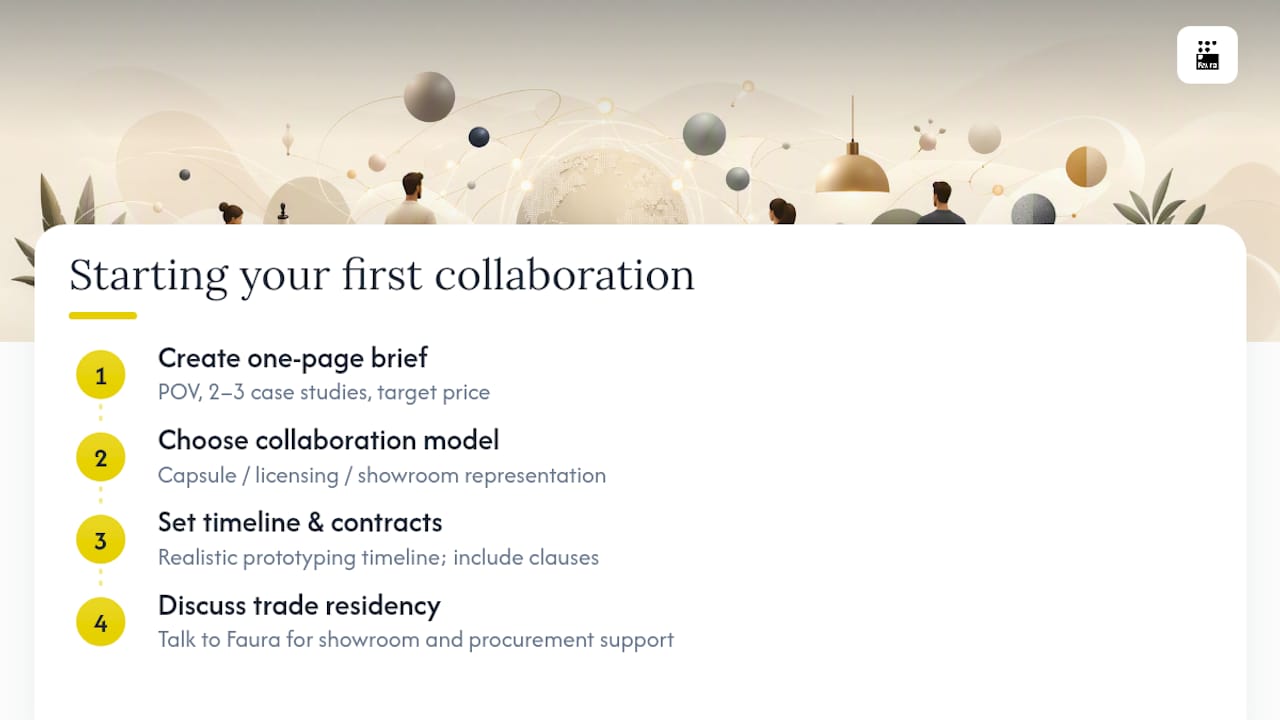
Start with a one-page brief: your design point of view, two or three client case studies, and a target trade or retail price point. Decide your model, whether that’s a capsule, a licensing arrangement, or straightforward showroom representation, before you approach anyone, because that choice shapes every clause you’ll need in the contract.
Set a realistic timeline for prototyping and don’t sign anything without the clauses covered above. When you’re ready to move from brief to brand, Faura’s trade residency is worth a conversation about showroom access and procurement support.
— Faura Editorial
Get trade access and showroom support through Faura
Faura gives designers access to over 200 brands and a Westminster showroom where schemes can be presented to clients, by appointment. Instead of placing orders brand by brand, designers can consolidate procurement through Faura — one order, one invoice — freeing up time for design and client work. That structure suits any designer moving from a single capsule collection towards ongoing brand partnerships and repeat procurement. If you’re preparing your first collaboration brief, book a showroom appointment with Faura to discuss trade access, procurement terms and how residency support fits your next launch.