Importing Furniture to the UK: 3 Pre-Shipment Checks for Designers
By Faura ·
Yes, you can import furniture into the UK for client projects or showroom stock, but three things need sorting before anything leaves the factory: register for a GB EORI number, agree who is importer of record under your Incoterms, and confirm your supplier has the correct commodity codes and safety documentation ready. Miss any of these and your container sits at the port while the invoices keep running.
TL;DR:
- Ensuring your supplier has the correct commodity codes, safety documents, and compliance labels is essential before goods depart, or customs clearance will be delayed.
- A full import declaration via HMRC’s CDS requires assembling detailed documents, classifying every SKU accurately, and choosing the correct customs procedure code.
- Duty rates vary based on the exact 10-digit commodity code and origin declaration, with import VAT set at 20% of the duty-inclusive value, payable through deferred schemes.
- Furniture imported into the UK must meet specific fire safety, electrical, textile, and packaging requirements, and missing evidence can hold up clearance or sale.
- Working with experienced freight forwarders and procurement support from a trade showroom can minimize delays, ensure compliance, and streamline the entire import process for designers.
Table of Contents
- What to check before your supplier ships anything
- How do you make a full import declaration through CDS?
- What documents and safety proofs does your supplier owe you?
- How much duty and VAT will you actually pay?
- Planning shipping timelines without derailing your project
- Choosing a freight forwarder who won’t slow you down
- Safety and labelling rules that determine whether goods clear customs
- Why procurement admin shouldn’t sit on a designer’s desk
- Get procurement support through Faura’s trade showroom
- Sources
What to check before your supplier ships anything
Many import delays trace back to a single missing document. Before goods leave the factory floor, work through this list.
- Apply for a GB EORI number or confirm your agent or seller already holds one, since customs declarations cannot proceed without it.
- Agree Incoterms in writing and settle who is importer of record, because that decision determines who carries the VAT and duty liability.
- Ask the supplier for SKU-level commodity codes, a signed country-of-origin statement, and any technical specifications or test reports referenced on the invoice.
- Confirm ISPM 15 marking on wooden crates and pallets, permanent compliance labels on upholstered pieces, and UKCA or CE conformity evidence where the item needs it.
- Arrange transit insurance and agree realistic shipping timings with your carrier before committing to a client handover date.
Treat this as a pre-flight check, not paperwork to chase after the container has sailed. Suppliers who export regularly to the UK will have most of this ready if you ask early enough in the order process.
How do you make a full import declaration through CDS?
Every commercial shipment into the UK needs a formal customs entry submitted through HMRC’s Customs Declaration Service, and the sequence matters more than most designers expect on their first import.
- Assemble the document pack. You need a commercial invoice with a clear goods description and stated Incoterms, a packing list, the bill of lading or air waybill, an origin statement, and any test reports the goods require.
- Classify every SKU. Use the UK Integrated Online Tariff to find the correct 10-digit commodity code for each item, and keep a short written note explaining why that code was chosen.
- Decide who files. You, an appointed customs agent, or the seller under a DDP arrangement can submit the entry, but somebody needs to own it explicitly in writing before the goods arrive.
- Choose the customs procedure code that matches your scenario, whether that’s a standard import for resale or a temporary movement.
- Submit the full declaration in CDS, including the declaration unique consignment reference and every required data element covering value, origin, and classification.
- Watch the timing rules. Declarations can often be submitted before arrival, but HMRC’s guidance on full import declarations sets out exactly when acceptance and arrival notifications interact.
Commodity codes run to 10 digits in the UK, and each digit narrows the classification further. Getting even one digit wrong can shift the duty rate or trigger a licensing requirement you weren’t expecting, according to the tariff classification tool.
Once you submit, HMRC calculates duty and VAT against your declared value, and may request supporting documents before releasing the goods. Most compliant shipments clear without examination, but a missing origin statement or an unclear invoice description is the most common reason for a hold. Build a short buffer into your project schedule for this step alone, particularly on a first order from a new factory.
What documents and safety proofs does your supplier owe you?
Compliance failures rarely happen at the border. They happen weeks earlier, when a factory ships without the right paperwork and nobody catches it until customs does.
- Upholstered goods: insist on BS EN 1021‑1 and BS EN 1021‑2 ignition-resistance test certificates for contract pieces; for domestic pieces, test evidence under the Furniture and Furnishings (Fire) (Safety) Regulations 1988 and the required permanent label.
- Electrical items and lighting: request conformity documentation and applicable UKCA or CE safety evidence before the item is boxed.
- Textiles and finishes: check fibre-content labelling, chemical restriction compliance, and care labels are already attached.
- Wood packaging: confirm ISPM 15 marking is stamped on crates and pallets, with phytosanitary paperwork available if requested.
Pro Tip: Fixing missing fire-safety labels or test evidence after goods reach the UK is slow and costly, and non-compliant pieces cannot be supplied until it is resolved. If a supplier can’t produce the label at the point of shipment, the piece doesn’t leave the factory, full stop.
Keep a single digital folder per shipment holding the invoice, packing list, origin statement, and every test certificate, named by purchase order. When a customs officer asks for supporting evidence, the businesses that clear fastest are the ones who can produce the full pack in one email, not the ones scrambling to call a supplier in a different time zone.
How much duty and VAT will you actually pay?
Customs value is calculated as price paid, plus insurance, plus freight, known as the CIF basis, and both duty and import VAT are calculated against that figure rather than the invoice price alone.
Many furniture commodity codes carry 0% duty under the UK Global Tariff, but that’s never a safe assumption. Duty depends entirely on the exact 10-digit code and the goods’ declared origin, and even similar-looking pieces can sit in different tariff lines with different rates, as the tariff entry for articles of furniture shows.
Import VAT is charged at the standard 20% rate on the duty-inclusive value, and VAT-registered design businesses can normally reclaim it as input tax, subject to the usual rules. Postponed VAT Accounting is the tool that makes this manageable: instead of paying VAT in cash at the border and waiting to reclaim it, PVA lets you account for it on your VAT return, reconciled against your monthly statement.
| Cost element | Basis of calculation | Cashflow treatment |
|---|---|---|
| Freight and insurance | Actual carrier and insurer costs | Paid upfront, added to CIF value |
| Import duty | CIF value × commodity code rate (often 0% for furniture) | Paid at import unless deferred |
| Import VAT | 20% of duty-inclusive value | Deferred and reclaimed via PVA |
A duty deferment account or customs warehousing arrangement can spread payments further, useful if you’re bringing in several containers across a busy project quarter. Temporary admission may apply in narrow cases, such as goods brought in for a trade fair rather than sale, but check eligibility before relying on it.
Planning shipping timelines without derailing your project
Sea freight from major furniture-manufacturing regions typically takes 28 to 40 days to reach the UK, and that window assumes no transhipment delays.
- Common UK arrival ports include Felixstowe, Southampton, Tilbury, and Liverpool, and your routing choice affects both cost and speed.
- Door-to-port services leave final-mile delivery and clearance to you or your agent, while door-to-door (landed) services bundle the whole journey into one quoted price.
- Transhipment through a secondary hub adds transit time and raises the chance of an inspection hold, since goods change hands more often.
- Full declarations generally need to be made within a fixed window after goods enter temporary storage, so don’t assume you can leave paperwork indefinitely once a container lands.
- Build in extra days for labelling queries or inspection holds, particularly on a first shipment from a new supplier relationship.
For a client installation with a fixed handover date, work backwards from that date and add a buffer of at least a week beyond the quoted transit time, not as a formality but because ports genuinely do get congested.
Choosing a freight forwarder who won’t slow you down
An experienced customs agent earns their fee by getting classification right the first time, since a wrong commodity code can trigger a post-clearance adjustment months after the goods have already reached your client’s home.
- Ask about CDS experience directly, not just general freight handling, since declaration accuracy is where most delays originate.
- Check commodity-code support. A good agent should be willing to justify a classification decision, not just accept whatever code the supplier printed on the invoice.
- Confirm liability limits and insurance cover, and ask how they handle an unexpected inspection or a documentation request from HMRC.
- Request an audit trail. You want a record of every declaration filed on your behalf, not a verbal assurance that it’s “all sorted.”
Put the essentials into the contract itself: who is designated importer of record, the agreed Incoterms, who supplies proof of origin, who is responsible for test reports, and a clear turnaround time for filing declarations. Pro Tip: Ask your forwarder how they’d handle a rejected declaration before you sign, not after it happens on your first shipment. For repeat volume, ask whether customs warehousing or inward processing suits your pattern of orders, though these regimes need a separate application and aren’t something every agent can set up.
Safety and labelling rules that determine whether goods clear customs
Product safety compliance is where furniture imports most often stall, because the rules differ by category and a supplier used to shipping elsewhere may not know UK requirements by default.
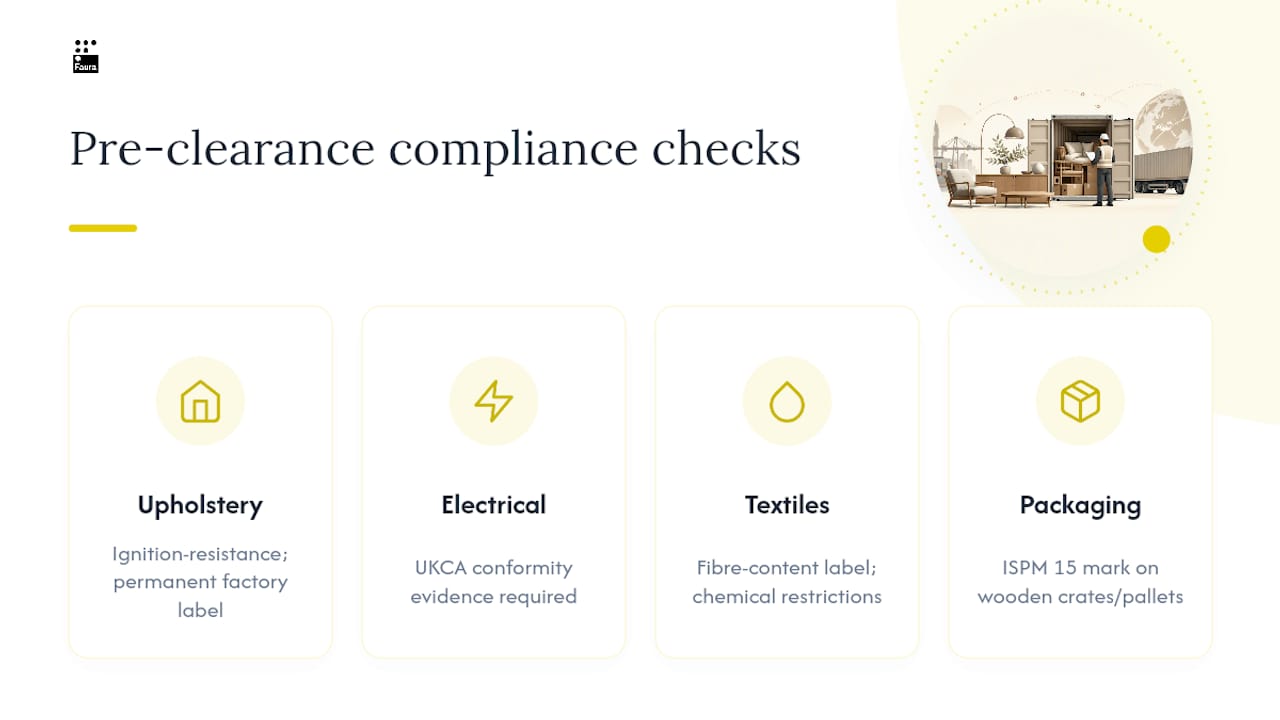
Upholstered domestic furniture must meet ignition-resistance standards, with the correct permanent label fitted before the item leaves the factory. This applies to sofas, armchairs, and any upholstered seating destined for domestic use, and correcting it after the goods reach a UK warehouse is slow and costly. Contract furniture, such as pieces specified for a hospitality or commercial fit-out, follows a different fire-safety framework, and that specification should sit with the project’s fire-safety adviser rather than being assumed identical to domestic rules.
Electrical goods and lighting fixtures need UKCA or CE conformity evidence, covering everything from statement lamps to integrated LED joinery. Textiles require fibre-content labelling and adherence to chemical restrictions, which matters for imported fabric-wrapped panels, cushions, and soft furnishings as much as for upholstery itself.
Wooden packaging, crates, and pallets need ISPM 15 marking, a requirement that catches out first-time importers more often than any furniture-specific rule, since it applies to the packaging rather than the product. None of these checks are optional extras. They’re the difference between a shipment that clears in days and one that sits in a bonded warehouse while your client waits for a delivery date that keeps slipping.
Why procurement admin shouldn’t sit on a designer’s desk
Every step above is manageable, but stacked across six or seven suppliers on a single project, it becomes a full-time administrative job that pulls a designer away from the work clients actually pay for.
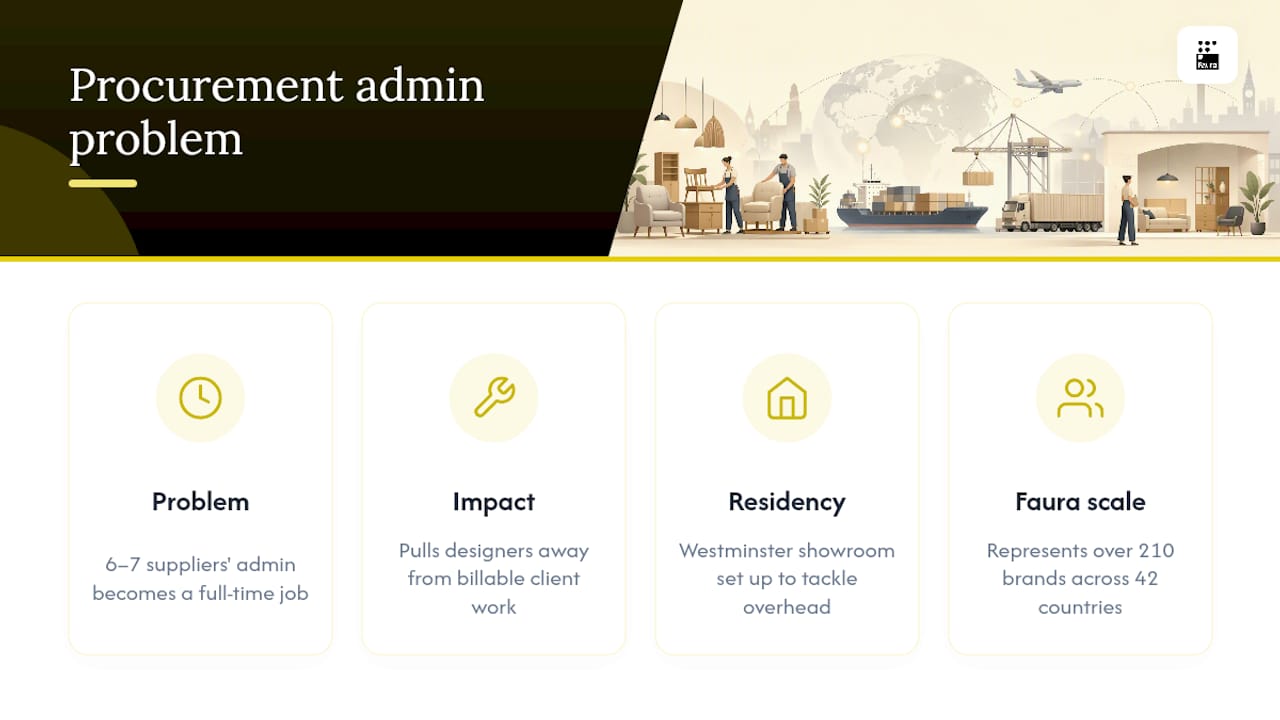
A residency and trade showroom in Westminster was created to address how sourcing and compliance overhead was eating into design time across the industry. Faura works with over 200 curated brands and its procurement team handles ordering, logistics and delivery for trade clients. When procurement relationships are established and ongoing, commodity codes, origin proofs, and test reports get collected as a matter of course, rather than chased after a shipment has already left the factory.
That operational layer is what separates a smooth import from a stalled one, and it’s exactly the gap Faura exists to close for independent designers.
— Faura Editorial
Get procurement support through Faura’s trade showroom
A trade showroom offers independent designers a faster route through procurement friction: trade terms, a curated product library spanning many brands, and one team handling ordering, logistics and delivery. Rather than negotiating import terms supplier by supplier, designers working through Faura’s trade programme can place orders through one team, with compliance documents confirmed for each project.
If you’re weighing up sourcing routes for an upcoming project, or want to see the showroom and curated brands in person, request a trade enquiry to find out how Faura’s residency model could sit alongside your next import.