Interior design fees UK: what to ask about trade access costs
By Faura ·

Interior design fees in this context mean what independent designers pay to access a London trade showroom and residency, not what designers charge private clients. These fees typically fall into three formats: a subscription or membership charge, a procurement commission on goods sourced through the showroom, and one‑off representation fees for brand exposure or events. Before signing anything, ask each provider one question first: what exactly is included in procurement terms and private client hosting? The answer determines whether the fee is genuinely good value or simply a workspace rental with a showroom attached.
Three things to check on any quote:
- Services included — is it access only, or does it bundle procurement, hosting, and back-office support?
- Procurement terms — is the commission a flat percentage, sliding scale, or fixed handling fee, and who places the order?
- Client hosting — can you book the showroom for private client meetings, and is that time metered or unlimited?
Key Takeaways
Interior design fees in the UK trade context cover residency membership, procurement commissions, and representation, and their value depends on how much operational time they genuinely save.
| Point | Details |
|---|---|
| Define the fee type first | Confirm whether a quote is a subscription, a procurement commission, or a one-off representation fee before comparing prices. |
| Check procurement terms in writing | Ask whether commissions are cost-plus or pass-through, and get the structure disclosed before signing. |
| Location drives cost | Central London addresses like Westminster carry a premium that reflects client credibility, not just rent. |
| Amortise the fee per project | Divide the annual membership cost across your expected project pipeline to get a real per-project figure for client proposals. |
| Faura reduces sourcing time | Faura’s Westminster residency offers procurement handled by one team, space to present schemes to clients, and over 200 brands. |
Table of Contents
- What showroom and residency fees cover
- Pricing models and what changes the cost
- What does a London membership actually cost?
- Budgeting, negotiating and reading the contract
- How Faura’s residency model supports sourcing
- What’s actually included in a typical fee breakdown
- Independent designers versus design firms: how fees differ
- Regional variations in interior design fees across the UK
- Fee structures by project type
- Assessing value for money in a fee quote
- Why the real cost isn’t the headline fee
- Faura’s membership for designers who want a London base
- Sources
What showroom and residency fees cover
A membership quote usually bundles four distinct services, and unpicking them is the fastest way to compare two offers properly.
- Access and workspace hours. Where a provider charges for access, check whether it means a set number of desk or studio hours or something else. Check whether showroom access means browsing the product library unaccompanied or booking staffed appointment slots.
- Private client hosting. Ask whether bringing a client to a showroom for a specification meeting is included or charged separately. Ask whether hosting includes refreshments, meeting room booking, or presentation support.
- Brand representation and events. Some fees cover showroom placement for a specific brand, or access to networking and specification events. Trade shows and specification events such as Decorex remain priority sourcing venues for UK designers, so representation fees that include event exposure carry genuine weight.
Pro Tip: Ask for a line-by-line breakdown before comparing prices. A £250 monthly fee that includes procurement handling can be far better value than a £150 fee that charges separately for every order placed.
Pricing models and what changes the cost
Where trade showrooms or residencies do charge designers, the fees tend to take one of three forms.
- Subscription or membership tiers. Monthly or annual fees that scale with what’s included. Entry tiers usually cover showroom access and basic procurement support; higher tiers add CPD-accredited training, business mentoring, and networking events alongside dedicated account management.
- Procurement commissions. Structured as a flat percentage of the order value, a sliding scale that reduces as volume grows, or a fixed handling fee per order regardless of size. The structure matters more than the headline number, since a sliding scale rewards designers who consolidate purchases through one showroom.
- One-off fees. Standalone brand representation, a specific event co-hosting arrangement, or a temporary showroom fit-out. These sit outside the membership and are negotiated per project.
Location is the single biggest cost driver. A Westminster or Clerkenwell address carries more weight with private clients than a fringe postcode, and that premium shows up in the fee. Some London showrooms now share floor space to split rent and service costs, which changes the economics of a central address without the full overhead of a solo lease. The other variables are curated brand density (how many recognised names are in the library), how much private hosting is included, and whether procurement is bespoke or self-service.
What does a London membership actually cost?
There is no standard published rate for showroom or residency access in London, and providers structure any charges very differently. The variation is wide enough that quoting a single figure would be misleading. What matters is matching the tier to your actual project volume, not the tier with the most features.
Amortising the fee across your expected project pipeline turns an abstract monthly cost into a real per-project number you can defend to a client.
Procurement commissions vary by showroom and by product category, but the principle is consistent: the commission should be disclosed as either cost-plus (added on top of the trade price) or pass-through (shown transparently to the client). Clear disclosure of procurement commissions when budgeting for client proposals avoids margin leakage further down the line.
A simple worked example: if an annual membership costs £3,600 and you run three projects that year, that’s £1,200 per project before any procurement activity. Add a commission on furniture and finishes sourced through the showroom, and the total cost of trade access becomes a specific line item you can present to a client rather than a vague overhead. Always check the contract for minimum order fees or mark-ups that sit outside the headline commission rate, since these erode the value of an otherwise competitive membership.
Budgeting, negotiating and reading the contract
Treat a showroom or residency contract the same way you’d treat a supplier agreement, because that’s effectively what it is.
- Ask about trade discount levels and lead times before comparing headline membership prices; a lower fee with slower fulfilment can cost more in project delays.
- Confirm who places orders — you, or the showroom’s procurement team — and what happens when a specification changes mid-order.
- Check the returns policy and cancellation terms in writing, not verbally, especially for bespoke or made-to-order pieces.
- Negotiate on volume and tenure. Multi-year commitments, referral introductions to the showroom’s network, or co-hosting an event can often unlock better commission rates than the standard tier pricing.
When presenting membership costs to a client, amortise the annual fee across your typical project count and state procurement pass-throughs as a transparent line item rather than folding them invisibly into supplier quotes. Read any confidentiality and conduct clauses as carefully as the pricing schedule.
Pro Tip: A vague phrase like “preferential trade rates” with no stated percentage is a red flag. If a showroom won’t commit a commission structure to writing, assume it’s negotiable in their favour, not yours.
How Faura’s residency model supports sourcing
Faura operates as a trade-only showroom and residency in Westminster for interior designers, architects, developers and contractors, rather than as a retail space. Its model brings together a curated product library, space to present schemes to clients, and procurement, logistics and delivery handled by one team.
- Trade-only showroom access in a central London location, designed for client-facing meetings rather than casual browsing.
- Private client hosting with dedicated appointment scheduling, so a specification meeting feels considered rather than improvised.
- A curated library representing a large curated selection of brands, reducing the need to chase multiple suppliers across the city.
- Procurement terms and operational support that designers who fully use a showroom’s back-office typically use to reclaim time otherwise spent on order chasing and delivery coordination.
Faura treats designers as clients in their own right, not as an afterthought to the brands on display, and that shapes everything from procurement terms to how hosting is scheduled.
For designers weighing up sourcing logistics, the guide to opening a trade account in London sets out how procurement access actually works in practice, while the showroom page covers appointment scheduling and hosting capacity in detail.
What’s actually included in a typical fee breakdown
Most interior design practice fees cover four categories of work: consultation, design development, project management, and installation. Consultation typically covers the initial brief, site visit, and scope agreement. Design development is where concept boards, material selection, and specification documents get built, often the most time-intensive stage.

Project management covers the coordination work: liaising with contractors, tracking delivery schedules, and managing the inevitable changes that come up mid-project. Installation is the final phase, covering delivery oversight, styling, and snagging. A residency or showroom fee doesn’t replace any of these stages, but it changes how much time and cost the procurement and logistics portion of project management consumes. When a showroom’s back-office handles order placement and lead-time tracking, that portion of the project management fee effectively shrinks, because the designer isn’t personally chasing every delivery.
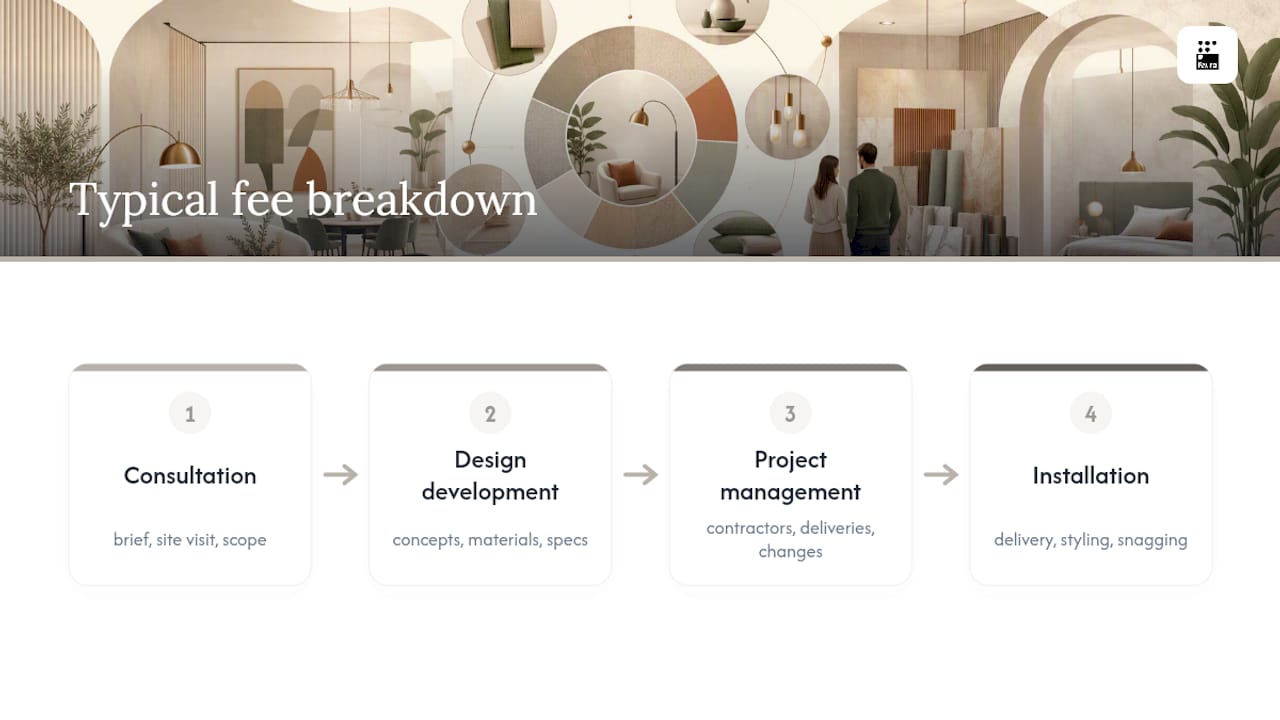
Understanding this breakdown matters when a designer is deciding whether membership fees are worth paying, because the value shows up specifically in the project management stage, not in design creativity or client consultation.
Independent designers versus design firms: how fees differ
Independent designers and larger design firms structure their costs differently, and that difference extends directly to how they use trade showrooms and residencies. A sole practitioner typically has no in-house procurement team, no dedicated buyer, and limited buying power with individual suppliers. A residency membership fills that gap directly, giving one person the trade pricing and operational support that a firm would otherwise build internally.
Larger firms often negotiate supplier relationships directly, at volumes that justify better commission rates without a showroom intermediary. Their overhead is spread across more projects and more staff, so a monthly membership fee that makes sense for a sole practitioner might be redundant for a ten-person studio with its own procurement function.
This is why independent designers and small studios are the natural audience for a residency model. The fee replaces functions a firm would staff internally: procurement, client hosting infrastructure, and a credible London address. For a firm with an established office and buying team, the value proposition shifts toward brand representation and event access rather than basic procurement support.
Regional variations in interior design fees across the UK
Fees for trade showroom access and residency membership vary by region, reflecting commercial property costs and client density, with Central London areas generally demanding higher fees, reflecting both premium rents and the concentration of high-net-worth private clients who expect a London-based hosting venue.
Trade showroom options in regional cities such as Manchester, Bristol and Edinburgh differ in brand range and in whether they can host client meetings. Designers working across regions sometimes maintain a London residency specifically for client hosting and brand credibility, while sourcing day-to-day materials through regional or online trade accounts.
The practical implication for budgeting is straightforward: a London address costs more, but it also does more work commercially, particularly for designers whose private clients expect a central London meeting point. Shared showroom arrangements, increasingly common in areas like Clerkenwell, give designers a way to access that London credibility without paying full solo overhead, which is worth exploring for anyone priced out of a standalone lease.
Fee structures by project type
How a residency or showroom fee affects your bottom line depends heavily on the type of project it’s supporting. Residential projects, particularly full-home renovations, tend to generate the highest procurement volume per client, meaning commission-based fees scale naturally with project size. A designer running several residential projects a year will feel the value of a membership fee more directly than one running a single small job.
Commercial projects, such as hospitality or retail fit-outs, often involve larger order values but tighter timelines, making the operational back-office support of a showroom membership particularly valuable for keeping delivery schedules on track. New-build projects tend to require broader procurement across every category, from lighting to finishes, which suits designers with access to a wide curated library rather than a narrow specialist showroom.
Renovation projects sit in between, often needing fast turnarounds on a smaller number of specific items rather than a full furnishing package. For any project type, the core question is the same: does the fee structure reward the volume and pace of the work you actually do, or does it charge a flat rate regardless of how much you use it?
Assessing value for money in a fee quote
Value for money in this context isn’t about finding the cheapest membership. It’s about matching the fee structure to how much you’ll genuinely use.
A designer running one or two projects a year should weigh whether a monthly subscription outweighs the benefit, or whether a pay-as-you-go procurement arrangement makes more sense. A designer running a steady pipeline of residential or commercial work will usually find that the time saved on procurement and logistics justifies a higher membership tier, because that time converts directly into billable hours elsewhere.
The clearest test is to ask what the fee replaces. If it replaces staff time you’d otherwise spend chasing suppliers, coordinating deliveries, and negotiating trade pricing, the fee has a measurable return. If it simply grants access to a showroom you rarely visit, it’s an overhead with no offsetting benefit. Reading the contract for transparency, on commissions, on hosting limits, on cancellation terms, remains the single best indicator of whether a provider is offering genuine value or simply charging for proximity to a good address.
Why the real cost isn’t the headline fee
The conventional advice on this topic focuses almost entirely on the membership price, and that’s the wrong starting point. The number that actually determines value is the time a designer gets back from not managing procurement, chasing lead times, and coordinating deliveries manually. A £400 monthly fee that eliminates a week of admin per project is worth more than a £150 fee that leaves all the logistics work in the designer’s hands.
Most guidance aimed at independent designers treats showroom access as the headline benefit, when in practice it’s the operational support underneath that changes margins. A London address is useful for client credibility, but it doesn’t save time on its own. Procurement handling does.
If there’s one priority for a designer reading a quote for the first time, it’s this: ask what happens after you place an order, not before. Who chases the supplier, who manages a delayed delivery, who handles a returns dispute. That answer tells you more about the real value of a fee than any headline percentage or monthly rate ever will.
— Faura Editorial
Faura’s membership for designers who want a London base
Faura works specifically for independent designers who need a credible London base without building procurement infrastructure from scratch. Instead of choosing between a solo lease, a shared studio with no client-facing space, or a full retail showroom aimed at consumers, Faura sits in the gap that suits a trade-only practice: space to present schemes to clients, over 200 brands, and trade terms confirmed directly with each approved account.
For a designer weighing up whether membership pays for itself, the practical answer is in the logistics it removes. For orders placed through Faura, procurement, logistics and delivery are handled by one team, which can reduce the time a designer spends chasing suppliers.
Start by applying for a trade account to see which level matches your current project volume, or get in touch through the main site to book a showroom visit before committing.