Pick an Interior Design Residency That Solves Client Facing Needs
By Faura ·
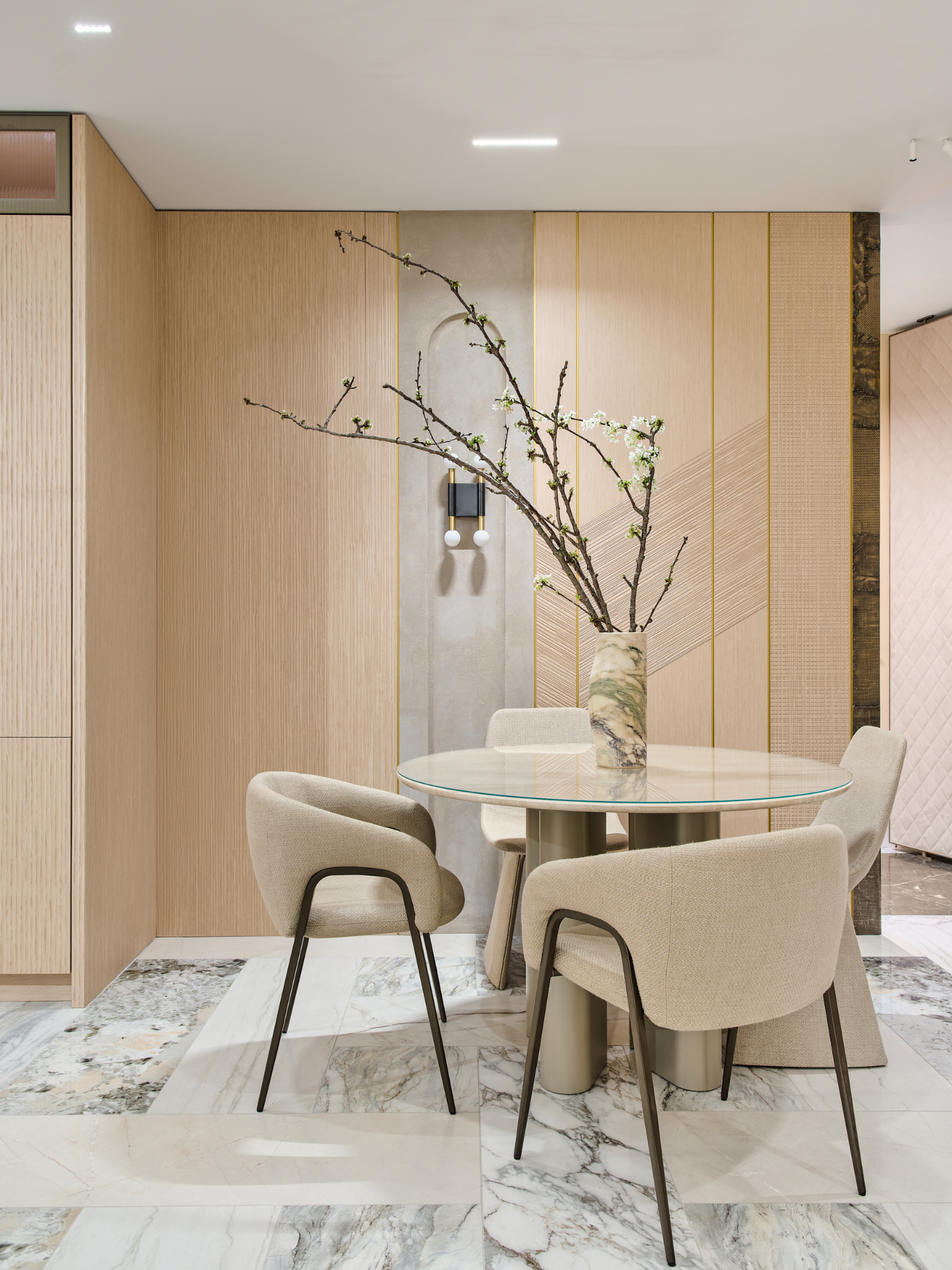
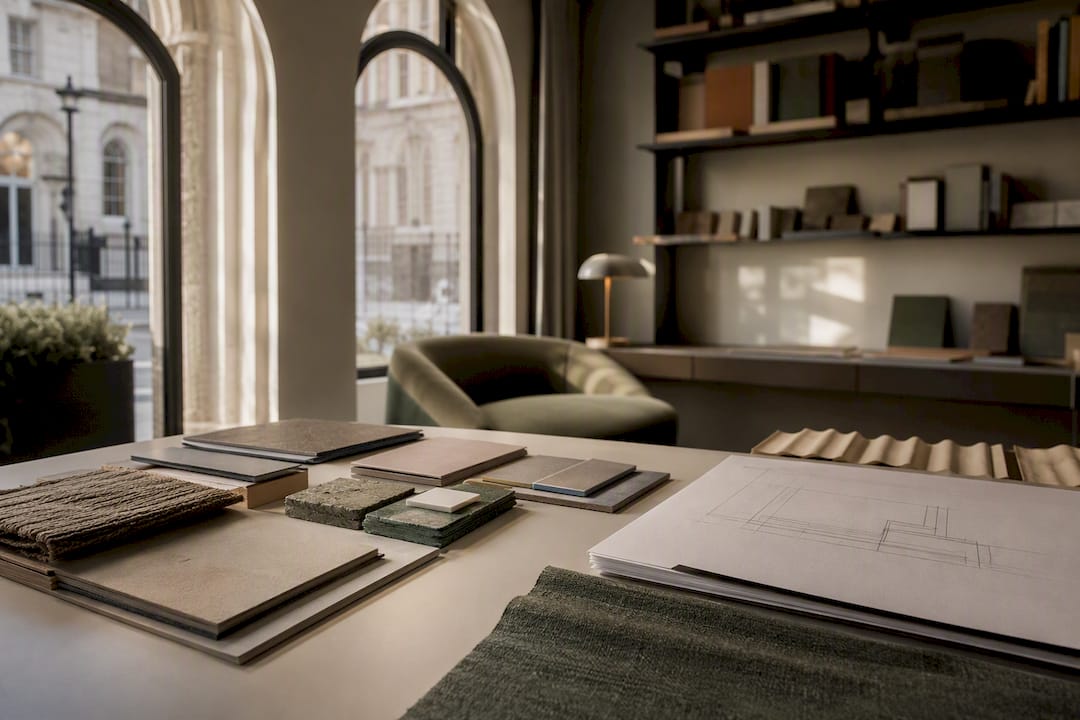
An interior design residency gives a designer dedicated time, space and resources to research, develop or prototype a design-led project, usually outside the pressure of billable client work. Most suit early to mid-career designers, small studios and craft specialists who need focused time or access to specialist equipment they cannot justify buying outright. This guide covers the main formats, what to expect from funding and facilities, how selection panels actually work, and where a trade showroom residency offers a more practical route for client-facing practice.
TL;DR:
- Most residencies offer stipends or budgets that are best evaluated by daily rate, as shorter, well-paid placements can outperform longer, lower-paid ones.
- Choosing a residency should be based on project-specific needs such as technical facilities, funding, or client-facing support, rather than reputation alone.
- Public engagement duties are a significant part of many residencies, so applicants must consider their comfort with open studios, workshops, or dissemination tasks.
- Clear boundaries, transparent contracts, and understanding ownership of work are essential; watch for clauses that assign IP rights or restrict other work during the residency.
- For client-facing, product-driven practice, trade showrooms offering sourcing and procurement support may be more practical than traditional research or public dissemination-focused residencies.
Table of Contents
- What types of interior design residency exist?
- What do residencies actually provide?
- Who is an interior design residency actually for?
- How do you choose the right residency for your practice?
- What does the application process involve, and when should you start?
- What are the day-to-day expectations once you start?
- When does a trade showroom residency work better than an institutional one?
- What challenges come up during a residency, and how do you manage them?
- How do you turn a residency into real career momentum?
- What happens after a residency ends?
- How does a residency differ from an internship or fellowship?
- The overlooked truth about residencies
- How Faura supports designers building client-facing practice
- Where to check current deadlines and application forms
- Sources
What types of interior design residency exist?
Not every residency looks the same, and matching the format to your project matters more than chasing prestige. Four models dominate the field.
Institutional or museum placements sit at the research-facing end. The Design Museum’s Design Researchers in Residence programme funds four researchers at a time, culminating in a public display, while The Shed at Young V&A runs a six-month design placement built around public engagement as much as making. These suit designers whose work has a research or educational angle.
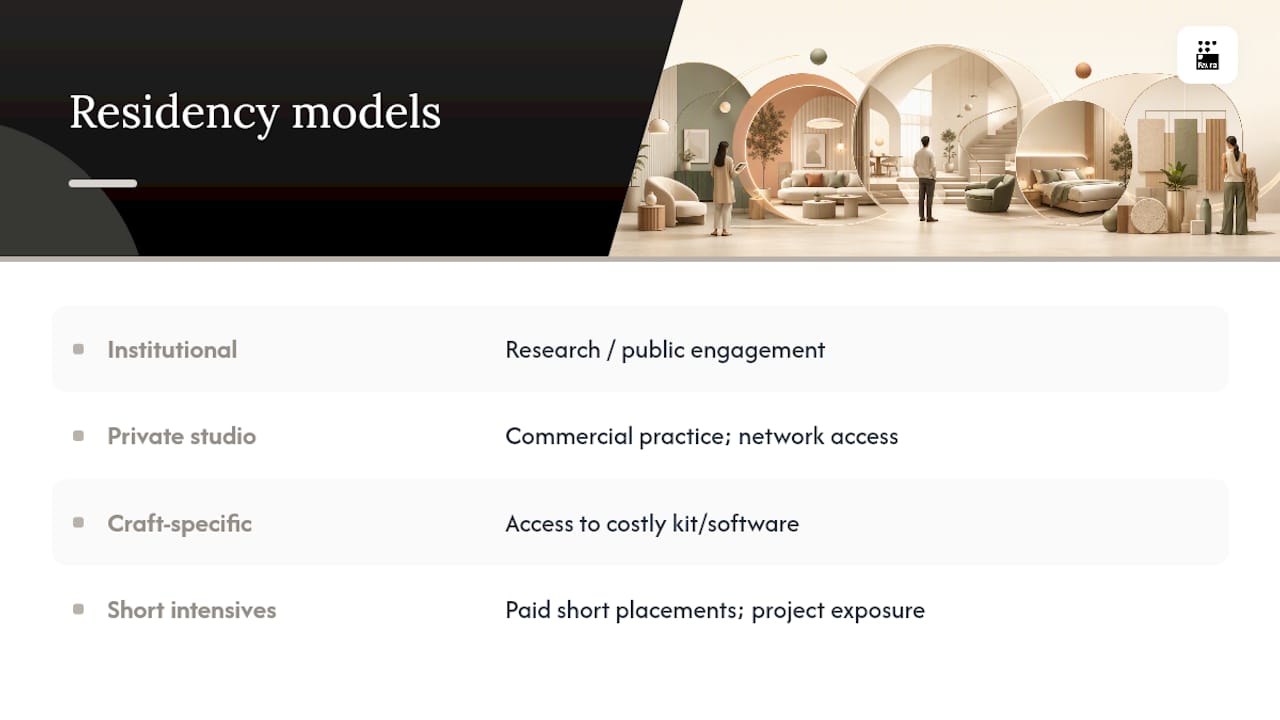
Private studio and trade-membership residencies operate closer to commercial practice. They give access to a working base, sometimes client-facing space, and often a curated network rather than a public brief.
Craft- and technique-specific residencies solve a narrower problem: expensive equipment or software you would never buy for one project. The London Embroidery Studio’s residency programmes include Wilcom software licences and machine access, a genuine saving given commercial licence costs.
Short intensives and paid placements offer a lower-commitment entry point. Some, like the paid internship model at The Further Residency, pay London Living Wage across a three-month placement, giving early-career designers real project exposure without the public-dissemination load of a museum residency.
Residential and rural options such as Cove Park add a fifth flavour: distance from your usual studio, which some practices need more than any piece of kit.

What do residencies actually provide?
Funding, facilities and expected outputs vary enormously between programmes, and this is where most applicants under-research before applying.
Studio access tends to follow one of two patterns: fixed opening hours shared with other residents, or a set weekly allowance (two days, three days, full-time). Equipment lists are worth scrutinising line by line rather than skimming, since “specialist facilities” can mean anything from a single embroidery machine to a full workshop.
Funding models generally cover:
- A stipend paid directly to the resident, sometimes with a separate production or commissioning budget
- Bursaries structured as one lump sum rather than staged payments
- Material or production support capped at a fixed amount
- Free or discounted access to deadstock materials and sample libraries
The Design Museum’s 2026/27 residency offers a commissioning budget alongside a bursary for each of its researchers.
Compare that with The Shed’s placement, which pairs a stipend with a separate production budget across a two-day-per-week, six-month term. Neither figure tells you much alone. What matters is stipend per day of commitment, since a shorter, better-paid placement can outperform a longer one on paper.
Outputs typically fall into four categories: open studios, learning resources for the host institution, a public exhibition or display, and physical prototypes. Read the brief for which of these is mandatory versus optional before you commit weeks of unpaid preparation to a proposal.
Who is an interior design residency actually for?
Residencies suit designers who need protected time or access rather than more billable hours. Early-career practitioners use them to build a body of research-led work; mid-career designers use them to test a new material or technique without client risk; studios and collectives use them to prototype something too speculative for a paying brief.
Eligibility criteria tend to repeat across programmes:
- A written statement of practice, usually a defined word count
- An up-to-date CV and portfolio, often capped by image number
- Studio images showing your current working environment
- A short proposal describing what you would do with the time
Practical constraints catch people out more than eligibility does. Museum residencies frequently require a Disclosure and Barring Service check where the role involves school workshops or under-18 visitors. Public engagement is rarely optional. If open studios, social documentation or workshop delivery sound like a distraction rather than a benefit, an institutional placement is the wrong fit.
A residency also isn’t right if you need uninterrupted billable time, or if your current projects involve client confidentiality that a public-facing brief would compromise. Private client work under NDA sits awkwardly inside a residency built around dissemination, so check the sharing obligations before you sign anything.
How do you choose the right residency for your practice?
Most designers pick a residency on reputation alone, then discover halfway through that the facilities or the funding structure did not match their project. A weighted checklist fixes that before you apply, not after.
Score each option out of five on six criteria, then weight the criteria by what your project actually needs:
- Funding adequacy — does the stipend or bursary cover your living costs for the commitment period, not just look impressive as a headline figure?
- Facilities and equipment — does the studio give you tools, software licences or machine access you could not otherwise afford, as with Wilcom licensing at craft-focused embroidery residencies?
- Mentoring and technical support — is there a named contact, or are you left to your own devices once the door closes?
- Output visibility — does the residency end in a public display, publication or exhibition that genuinely builds your profile, or is “dissemination” vague marketing language?
- IP and contract terms — who owns the work you produce, and does the contract assign rights to the host institution?
- Timeline fit — does the commitment (two days a week, full-time, six months) work against your existing client obligations?
Weight funding and IP terms highest if you’re taking unpaid leave from paid work to attend. Weight facilities and mentoring highest if the residency is a technical stepping stone rather than an income replacement.
Red flags worth walking away from:
- Contracts that assign full IP to the host with no licence-back to you
- Exclusivity clauses preventing you from taking on other work during the term
- Vague references to “opportunities for exposure” with no stipend attached
- Public engagement duties added after acceptance, not disclosed in the open call
Before signing, ask organisers directly: what are the studio access hours, is machine time shared or exclusive, does their insurance cover your work and materials, and what dissemination obligations are contractually binding versus optional.
Pro Tip: Weight a technical residency’s equipment access against the commercial licence cost you’d otherwise pay. A six-month Wilcom licence included free in a craft residency can be worth more than a modest stipend once you price the software separately.
For a speculative research project, prioritise output visibility and mentoring. For a technique you need to master fast, prioritise facilities. For anything touching live client work, prioritise IP terms above everything else.
What does the application process involve, and when should you start?
Most interior design residencies follow the same three-stage pattern: register interest, submit a proposal and portfolio, then interview if shortlisted. Building your materials against this structure from the outset saves weeks of rewriting.
Documents to prepare in advance:
- A statement of practice, typically 300 to 500 words
- A project proposal, usually 500 to 800 words, describing what you would make or research
- A portfolio within the stated image limit, plus images of your current studio
- A basic budget outline showing how you would use any production or commissioning funds
Selection panels weigh feasibility above ambition. A proposal that can realistically be delivered within the stated time and budget beats a more exciting idea with no clear plan for execution. Fit to the specific brief matters more than general talent; a technically brilliant proposal aimed at the wrong institution rarely progresses past the first stage.
Public engagement capability is assessed too, particularly for museum placements. If the brief mentions school workshops or open studios, panels want evidence you can communicate your process to a non-specialist audience, not just produce strong design work in isolation.
Tailor tone and content to the host. A museum proposal should foreground research questions and public relevance. A craft studio proposal should foreground technical ambition and material experimentation. A trade or showroom residency proposal should foreground commercial feasibility and client outcomes, since that audience is judging deliverability, not just concept.
What are the day-to-day expectations once you start?
Weekly commitment ranges widely: The Shed’s placement asks for two days a week across six months, while some studio placements run full-time for shorter periods. Confirm exact studio opening hours before accepting, since shared spaces often restrict access outside core hours.
Expect a mix of these commitments:
- Open studio sessions where the public can view work in progress
- School workshops or educational sessions, particularly under museum residency terms
- Regular social media documentation of your process
- Contribution to the host’s own learning resources or publications
The underlying workflow, research, then making, then dissemination, shapes what you can realistically produce. A six-month term sounds generous until public engagement duties eat into studio time. Check whether insurance, travel and any accommodation costs are covered by the host or fall to you; this detail is often buried in the small print rather than the headline stipend figure.
When does a trade showroom residency work better than an institutional one?
Institutional residencies serve research and public dissemination well, but they solve a different problem to the one most working designers face day to day: where do you host a client, source product quickly, and keep a live project moving without a museum’s exhibition schedule attached to it.
Faura operates as a trade showroom and residency-style base in Westminster, built around three things a working designer actually needs: private client hosting, a curated product library spanning over 200 brands, and procurement support handled by one team.
Choose a showroom residency over an institutional one when:
- Your project is client-facing rather than research-facing
- You need procurement and sourcing support, not a public exhibition brief
- Product-led prototyping matters more than museum-style dissemination
- You want operational support (deliveries, scheduling, specification) rather than a stipend tied to public engagement duties
Designers use the trade showroom for exactly this: presenting to a private client in a dressed, professional space, then sourcing directly from the curated brand library without weeks of separate supplier calls. Where the model differs from an institutional residency is straightforward: it treats designers as trade clients, not as fellows delivering a public brief.
What challenges come up during a residency, and how do you manage them?
Time fragmentation is the most common complaint among residents. Two days a week sounds manageable until public engagement duties, unplanned admin and travel eat into the studio hours you budgeted for actual making. Build in a generous buffer beyond your planned working hours before you calculate what’s realistically achievable.
Funding gaps are the second recurring problem. A stipend calculated against a full working week doesn’t stretch the same way when public engagement adds unpaid preparation time on top. Read the contract for whether workshop preparation, travel to schools or social media documentation counts within your paid hours or sits outside them.
Isolation affects designers used to studio collaboration more than expected, particularly in rural or single-resident placements like those at Cove Park. Community-engaged residencies address this deliberately, but solo research placements can leave practitioners without peer feedback for months.
Scope creep is the quiet one. A proposal written for a defined outcome can balloon once a host institution asks for additional workshops, extra open studios or unplanned dissemination. Agree the boundaries of your public-facing commitments in writing before you start, not once you’re three weeks into the term and the schedule has already filled up.
Finally, confidentiality clashes with any client work you’re still running alongside the residency. If a live project involves an NDA, flag this to organisers early. Most hosts can accommodate discretion around specific client details, but only if you raise it before the open studio schedule is published, not after.
How do you turn a residency into real career momentum?
A residency only advances your career if you treat the output as a marketing asset, not just a personal development exercise. The public display, exhibition or prototype a residency produces is content: photograph it properly, write up the process, and use it in future proposals to clients and other residency panels alike.
Networks matter more than most designers expect going in. Fellow residents, technical staff and host curators become a professional network that outlasts the placement itself. Follow up with genuine contacts within weeks of finishing, not months, while the connection is still warm.
Use the credibility deliberately. A completed Design Museum or museum-affiliated residency carries weight with clients who value research-led practice, and it’s worth naming explicitly in pitches rather than burying it in a CV line.
Translate the technical skills gained, particularly from craft or software-specific residencies, into a service offer. A designer who spent six months mastering an embroidery technique with a licensed tool like Wilcom has a genuinely differentiated capability to sell, not just an interesting anecdote.
Finally, treat the residency as evidence for the next one. Panels favour applicants who can show they delivered on a previous brief within budget and on time. Document your process well enough that it doubles as proof of feasibility for your next application.
What happens after a residency ends?
Most alumni networks are informal rather than structured, built through group chats, shared exhibitions or occasional reunion events rather than formal membership schemes. Stay visible within the host institution’s own channels; being tagged in their social media documentation or listed in an alumni page (where one exists) extends the residency’s marketing value well beyond the term itself.
Some hosts offer follow-on opportunities: a second commission, an invitation to contribute to future exhibitions, or informal introductions to collectors and clients who visited the open studio. These rarely appear in the open call, so ask directly during your term whether any post-residency pathway exists.
Peer relationships formed during a residency often outlast the institution’s own involvement. Designers frequently collaborate on future projects with people they met through a shared studio, particularly at community-engaged programmes like Cove Park, where the format is explicitly built around ongoing practice development rather than a one-off output.
Treat the end of a residency as the start of active follow-up, not a natural full stop. Send a short update to your host contact three or six months later showing what came from the work. Institutions remember designers who demonstrate impact after the funding stops, and that memory is often what leads to a second invitation.
How does a residency differ from an internship or fellowship?
The terms get used loosely, and that causes real confusion when comparing opportunities. A residency centres on an independent, self-directed project with the designer setting the research question. An internship, by contrast, generally places the designer within an existing team structure working on the organisation’s own briefs.
The paid internship model at The Further Residency, despite its name, sits closer to an internship in practice: residents work on real client projects under mentorship, paid at London Living Wage, rather than developing an independent research brief.
A fellowship usually implies a longer-term, often prestige-oriented award tied to a body of research or a specific institution, sometimes without the studio-access component that defines a design residency. Fellowships also tend to carry fewer public-facing obligations than museum residencies, since the output is often written or academic rather than exhibited.
The practical distinction that matters most when choosing between them: residencies trade time and space for a self-directed outcome; internships trade labour for mentorship and a wage; fellowships trade research output for prestige and, sometimes, funding. Read the contract’s language on ownership and direction of the work, not just its title, since institutions apply these labels inconsistently.
The overlooked truth about residencies
The conventional advice treats residencies as uniformly good for a career, a badge worth chasing regardless of fit. That advice is incomplete. A residency is a resource-allocation decision, not a prestige purchase, and the biggest mistake designers make is applying to whatever sounds most impressive rather than whatever solves their actual constraint, whether that’s cash, equipment, or client-facing space.
The research also suggests something the open calls rarely admit outright: public engagement duties are not a footnote, they’re often half the job. Designers who resent open studios and school workshops after accepting a museum placement usually skipped reading that section of the brief closely enough.
What should come first is brutally simple: name the constraint before you search for a residency to solve it. If the constraint is a lack of client-facing space and sourcing support rather than research time, an institutional residency is the wrong tool entirely, and a working showroom base solves the actual problem faster.
— Faura Editorial
How Faura supports designers building client-facing practice
Faura works best for independent interior designers who need somewhere to host clients properly, source product without weeks of supplier chasing, and keep projects moving without an exhibition schedule attached to the process. The trade showroom in Westminster combines private client hosting, a curated product library drawn from over 200 brands, and procurement support, with trade terms confirmed directly with each approved account.
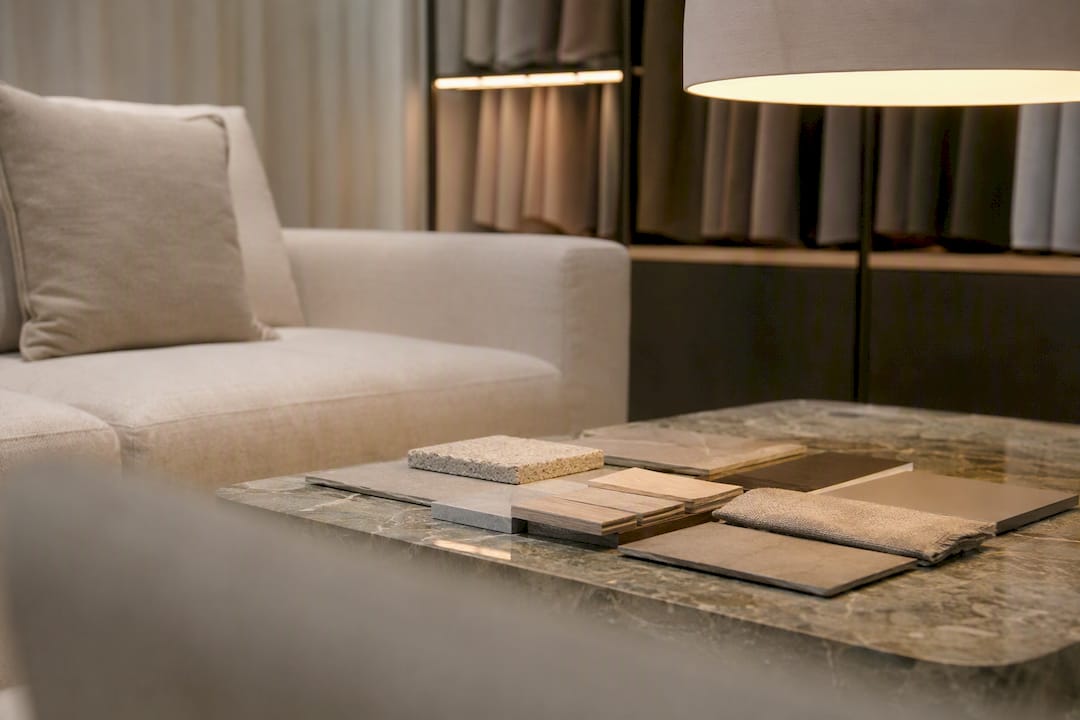
If your practice depends on client presentations and product-led delivery more than research dissemination, this is the more useful base. Designers can use it to move from concept to specification with samples, technical files and procurement support in one place.
Start by opening a trade account to see how the showroom and procurement support fit your next client project.
Where to check current deadlines and application forms
For exact dates and bursary figures, go directly to the source. The Design Placement Open Call 2026 PDF sets out The Shed’s stipend and stages. The Design Museum’s 2026/27 open call confirms bursary terms. West Dean College and Cove Park list studio specifications directly.
Sources
- Design Placement Open Call 2026 (The Shed, Young V&A)
- Design Researchers in Residence 2026/27: Open Call - Design Museum
- Embroidery Residency London - The London Embroidery Studio
- Residences | West Dean College
- Residencies overview - Cove Park