Save Weeks: 6 Step Product Sourcing Workflow for Designers
By Faura ·

Save Weeks: 6 Step Product Sourcing Workflow for Designers
Product sourcing for designers means finding, vetting, and procuring the furniture, finishes, and materials a project specification calls for, on time and within budget. The immediate next step is always the same: lock the brief and budget first, then pick two sourcing channels, one trade platform and one showroom, before opening a single supplier catalogue. Everything else follows from that.
TL;DR:
- Most sourcing workflows should begin with defining measurable priorities such as performance, durability, and maintenance before narrowing down potential products.
- Relying solely on online listings or manufacturer sites is risky because color and texture often appear differently in real life, making showroom visits essential for validation.
- Technical and sustainability certifications must be requested upfront and verified through independent certificates, not just marketing claims, to ensure compliance.
- Ordering samples promptly from shortlisted suppliers and photographing client approvals help prevent costly color or finish mismatches later.
- Building verified supplier relationships and tracking lead times improve procurement efficiency and reduce risks of delays or specifications failure.
Table of Contents
- What is the full sourcing workflow for designers?
- Turning client brief and budget into a workable product specification
- Where should designers actually source products?
- Evaluating and specifying products: what to check before you commit
- Samples, testing and final validation: how to be sure before you commit
- Building vendor relationships and a procurement workflow that scales
- How a trade showroom model speeds sourcing
- A designer’s micro-workflow that actually saves time
- Ready to source through Faura’s trade showroom?
- Sources
What is the full sourcing workflow for designers?
Sourcing runs in a fixed sequence, and skipping a stage is usually what causes the budget overrun or the late delivery. RoomSketcher’s sourcing guide frames the same logic: define style and budget, research channels, assess materials, then sample before finalising.
- Inspiration. Gather mood boards and precedent images; this resolves the aesthetic direction, not the spec.
- Brief. Translate client conversations into written priorities and constraints; deliverable is a one-page design brief.
- Filter. Narrow candidates by budget, lead time, and technical requirement; deliverable is a shortlist of three to five products per item.
- Specify. Write the formal spec, including finish codes and dimensions; deliverable is the spec sheet.
- Validate. Order physical samples and run technical or sustainability checks; deliverable is a signed-off sample board.
- Order. Raise the purchase order and confirm delivery windows; deliverable is a tracked order log.
Technical checks (fire, acoustic, slip resistance) and sustainability checks belong at the validation stage, never earlier, because specifying against a product that later fails a certificate check wastes the filtering work already done.
Turning client brief and budget into a workable product specification
A brief only becomes useful once it is broken into measurable priorities: how the product performs (function), how long it needs to last (durability), and what upkeep it demands (maintenance). A client who says “hardwearing but low-maintenance” for a rental property is really specifying abrasion resistance and a wipeable finish, not a mood.
Budgeting works two ways. Unit budgeting sets a ceiling per item, useful when a client fixates on one hero piece. Category budgeting sets a pool across furniture, lighting, and soft furnishings, giving more flexibility to trade off between them.
- Extract three measurable priorities from every brief line before sourcing starts.
- Choose unit or category budgeting deliberately, not by default.
- Convert each priority into a filter: material, rating, colour tolerance, lead time.
- Set the contingency figure before shortlisting, not after.
Pro Tip: Write your filters as if you were handing them to someone else to search. If a filter is too vague for a stranger to use, it is too vague for a supplier’s search tool too.
Where should designers actually source products?
No single channel covers everything, so most working designers run two or three in parallel rather than relying on one.
Trade platforms and directories centralise specification data, trade pricing, and vetted suppliers in one search. Supplier Finder lists over 200 accredited commercial furnishing suppliers with filters by product type and sector, which cuts the vetting work down before a single email is sent. The trade-account route is well documented in supplier-side resources such as this designer trade programme guide, which explains what trade pricing typically requires in return.
Showrooms exist for multisensory validation and curated brand access. A textile’s drape or a paint’s undertone under real light rarely translates through a product photo, which is why representative appointments matter for hero pieces.
- Trade platforms: fastest for volume sourcing and price comparison.
- Showrooms: best for finishes, upholstery, and anything a client will touch daily.
- Manufacturer and online sites: fastest for breadth, but colour and texture rendering on screen is unreliable, so treat listings as a shortlist tool, not a final decision.
- Secondhand and salvage: strong for character pieces and sustainability targets, but factor in longer lead times for refurbishment and always request condition photos and structural checks before committing.
Evaluating and specifying products: what to check before you commit
A specification is only as strong as the paperwork behind it. Before finalising, request the technical documents that prove a product performs as claimed rather than relying on a supplier’s own marketing description.
Essential technical checks include fire ratings, acoustic performance (measured as NRC for absorptive materials), slip resistance for flooring, and UKCA or CE marking references where the product falls under UK product safety rules. For anything safety-critical, cross-check against the relevant statutory text on Legislation rather than taking a supplier’s word for compliance.
Sustainability credentials worth requesting include an Environmental Product Declaration (EPD), recycled content percentage, and low-VOC declarations, particularly for adhesives, paints, and upholstery foams.
- Safety Data Sheet (SDS) for any wet-applied or chemical-treated product.
- Independent test certificates for fire and acoustic ratings, not just a datasheet claim.
- BIM files where available, to keep the digital model aligned with what gets installed.
- A short sign-off checklist covering rating, certificate, lead time, and sustainability declaration, ticked before the PO is raised.
Accredited supplier listings exist precisely because verifying every certificate from scratch on every project is unrealistic for a small studio, and platforms that pre-vet suppliers meaningfully reduce that burden, a point Design Insider’s Supplier Finder editorial team makes directly.
Samples, testing and final validation: how to be sure before you commit
Order samples the moment a shortlist narrows to two or three candidates, never after the spec is written, because waiting means discovering a colour mismatch too late to change course cheaply.
- Request samples in parallel from all shortlisted suppliers, not sequentially.
- Use consolidated logistics where available. Material Bank offers overnight delivery of consolidated sample boxes across hundreds of brands, which compresses what used to take weeks of individual requests into a single delivery.
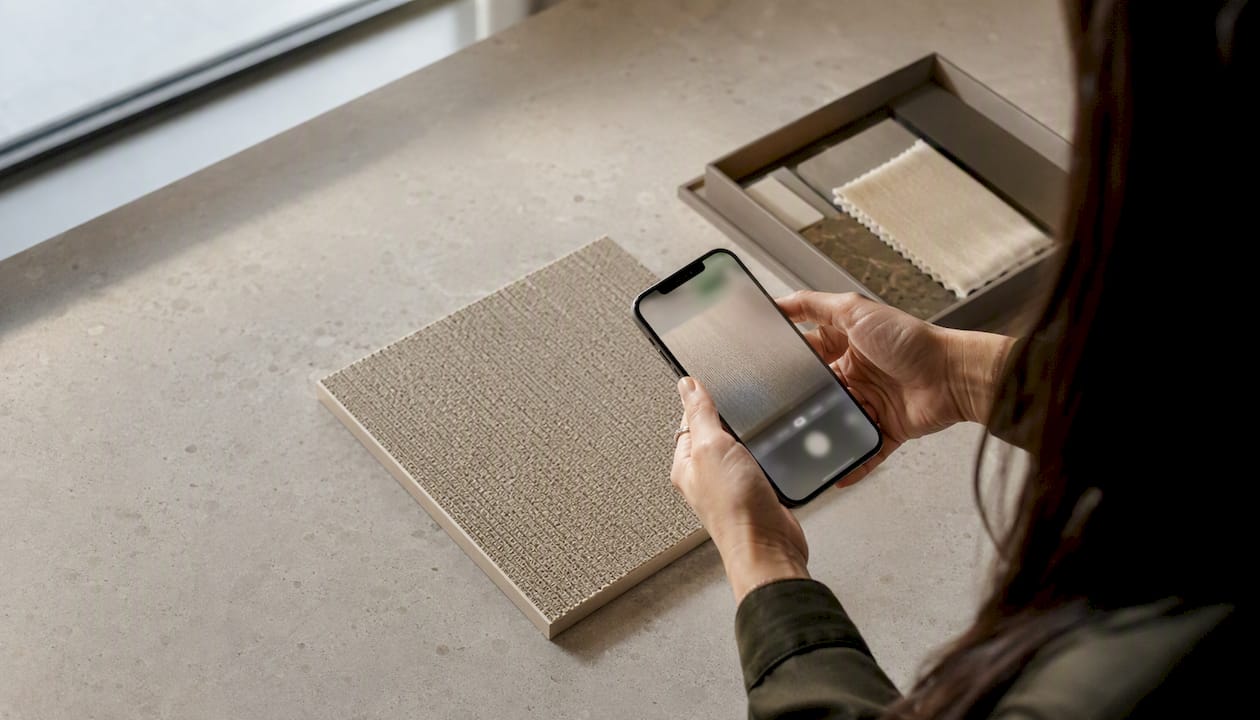
- Run three physical checks on every finish or upholstery sample: texture, weight or handle, and how it reads under the room’s actual light, not the studio’s.
- Photograph the client’s sign-off against the sample board and file it with the project record.
Digital catalogues have improved, but they still can’t replicate handle or light interaction, which is why in-person validation at showrooms still catches the details a screen genuinely can’t.
Pro Tip: Keep a dated photo of every sample sign-off. If a client later disputes a finish, the sign-off record settles it in minutes instead of a drawn-out email chain.
Building vendor relationships and a procurement workflow that scales
Vetting a new supplier once properly means it never needs re-vetting on the next project. Check accreditation, ask for two references from other designers, confirm actual lead time reliability rather than quoted lead time, and get their sample policy in writing before the first order.
A repeatable procurement sequence removes most of the friction: RFQ to compare pricing and lead time, PO once terms are confirmed, delivery tracking against the promised date, then installation sign-off. Product-cataloguing tools such as Mydoma Studio replace the scattered spreadsheet with a single trackable order log, which matters more as project volume grows.
- Confirm accreditation and request two verifiable references before opening an account.
- Log lead time performance per supplier after each order, not just at onboarding.
- Clarify sample policy (cost, return, replacement) in writing.
- Track every order from RFQ through installation in one system, not several.
One detail catches out new practices: whether you’re acting as agent or principal changes who carries liability if a product fails. BIID’s guidance on sourcing and supplying sets out that distinction clearly, and it belongs in every procurement contract, not just the large ones.
How a trade showroom model speeds sourcing
A curated trade showroom collapses several sourcing stages into one visit: discovery, technical comparison, and procurement support happen in the same appointment instead of across a dozen separate supplier calls. Faura works this way, operating as a residency and trade showroom in Westminster with a curated library spanning over two hundred brands, built specifically around independent designers rather than retail browsers.
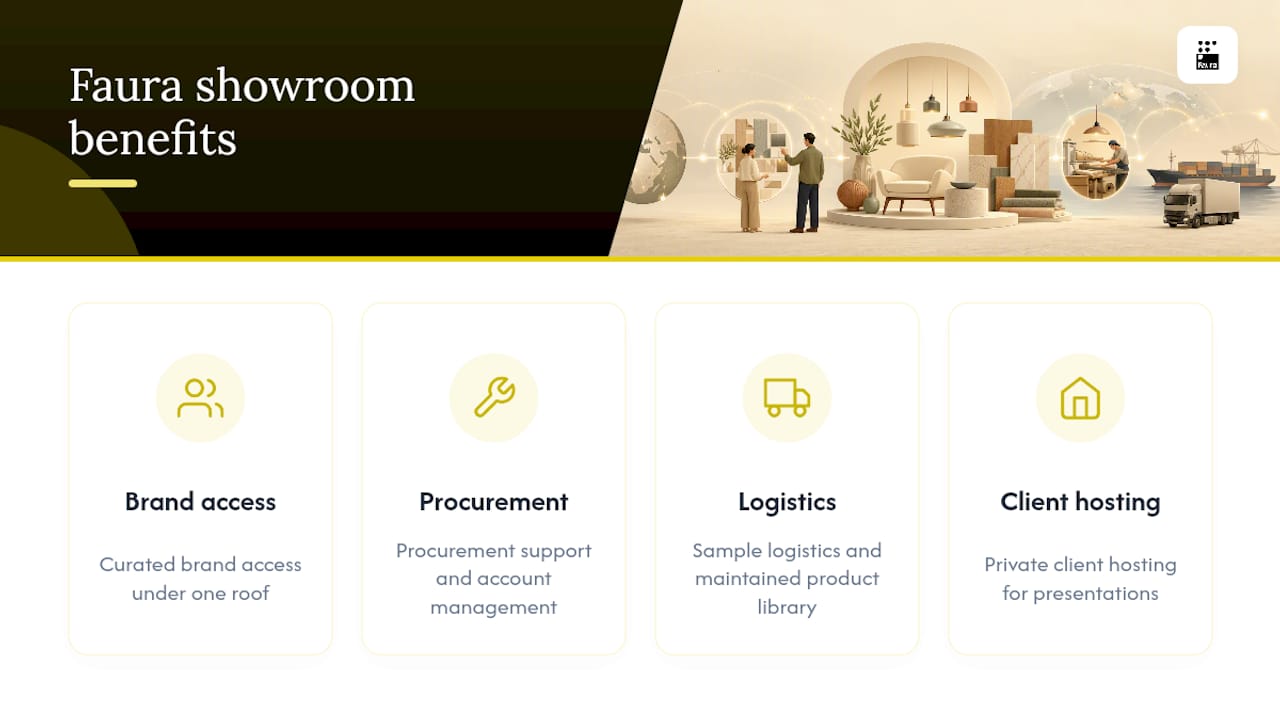
- Curated brand access removes the need to vet dozens of suppliers individually.
- Exclusive procurement terms give trade pricing without a separate negotiation per brand.
- Sample logistics and account management are handled centrally rather than chased supplier by supplier.
- Private client hosting means the same space can carry a project from sourcing through client presentation.
A showroom model like this suits designers running multiple concurrent projects who need speed; sourcing direct from individual manufacturers still makes sense for a single bespoke item outside a curated range. Full details on trade access are available on Faura’s trade page.
A designer’s micro-workflow that actually saves time
Three habits do most of the work: filter every brief line into a spec before browsing anything, batch sample requests weekly rather than as each idea strikes, and log every supplier lead time after delivery, not at quote stage. The recurring mistake is trusting a quoted lead time over a tracked one. Fix it by comparing your own delivery log against next quote, every time.
— Eugene
Ready to source through Faura’s trade showroom?
A trade showroom gives designers a working London base that replaces the scattered process this article has just walked through: curated brand access, procurement support, sample logistics, and account management under one roof, alongside private client hosting so the same space carries a project from sourcing to presentation. Instead of chasing accreditation, pricing, and lead times across dozens of individual suppliers, the showroom model consolidates that work into scheduled appointments and a maintained product library.
Designers ready to open a trade account or book a showroom appointment can start directly through Faura’s trade page, where enquiry and membership details are set out for independent designers and architects.
Sources
- Supplier Finder | Accredited suppliers of commercial interior furnishings
- The Ultimate Guide to Interior Design Product Sourcing
- Order Design & Architectural Product Samples | Material Bank