FF&E Spec Writing: A Practical Guide for Interior Designers
By Faura ·


A proper interior specification turns a design decision into a document a vendor, contractor or client can act on without asking a single follow-up question. It records the manufacturer, SKU, finish code, quantity, dimensions, price and installation detail for every specified item. The first job on any project is not writing prose descriptions; it is setting up a structured spec record and naming who owns it.
TL;DR:
- Structured specifications should include manufacturer, SKU, finish, dimensions, price, and installation details to enable seamless procurement and installation.
- Organizing specs by room, category, or both depends on project size, with hybrid formats offering the most manageable tracking for large or multi-phase projects.
- Early specification writing reduces errors and rework, with initial drafts created alongside budgets and finalized after vendor verification before orders are placed.
- Clarity in specifications, including flagging compliance standards and attaching manufacturer PDFs, helps meet safety, sustainability, and legal requirements effectively.
- Using dedicated software or customized spreadsheets, along with verified trade showrooms, accelerates the spec-to-procurement process and minimizes sourcing delays.
Table of Contents
- What is specification writing for interiors, and what should each entry contain?
- Should you structure specs by room, by category, or both?
- When should you start writing specs, and what happens at each phase?
- How do you write specs that satisfy both clients and suppliers?
- Which tools help you manage specs: spreadsheets or dedicated software?
- How do you keep procurement on schedule once specs are locked?
- How does a trade showroom shorten the spec-to-procurement loop?
- Treat your spec library as a living asset, not paperwork
- Where Faura fits when you want to outsource sourcing and hosting
- Sources
What is specification writing for interiors, and what should each entry contain?
Specification writing for interiors is the discipline of documenting every specified product with enough precision that procurement, fabrication and installation happen without guesswork. A spec sheet is only as useful as its weakest field, and the fields that matter rarely change between a small residential job and a hundred-key hospitality fit-out.
A robust specification needs, at minimum:
- Manufacturer, product line and model/SKU so procurement can order the exact item, not a lookalike.
- Finish or colour code, dimensions and unit quantity, written to the manufacturer’s own naming convention rather than a paraphrase.
- Vendor contact, verified price, lead time, minimum order quantity and an approved alternative, in case the first option falls through.
- Installation notes, warranty terms, maintenance requirements and a revision-history entry recording who changed what, and when.
Vague referencing, a finish described as “warm oak” instead of a manufacturer code, is one of the most common causes of budget overruns and delayed orders. Every field above exists to close that gap between what you meant and what gets delivered.
Should you structure specs by room, by category, or both?
The right structure depends on project scale, not personal preference. A practical spec-sheet template typically organises entries by space, category and subcategory, and most firms end up choosing between three approaches.
- Room-by-room works best on smaller residential projects and gives clients an immediately readable view of what is going into their living room versus their bedroom.
- Category-by-category, furniture, lighting, textiles, hardware, suits large or multi-unit schemes where you are ordering the same pendant across forty rooms and need one line to track, not forty.
- Hybrid templates nest subcategories inside rooms, for example splitting “lighting” into pendants, floor lamps and sconces within each space tab.
- Status and naming fields, such as “Specified”, “Ordered”, “Pending Client Approval”, prevent the version-control confusion that creeps in once a spec has been revised four times.
Documentation organised this way makes tracking possible across large or multi-phase projects, where a flat, unstructured list quickly becomes unmanageable.
When should you start writing specs, and what happens at each phase?
Specs that start late get compressed into a frantic few weeks before installation, which is exactly when errors multiply. Starting documentation during early design development tends to reduce rework at the end of a project compared with leaving it until procurement.
- Start preliminary specs alongside early budgets. Record provisional manufacturers and rough pricing as soon as a concept is approved, even before final selections are locked.
- Build the full-spec package. Add product images, manufacturer PDFs, tear sheets and CAD or render links once selections are confirmed, so the document works as both a design reference and a procurement instruction.
- Verify with vendors before committing. Confirm pricing, stock and lead time directly with suppliers; specifications act as legal and technical references once a purchase order is raised, so errors here carry contractual weight.
- Run submittal review and installation checks. Cross-check delivered items against the original spec codes, log any discrepancy immediately, and update the revision history rather than relying on memory or email threads.
A pre-construction walkthrough against the spec book itself reduces the number of site visits needed to resolve queries that a clearer document would have prevented.
How do you write specs that satisfy both clients and suppliers?
Clarity is not a nice sentence, it is a field that cannot be misread. Use standardised formats and concise, literal language rather than descriptive prose. Every product should be identifiable by code alone, and manufacturer PDFs or tear sheets should be attached directly to the entry rather than referenced by memory.
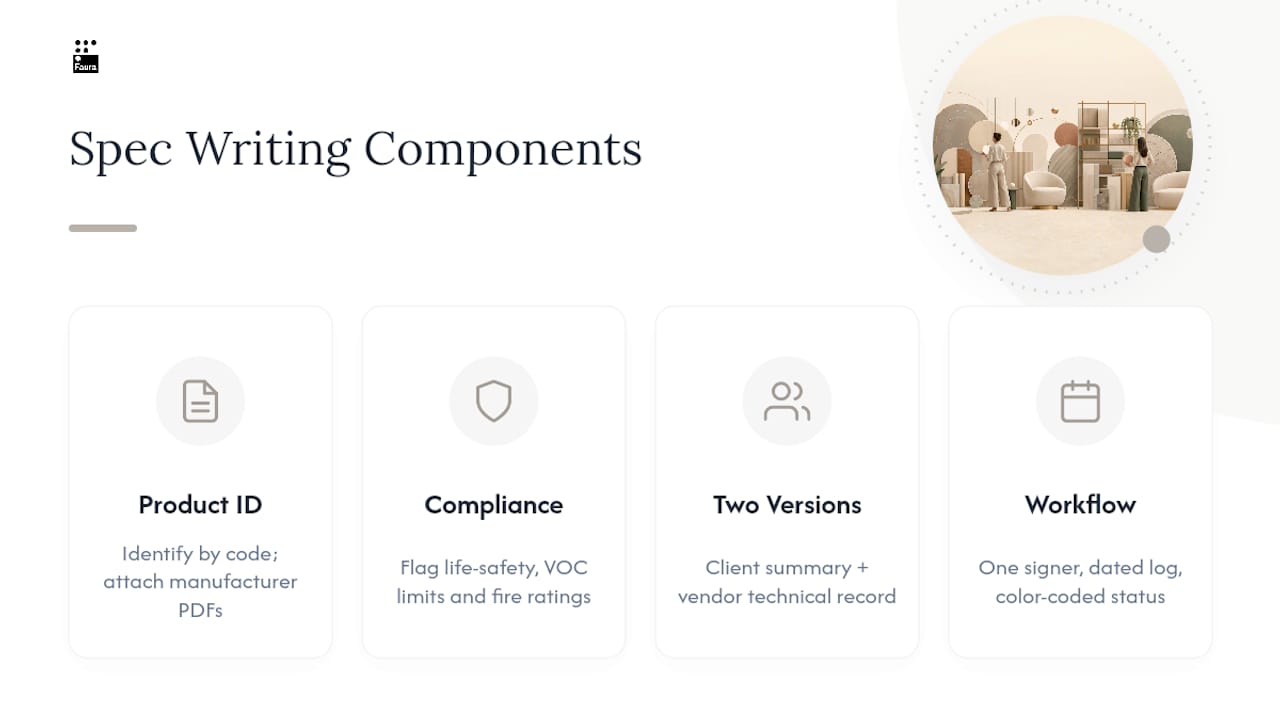
Life-safety, sustainability and indoor air quality requirements deserve their own flagged field, not a footnote. A specification functions as a contract-ready document once it references compliance standards, fire ratings or VOC limits, and reference texts built around performance and compliance checklists are worth keeping on the shelf for exactly this reason.
Insiders tend to run two versions of the same document: a simplified client-facing summary showing finishes and aesthetics, and a full vendor-facing technical record with pricing, MOQs and vendor terms hidden from the client view but fully visible to procurement. Assign one person sign-off responsibility for each revision, and keep a dated log rather than overwriting the last version.

Pro Tip: Colour-code your status column instead of writing status as free text. A glance at red versus green cells tells you which items are stuck without reading a single row.
Which tools help you manage specs: spreadsheets or dedicated software?
Spreadsheets remain the cheapest way to start, and for a single-room project or a design student building their first template, they are entirely sufficient. A workable spreadsheet needs, at minimum, space and category columns, product and supplier details, an image thumbnail, dimensions, pricing, an alternative option, a status field and a notes column, following the structure recommended in most FF&E template guides.
The limits show up once a project scales past a handful of rooms. Purpose-built specification software centralises the whole FF&E process, address books, budgets, a shared product catalogue, spec sheets with attachments, approval workflows and purchase-order tracking, and reduces manual data entry that spreadsheets simply push back onto the designer.
- Whichever tool you choose, customise three things first: status labels, a lead-time flag for bespoke items, and separate client and supplier views.
- Start from an existing template rather than building from a blank sheet; the structure matters more than the software brand.
How do you keep procurement on schedule once specs are locked?
Procurement problems rarely come from bad design choices, they come from unmanaged timing and unverified numbers. A handful of disciplined checks catch most of them before they become expensive.
- Flag long lead-time or bespoke items the moment they are specified, not once an order is overdue.
- Reconfirm pricing and stock availability with the vendor immediately before placing the order, prices quoted three months earlier are not reliable.
- Link every submittal back to its original spec code, and require photographic evidence for critical or custom items before sign-off.
- Log discrepancies the moment they surface and flag them during submittal review rather than waiting until an installer is standing on site with the wrong finish in hand.
How does a trade showroom shorten the spec-to-procurement loop?
Much of the time lost in specification writing has nothing to do with the document itself, it is the sourcing and verification work behind each row. A trade showroom that holds a curated product library, confirmed procurement terms and physical samples lets you check finishes and gather price and lead-time information with fewer separate supplier enquiries.
- Curated brand libraries mean fewer unverified manufacturer claims entering your spec in the first place.
- Trade pricing for items sourced through the showroom can be requested in the same conversation, though it should still be reconfirmed before ordering.
- Private client hosting lets you walk a client through finish and furniture decisions on-site, shortening the approval cycle that otherwise slows your revision log.
Integrating this kind of support means routing bespoke or high-value FF&E lines through the showroom’s verified vendor list before they go into your spec, not after.
Treat your spec library as a living asset, not paperwork
Most designers write specs once and let them go stale. That habit costs more than it saves. Keeping supplier data current and folding CAD and render links directly into the spec package cuts the misinterpretation that causes change orders, and a maintained spec library becomes a genuine asset that reduces repeat work on the next project, which shows up directly in a firm’s margins over time.
— Faura Editorial
Where Faura fits when you want to outsource sourcing and hosting
Faura is a trade-only showroom and residency in Westminster built for exactly the admin load this article has covered: verifying vendors, checking lead times, and hosting clients through finish decisions. Designers use the residency to access a curated library of over 200 brands with samples and technical files in one place, and trade terms confirmed directly with each approved account.
It suits projects carrying a heavy FF&E line count or a compressed timeline, where chasing vendor confirmations by email is the real bottleneck, not the design work itself. If your specs are light and your supplier relationships are already solid, keep the work in-house. If you are spending more hours verifying vendors than specifying rooms, book a visit to the showroom or explore private client hosting to see whether commissioning that support pays back the time.