Guide · Surfaces
Choosing stone, porcelain and marble surfaces for London interiors
By Faura Editorial · · 9 min read
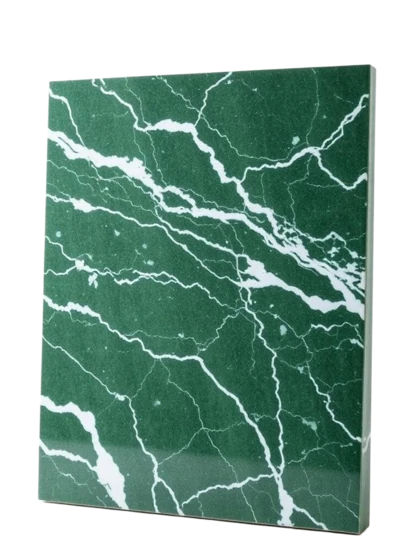
Choosing between natural stone, marble and large-format porcelain for a London interior comes down to how the surface will be used, how much visible movement the scheme wants and how the material will be maintained on site. Natural marble and stone from Margraf bring the depth and variation of a quarried block; large-format porcelain slabs from Florim offer consistency, resistance and lighter installation loads; and engineered surfaces from Cosentino sit between the two, with engineered performance and a designed pattern. All three are held at Faura's Westminster showroom so a specifier can compare slab boards and finish references against a live scheme.
When should I specify natural marble or stone?
Natural marble and stone are the right choice when the scheme wants unrepeatable veining, depth of tone and the quality of a genuinely quarried surface — feature walls, statement islands, bathroom vanities, entrance floors, fireplace surrounds. The trade-off is variation: no two slabs match exactly, so the designer selects the specific slabs at the yard or via a slab-selection service. Natural stone also requires informed detailing — sealed installations, correct edge profiles, and a maintenance regime the client is briefed on.
When does large-format porcelain make more sense?
Large-format porcelain slabs are the practical answer when the scheme needs a stone-like appearance with predictable performance — very large floor fields, wall claddings that repeat between rooms, wet areas where absorption matters, or bathrooms where a continuous look is more important than natural variation. Porcelain is lighter than natural stone (useful in apartment buildings), does not need sealing, and is available in slab formats that reduce the number of joints. It is also the more predictable specification for developer projects where units need to match.
Where do engineered surfaces fit?
Engineered surfaces sit between the two: designed patterns with engineered composition, sold in slab. They are commonly specified for kitchen worktops, high-use vanities and commercial settings where consistency and resistance matter more than natural variation. As with porcelain, you are working with a reproducible pattern rather than a unique block.
How do trade professionals view Florim, Cosentino and Margraf at Faura?
At Faura, Margraf is reviewed as the natural stone reference — designers look at full slab boards and, for statement pieces, arrange slab selection. Florim is reviewed for large-format porcelain — walls, floors, bathrooms and any project that wants a stone-adjacent look in porcelain performance. Cosentino is the engineered-surface reference for worktops, vanities and high-use elements. The three brands can be reviewed side by side, so the choice between them can be made in person, against physical samples, rather than on a screen.
How do I run a surfaces appointment?
- Send the plan and the room-by-room brief in advance — which walls, floors, worktops and vanities are in scope.
- Bring a moodboard or reference images so the host can pull comparable slabs from each brand.
- Review Margraf natural stone and Florim porcelain against each other for statement surfaces; review Cosentino for worktops and vanities.
- Take cuttings for client presentation and note the finish (polished, honed, brushed) against each reference.
- Ask about installation — Faura can introduce vetted tiling contractors for stone and porcelain installation so the surface is fitted by a specialist.
What about the rest of the fit-out?
Surfaces rarely travel alone: the same appointment usually touches bathrooms, brassware, lighting and paints. For how Faura assembles a full fit-out around a surfaces selection, see full fit-out sourcing in London and the finishes and materials landing page.
To review Florim, Cosentino and Margraf against a live London scheme at Faura's Westminster showroom, book a private appointment — the team will pull the relevant slabs and finish boards in advance.
Frequently asked questions
- Is porcelain a good substitute for marble in London bathrooms?
- In many cases yes. Large-format porcelain gives a stone-like appearance with predictable performance, is lighter than natural stone (useful in apartments), and does not need sealing. Where the scheme wants genuine natural variation, natural marble from Margraf is still the reference choice.
- Can I see full slabs at Faura?
- The Westminster showroom holds slab boards and finish references for Florim porcelain, Cosentino engineered surfaces and Margraf natural stone. For statement pieces, ask the team how slab selection can be arranged so the exact slab used on the project is chosen against the scheme.
- Who installs the stone or porcelain?
- On request, Faura can introduce vetted tiling and stone contractors, so the installation is handled by specialists.