Avoid VAT surprises: Trade Commission vs Markup for UK Designers
By Faura ·

Avoid VAT surprises: Trade Commission vs Markup for UK Designers
If you add any margin to a supplier cost, that charge becomes your own taxable supply, either a markup or a recharge, not a disbursement. Only an exact, separately invoiced pass-through, where the supplier bills your client directly, can qualify as a disbursement. The distinction decides whether VAT applies to the goods, whether the full sale value counts towards your taxable turnover, and what paperwork you need to defend your position.
TL;DR:
- If you add a margin to supplier costs, the charge becomes a taxable supply rather than a disbursement, affecting VAT, turnover, and paperwork requirements.
- Ensuring the supplier invoices the client directly and no margin is added confirms your transaction as a disbursement, provided the client authorizes the purchase beforehand.
- Markups on resold goods require charging VAT on the full sale price and increase your taxable turnover, which can impact your VAT registration threshold.
- Charging a procurement fee with the supplier invoicing the client directly typically results in a lower contribution to your turnover and reduces cash flow risk.
- Using a trade account service like Faura can help manage procurement without fronting cash and streamline administrative burdens for projects involving multiple suppliers.
Table of Contents
- Trade commission vs markup: definitions and a quick checklist
- What changes in VAT, turnover and bookkeeping when you mark up goods
- A worked example: markup versus procurement fee side by side
- Weighing up profit, cashflow and risk
- Setting rates: benchmarks and wording that avoids ambiguity
- Paperwork that proves the treatment you claim
- Differences between trade commission and markup in pricing strategies
- How trade commission versus markup shapes your profit margins
- Examples of commission and markup across industries
- Legal and regulatory considerations for commissions and markups
- How pricing choices shape client relationships and negotiations
- Faura’s view on when to hand procurement to a showroom partner
- Faura’s trade account: procurement support without the cash exposure
- Sources
- FAQ
Trade commission vs markup: definitions and a quick checklist
A disbursement is money you pay on your client’s behalf, as their agent, and recharge at the exact amount with no addition. A recharge or markup happens the moment you add anything to that cost, whether it is 5% or 50%, because you have then acted as principal and made your own sale. A commission typically describes a fee taken for arranging a purchase or introducing a supplier, often calculated as a percentage of the trade price.
Run any charge through this checklist before you invoice:
- Is the supplier invoice addressed to your client, not to your studio?
- Are you passing on the exact amount paid, with zero addition?
- Does your client authorise the specific purchase before you commit to it?
- Could HMRC see the transaction as you simply relaying a cost, rather than trading in goods?
If all four answers are yes, you likely have a genuine disbursement. If even one answer is no, most commonly because you have added a margin, you are almost certainly making a taxable supply of your own.
- Reimbursed courier costs, invoiced in the client’s name: usually a disbursement.
- Furniture bought on your trade account and resold at a marked-up price: always a recharge.
- A flat sourcing fee added on top of the exact trade price: a commission, and your own supply.
What changes in VAT, turnover and bookkeeping when you mark up goods
HMRC’s agency test looks at who bears the risk, who the supplier’s invoice names, and whether you had discretion over the purchase. If you negotiated the deal, held the goods, or added value beyond simple pass-through, HMRC will usually treat you as the principal, not the agent.
That distinction changes three things immediately once you buy and resell rather than merely recharge.
Input VAT: as principal, you reclaim the VAT charged on the supplier’s invoice to you, provided you are VAT registered.
Output VAT: you must then charge VAT on your resale price to the client, calculated on the full marked-up value, not just your margin.
Taxable turnover: the entire sale value, cost plus markup, counts towards your VAT registration threshold. A procurement fee model keeps only the fee itself in your turnover, which matters if you are close to the threshold.
| Treatment | What counts as turnover | VAT position |
|---|---|---|
| Disbursement (agent) | Fee only | VAT charged on fee, not goods |
| Markup/recharge (principal) | Full resale value | VAT charged on full resale value |
Keep the supplier invoice, the delivery note, and written client authorisation for every item. If you claim disbursement treatment and cannot produce an invoice addressed to the client, that claim will not survive scrutiny.
A worked example: markup versus procurement fee side by side
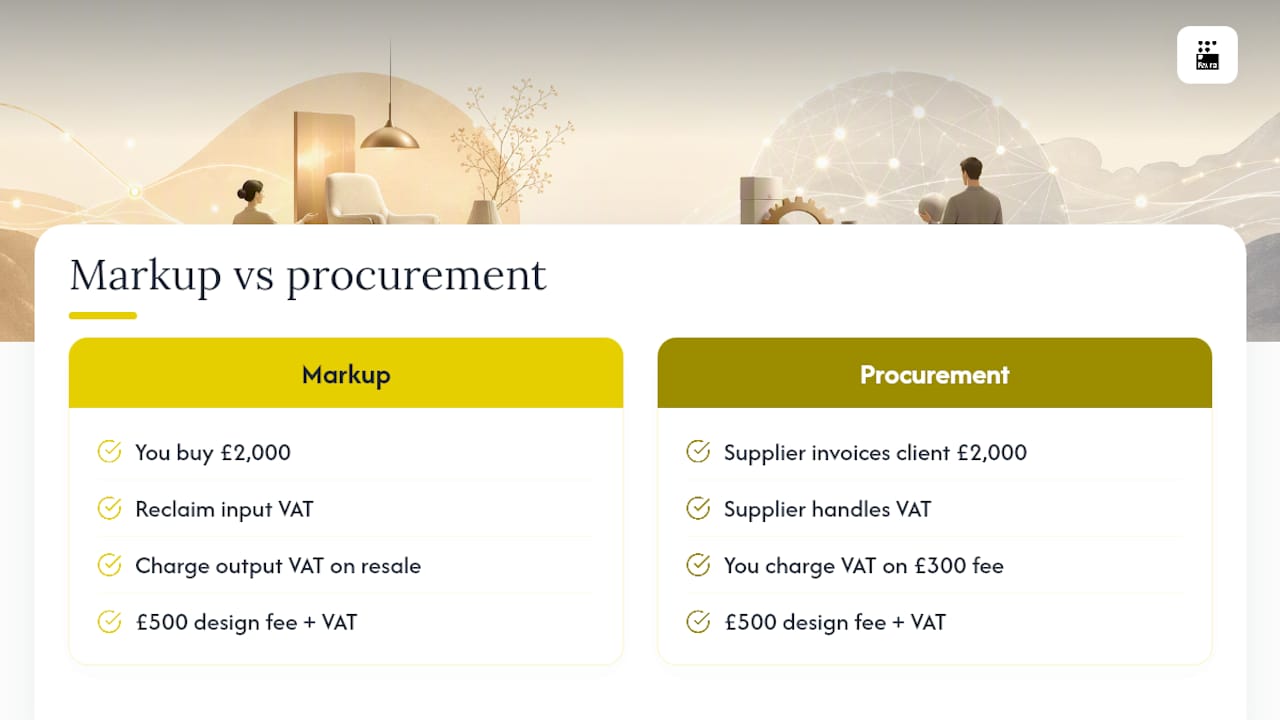
Numbers make the difference obvious. Take a sofa with a trade cost of £2,000, plus a £500 design fee for the same project.
Under a typical markup, you sell the sofa to your client for an amount higher than trade cost. You reclaim input VAT on the trade cost, then charge output VAT on the full resale price. Net VAT due to HMRC on the goods alone is the difference, and your gross margin on the sofa is the markup amount before costs. Add the design fee plus its own output VAT, and your total invoice to the client reaches the sum of all these charges. Crucially, the full resale goods value lands in your taxable turnover.
Under a procurement fee route, the supplier invoices the client directly for £2,000. Only that £300 counts towards your turnover, not the £2,000 goods cost, which is why studios running close to the VAT registration threshold model their turnover carefully before choosing a route. The worked ledger mechanics behind this example come from Zmartly’s disbursement guidance, which shows how VAT effectively passes through your books whichever model you use, while only one model inflates your turnover.
Weighing up profit, cashflow and risk
Markup gives you a bigger, more predictable margin on every item you specify, and it rewards the time you spend sourcing and vetting suppliers. The trade-off is that you must fund the supplier payment yourself before your client settles their invoice, and you absorb the risk if goods arrive damaged, get delayed, or need to be returned.
A procurement fee avoids fronting that cash. Your client pays the supplier directly, so your exposure is limited to the fee itself. The compromise is a thinner margin, and less control if a client tries to negotiate your fee down once they see the trade price.
- Markup: higher margin, full cash exposure, you own the returns risk.
- Procurement fee: lower margin, minimal cash exposure, client owns supplier risk.
- Mixed approach: many studios use markup on furniture and a fee on bespoke joinery, matching the model to the risk.
Pro Tip: Ask for a deposit before you commit to any supplier order under a markup model. Fronting five figures on a client who later cancels is the fastest way to damage your cashflow.
Setting rates: benchmarks and wording that avoids ambiguity
Procurement fees in the UK market typically sit between 10% and 20% of the trade price, with the BIID citing 15% as a common benchmark for administration on professional projects. Markups tend to run higher, often 30% to 35%, to compensate for the cash you front and the risk you carry as principal.
Push your percentage upward when:
- The item is bespoke, with a long lead time and no resale value if the client cancels.
- You are managing multiple suppliers or complex freight and installation.
- The order volume is small, so fixed administration costs cannot be spread across many items.
Whichever figure you land on, write it into your proposal in plain terms. Try: “Goods are supplied at trade cost plus a 30% margin, inclusive of sourcing, quality control and logistics coordination.” Avoid vague phrases like “trade discount passed on,” which tell the client nothing about what they are actually paying for. Transparency around how a pricing model is structured protects the relationship far more effectively than a lower headline number ever will.
Paperwork that proves the treatment you claim
Your invoice format is the single strongest piece of evidence for whichever treatment you are using, so get it right from the first project.
- If you want disbursement treatment, arrange for the supplier to invoice your client’s name and address directly, even if you place the order on their behalf.
- Itemise every invoice with separate lines: goods cost, procurement or design fee, and VAT shown against each line rather than lumped together.
- Keep the supplier invoice, the delivery note, the client’s written approval email, and proof the client actually paid, filed together per project.
- Where you are acting as principal, your own invoice to the client should show your business as the seller of record, not a pass-through agent.
Sloppy paperwork is the most common reason a designer’s claimed treatment falls apart under scrutiny, regardless of which model they intended to use.
Differences between trade commission and markup in pricing strategies
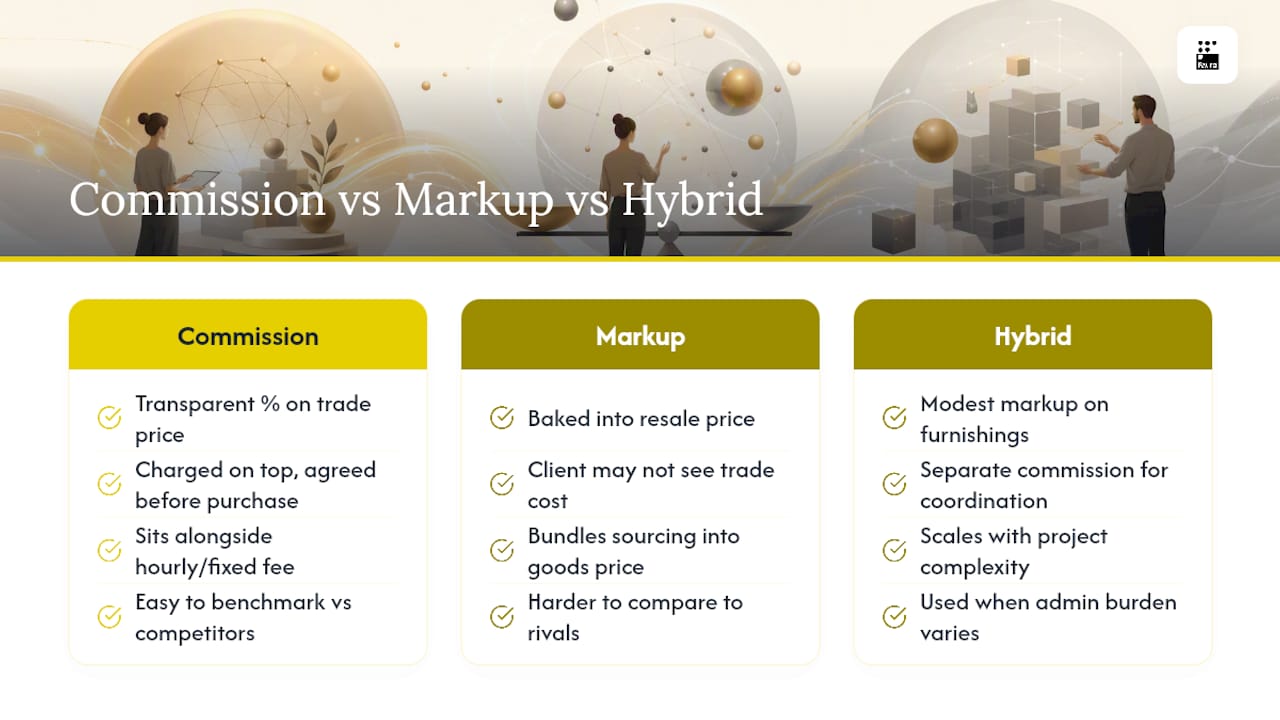
A commission is usually a fixed percentage charged transparently on top of a known trade price, agreed before the purchase. A markup is baked into the resale price itself, and the client may never see the original trade cost unless you choose to disclose it.
This matters for how you price a project. Commission-based pricing tends to sit alongside an hourly or fixed design fee, so the client understands they are paying separately for your sourcing time and for the goods. Markup pricing bundles sourcing effort into the goods price, which can simplify a client’s invoice but makes it harder for them to see exactly what they are paying you for versus paying the supplier.
Some studios blend both: a modest markup on furniture and finishes, alongside a commission-style fee for coordinating trades and contractors. That hybrid lets you scale your income with project complexity rather than relying on one lever. A studio managing a full fit-out with dozens of suppliers might charge markup on furnishings while billing separately for procurement coordination on joinery and stone, because the administrative burden differs so much between categories.
The choice also shapes how a client compares your pricing to a competitor’s. A visible commission percentage is easy to benchmark against another designer’s stated rate. A markup buried in the resale price is not, which can work in your favour on bespoke items but invites suspicion if a client later discovers the trade cost through a supplier’s own website or a showroom visit.
How trade commission versus markup shapes your profit margins
Markup margins scale with the value of goods specified, so a project heavy in furniture and lighting can produce a substantial profit even on a modest percentage. Commission-based fees scale with your time and coordination effort instead, which means a project with lots of small, cheap items but complex logistics might undersell your actual workload if you are only charging a flat percentage on trade cost.
The practical effect is that markup rewards designers who specify generously and manage supplier relationships well, while commission rewards designers who are efficient with their time. Studios that mix both models often find their overall margin is more stable across a portfolio of projects, because a slow month on markup-heavy jobs can be offset by steady commission income on fee-based work.
Margin volatility is the real risk with a pure markup model. If a client cancels an order after you have paid the supplier, your margin evaporates and you are left carrying a returns or restocking cost. A commission model insulates you from that volatility because the client, not you, holds the financial relationship with the supplier. Choosing between the two is really a choice about how much margin variability your studio’s cashflow can tolerate, not simply which percentage looks better on paper.
Examples of commission and markup across industries
Retail buying groups have long used markup as the default, since a shop owns its stock outright and prices for margin against overheads and shrinkage. Interior design borrows that logic when a studio buys furniture on a trade account and resells it, effectively running a small retail operation within each project.
Estate agency and recruitment sectors lean towards commission structures instead, because neither industry takes ownership of the underlying asset; a house or a candidate cannot be marked up the way a physical product can. Architecture firms sit somewhere between the two, often charging a percentage-based fee on construction value that behaves more like commission than markup, since the firm never buys the materials itself.
Within interior design specifically, the split tends to follow product category rather than studio preference. Furniture, lighting and soft furnishings are commonly marked up because they are tangible, resellable goods with a clear trade cost. Contractor labour and bespoke joinery are more often billed via a coordination fee or commission, because the designer is arranging a service rather than reselling a product. A studio working across both categories on a single project will typically run both models simultaneously, invoicing furniture at a marked-up resale price while charging a separate percentage fee for managing the joinery installation.
Legal and regulatory considerations for commissions and markups
The legal risk sits less in which model you choose and more in whether you disclose it. Acting as an agent while quietly taking an undisclosed commission from a supplier, without telling your client, can breach professional codes of conduct and, in some circumstances, fall foul of the Bribery Act 2010. Professional bodies treat undisclosed commissions as a serious ethical breach, not a grey area.
VAT treatment carries its own regulatory weight. Misclassifying a markup as a disbursement to avoid charging VAT, or to keep turnover under the registration threshold, is a compliance failure that HMRC can challenge retrospectively, with penalties and backdated VAT liability attached. The safest position is to decide your model deliberately, document it consistently, and apply the same treatment across every client rather than switching case by case to suit whichever result looks better on a given invoice.
Contract wording matters too. A proposal that states goods are supplied “at trade cost plus margin” gives you a defensible legal position if a client later queries pricing. Silence on the point leaves you exposed to a client arguing they believed they were paying trade price with no addition at all.
How pricing choices shape client relationships and negotiations
Clients rarely object to paying a markup or a commission in principle. What damages trust is discovering, usually by accident, that a percentage they were never told about sat inside a price they assumed was fixed. A client who can see exactly what they are paying for, whether that is a disclosed fee or a stated margin, is far less likely to push back or feel misled than one who finds a hidden markup later.
Negotiation dynamics differ sharply between the two models. A commission percentage is an easy target for a client to negotiate down, because it is visible and comparable to what another designer might charge. A markup is harder to negotiate precisely because it is embedded, though that same opacity can backfire if a client becomes suspicious and asks to see trade invoices directly.
Studios that lead with transparent wording, whatever the percentage, tend to have shorter negotiation cycles and fewer disputes at project completion. The client who understands your pricing model from the proposal stage is not surprised by the final invoice, and that predictability is often worth more to the relationship than shaving a few percentage points off your rate.
Faura’s view on when to hand procurement to a showroom partner
Faura treats designers as clients in their own right, offering trade accounts, procurement support and dedicated client hosting so you are not fronting cash or chasing supplier invoices alone. Handing procurement to a showroom partner makes most sense when a project involves many small suppliers, where the administrative load outweighs the margin you would keep by managing it yourself.
Keep goods on your own books when the margin genuinely reflects your risk and effort. Before committing to any partner, ask directly about payment terms, who bears liability for damaged goods, and how quickly they settle with suppliers, because those answers tell you more than any published percentage.
— Eugene
Faura’s trade account: procurement support without the cash exposure
Rather than fronting supplier payments and managing dozens of invoices yourself, a trade account with Faura gives you exclusive procurement terms across a curated library of more than 200 brands, alongside operational support that handles the administrative load a markup model normally demands. Faura’s specify & source service coordinates sourcing directly, its client hosting lets you present schemes to private clients in a dedicated Westminster showroom, and its back-office support removes much of the invoice chasing and supplier coordination that eats into a solo studio’s margin.
For architects and developers, specification support and FF&E procurement extend the same principle to larger projects, where dozens of suppliers can otherwise turn into a full-time administrative job. The practical benefit is time: hours you would spend negotiating trade terms or chasing delivery notes go back into design work instead.
If you are weighing whether to keep procurement on your own books or hand it to a partner who already has the terms and the infrastructure in place, enquire about opening a trade account with Faura and see how the residency model fits your next project.
Sources
- Interior designer accounting: disbursements & markups
- Interior design fee structure: four models, four margins
- Interior design procurement: agent, principal & the law
- Are you buying right
FAQ
Is a trade discount passed on to a client a disbursement?
Only if you pass on the exact trade price with no addition and the supplier invoice is addressed to your client. The moment you add any margin, even to cover your time, it becomes a taxable recharge rather than a disbursement.
Do I charge VAT on a markup?
Yes. As principal, you charge output VAT on the full resale value, not just your margin, while reclaiming input VAT on what you paid the supplier.
What is a typical procurement fee percentage?
Procurement fees commonly range from 10% to 20% of the trade price, with the BIID citing 15% as a standard benchmark for administration on professional projects. Markups tend to run higher, often 30% to 35%, to reflect the cash and risk a designer carries as principal.
Does markup affect my VAT registration threshold?
Yes. If you buy and resell goods, the full resale value counts towards your taxable turnover, which can push you over the VAT registration threshold faster than a procurement fee model would.
Can Faura help me avoid fronting procurement cash?
Faura’s trade account and specify & source service give designers exclusive procurement terms and operational support, reducing the administrative burden of managing suppliers directly. Current pricing and account terms are available by enquiring through Faura’s site.