What is white glove delivery, and is it worth the cost?
By Faura ·


White glove delivery is a premium logistics service that carries an item into your home or project site, unpacks it, assembles or installs it, checks it works, and removes all the packaging on the way out. It sits above standard courier drop-off and above threshold delivery, which stops at your front door. The name borrows from the literal white gloves once worn to handle valuables with special care, and that is still the promise today.
Is it worth paying for? For fragile, heavy, or bespoke items, usually yes. The extra cost buys protection against damage, a working product on day one, and no packaging left behind for you to deal with.
Typical beneficiaries include:
- Retailers selling furniture, appliances, or premium goods
- Private individuals buying bulky or fragile items
- Interior designers managing client installations and project handovers
Key Takeaways
White glove delivery works because it combines inside placement, assembly, functionality checks, and debris removal into one accountable service with insurance behind it.
| Point | Details |
|---|---|
| Core service scope | Expect pickup, inside placement, unpacking, assembly, functionality checks, and debris removal as standard. |
| Pricing is not fixed | Costs vary by weight, access, assembly complexity, and crew size, so always request an itemised quote. |
| Best suited to high-value goods | Furniture, appliances, artwork, and fitness equipment benefit most from reduced damage risk. |
| Vet providers on process | Ask about insurance limits, assembly scope, haul-away, and documented damage procedures before booking. |
| Site prep prevents delays | Accurate measurements and clear access instructions avoid the majority of installation-day problems. |
Table of Contents
- What does white glove delivery actually include?
- What makes white glove different from standard delivery?
- The practical benefits, beyond just “nicer service”
- Who actually uses white glove delivery?
- How white glove pricing actually works
- How to choose a white glove delivery provider
- White glove versus curbside and threshold delivery
- How Faura coordinates white glove deliveries on design projects
- What most guides get wrong about white glove delivery
- Ready to simplify sourcing and delivery for your next project?
- Sources
What does white glove delivery actually include?
The core service is consistent across providers, even when the finer details vary. Ryder’s breakdown of the standard offering covers five components that most quotes should account for.
- Pickup and protective packaging — the item is collected and wrapped to withstand transit, with extra padding for fragile or high-value pieces.
- Inside placement — the crew carries the item into the room you specify, not just through the front door.
- Unpacking, assembly, and functionality checks — furniture gets built, appliances get plumbed in or wired up, and someone tests that the thing actually works.
- Debris removal — all boxes, foam, and plastic wrap leave with the crew.
- Scheduling, communication, and insurance — you get an appointment window, updates as the delivery approaches, and cover if something goes wrong.
Haul-away of an old item, such as a sofa or fridge being replaced, is often available too, though it is usually quoted separately.
Pro Tip: Ask suppliers explicitly whether haul-away and recycling are included or billed as extras. Many providers offer these as optional add-ons rather than automatic inclusions, and assuming otherwise is a common source of quote disputes.

What makes white glove different from standard delivery?
The gap between white glove and a courier drop-off is not just service level. It is a different operating model entirely, built around specialist vehicles, trained people, and documented handovers.
- Purpose-built vehicles with padded interiors, tail lifts, and internal racking designed to stop items shifting or scraping in transit.
- Trained, uniformed technicians who carry their own tools and know how to assemble specific product categories, not just move boxes.
- Defined appointment windows rather than an all-day “sometime Tuesday” promise, with a documented handover once the job is done.
- Insurance and a clear claims process, so damage during handling has a defined route to resolution rather than an argument over who is liable.
Retailers and third-party logistics providers position white glove as a premium tier specifically because it protects brand reputation and reduces returns, which matters more for a £4,000 sofa than a £40 lamp. The uniformed crew and tracked appointment are not just for show. They are trust signals that reduce the anxiety buyers feel handing over a large payment for something they have not yet seen delivered.
The practical benefits, beyond just “nicer service”
The value of white glove delivery is measurable, not just a feel-good add-on.
- Fewer damages and returns. White glove handling covers the final stretch of a delivery, when an item is carried into and placed within a home or site. Bringing the product inside, assembling it, and clearing the packaging removes that risk almost entirely.
- Higher perceived value. A premium unboxing experience shapes how a customer feels about a purchase long after the invoice is paid.
- Ready-to-use on arrival. No flat-pack instructions, no missing screws, no half-day spent assembling a wardrobe alone.
- Brand protection for retailers. A damaged delivery or a bad unboxing story travels fast; white glove reduces that exposure for anyone selling premium goods.
Who actually uses white glove delivery?
The service earns its cost fastest with items that are large, delicate, or genuinely difficult to install alone.
- Furniture and bespoke joinery, where scale and finish make DIY handling risky
- Appliances, fitness equipment, and large electronics, which often need installation or wiring, not just placement. Medical devices and gym equipment fall into this category too
- Artwork, lighting, and fragile luxury goods, where a single scratch or crack is an expensive mistake
- Design and project handovers, where a showroom piece or a full room needs to arrive ready for a client walkthrough
If your item ticks any of these boxes, white glove is almost certainly the right delivery tier to specify.
How white glove pricing actually works
Pricing rarely follows one flat formula. Most providers blend a few charging models depending on the job.
- Per-stop or per-item fees for straightforward jobs with minimal complexity
- Hourly labour charges where assembly or installation takes genuine skill and time
- Surcharges for stairs, narrow access, long carry distances, and out-of-hours or weekend scheduling
Elite Anywhere notes that surcharges for stairs, tight access, and assembly complexity are standard practice across the industry, not a sign of a supplier padding the bill. Size and weight of the item, the number of crew required, and how far the delivery travels from the depot all factor into the final number too.
Before accepting a quote, ask exactly what triggers a surcharge, whether haul-away is included, and what happens if access on the day turns out to be harder than described.
How to choose a white glove delivery provider
A good white glove provider should be able to answer every question below without hesitation. Hesitation is itself useful information.
- What are your insurance limits, and what happens if an item is damaged during handling?
- What exactly does assembly scope cover — full installation and testing, or just placement and basic build?
- Is haul-away of an old item included, or is it a separate line item?
- How rigid is your appointment window, and how will you communicate delays?
- What is your documented damage procedure, from report to resolution?
Beyond the questions, providers with genuinely documented handling protocols, clear insurance, and a defined claims process tend to be the ones worth trusting with expensive goods. Ask for references from similar jobs, not just generic reviews.
Pro Tip: Treat vague answers to insurance or damage-procedure questions as a red flag. A provider that cannot state its liability limits clearly on a call is unlikely to handle a dispute any more clearly after the fact.
White glove versus curbside and threshold delivery
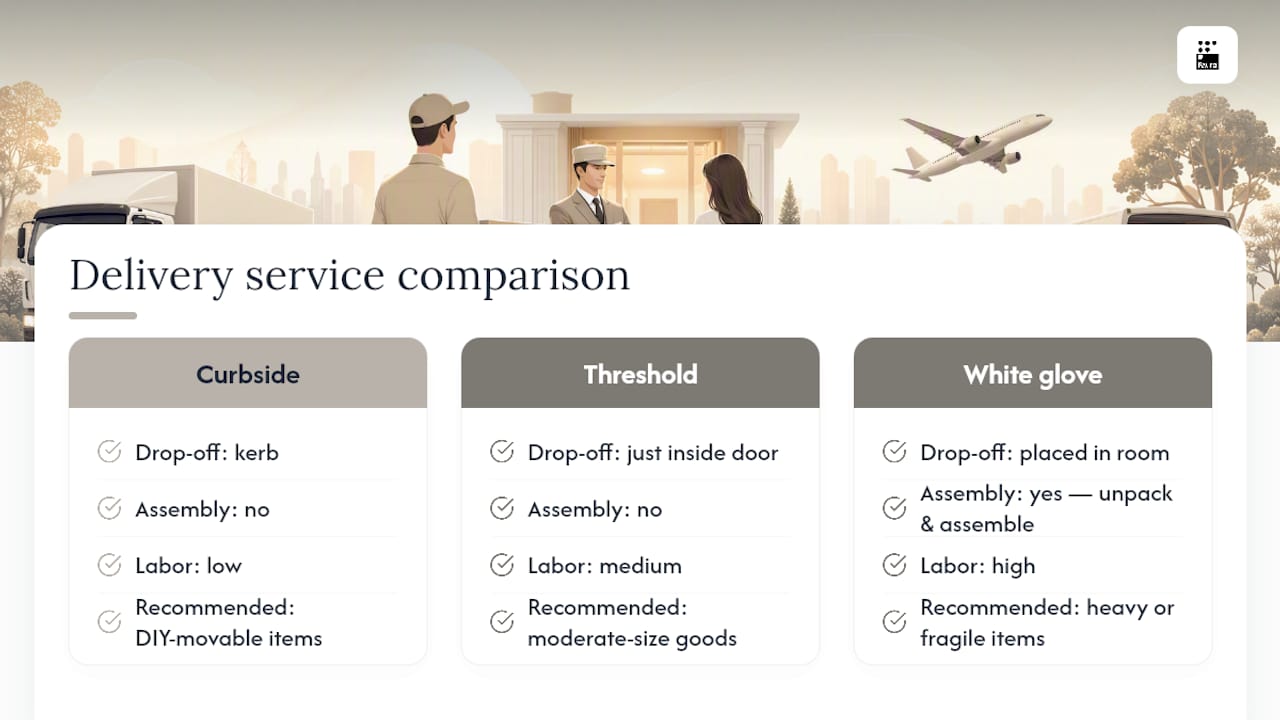
Curbside delivery drops the item at the kerb; you handle everything from there. Threshold delivery gets it just inside your front door, no further. White glove takes it into the room, unpacks it, assembles it, and clears the debris.
Choose curbside for items you can move yourself. Choose threshold for moderately sized goods without assembly needs. Choose white glove for anything heavy, fragile, or requiring installation, where the cost difference reflects genuinely more labour, not just branding.
How Faura coordinates white glove deliveries on design projects
Faura’s Westminster showroom exists precisely because sourcing and delivery coordination eat into a designer’s time that should go towards the actual creative work. With over 200 brands represented and procurement, logistics and delivery handled by one team, project support extends into how pieces actually arrive on site, not just how they are specified.
Coordinating site readiness, access, and accurate product dimensions before scheduling avoids many of the installation delays designers encounter on delivery day.
For designers briefing a white glove delivery, three things matter most before the appointment is even booked:
- Confirm final measurements and access constraints (lift size, stairwell width, parking restrictions) with the client in advance
- Brief the crew on placement expectations in writing, not verbally on the day
- Build haul-away of existing furniture into the brief early, rather than negotiating it on arrival
What most guides get wrong about white glove delivery
The conventional advice treats white glove as a single fixed tier, as though every provider offers the identical bundle at a comparable price. That is not how the market actually works. Two suppliers quoting “white glove” for the same sofa can differ by hundreds of pounds because one includes haul-away and full assembly testing while the other stops at inside placement.
The more useful question is not “should I pay for white glove” but “which specific components am I actually paying for.” A £4,000 art piece needs insurance limits and padded handling far more than it needs a technician with a screwdriver. A wardrobe needs assembly skill more than it needs a branded uniform. Buyers who ask providers to itemise scope, rather than accepting the label at face value, get better outcomes and fewer disputes than those who assume the term guarantees a fixed standard.
For designers specifically, the biggest overlooked lever is not the delivery company at all. It is site preparation. Most delivery failures trace back to inaccurate measurements or unclear access instructions given before the crew even arrives.
— Faura Editorial
Ready to simplify sourcing and delivery for your next project?
Faura’s trade showroom in Westminster brings curated brands, procurement terms, and project execution support together under one roof, so delivery coordination stops being an afterthought bolted onto the end of a project. Designers working through Faura’s trade account get procurement, logistics and delivery handled by one team, with support to brief deliveries properly from the outset. Visit Faura to see how the showroom and residency model works for independent designers sourcing across over 200 brands.
Sources
- The Ultimate Guide to White Glove Delivery in 2026 | Ryder
- White Glove Delivery: Benefits, Key Features & Use Cases
- Merriam-webster
- White Glove Delivery Explained: Who Benefits From White Glove Services (& How Do They Do It)? | ShipBob