What wholesale terms in furniture contracts actually mean
By Faura ·


Before ordering a single piece, check five clauses: price and price-change rights, VAT treatment, payment terms, title and risk transfer, and minimum order or return conditions. These decide whether you overpay, tie up capital in stock you cannot return, or lose goods entirely if a supplier becomes insolvent. Scan your quotation and invoice terms for the payment schedule and the title clause first, then work through the rest.
TL;DR:
- Suppliers may reserve the right to adjust quoted prices if raw material costs change before dispatch, especially for made-to-order furniture with long lead times.
- Risk often transfers from supplier to buyer upon shipment, while legal ownership typically remains with the supplier until full payment, affecting reclamation rights if insolvency occurs.
- Wholesale contracts usually require deposits of 30-50% upfront and later payment within 30 or 60 days, with early discounts and automatic card charges common but needing careful review.
- Return and warranty policies are strict, often prohibiting cancellations after 24-48 hours and limiting defect coverage to specific elements, making documentation crucial.
- Consolidating procurement through a trade showroom such as Faura can reduce administrative work for designers managing multiple suppliers.
Table of Contents
- Key wholesale terms furniture buyers need to understand
- Who owns the furniture and when does risk actually transfer?
- Returns, cancellations and warranty terms for wholesale furniture
- What do suppliers require to open a trade account?
- Which clauses should you flag before signing wholesale terms?
- How to read and rewrite common wholesale clauses
- Faura’s view on trade procurement for designers
- The clause that actually protects you isn’t the one you’d expect
- An alternative to negotiating every supplier relationship alone
- Sources
Key wholesale terms furniture buyers need to understand
Wholesale contracts read differently from retail receipts because they are built for repeat business, not single transactions. A published price list is the supplier’s standing rate card, reviewed periodically and often subject to change without individual notice. A quoted price, by contrast, is fixed for that specific order, usually for a set validity window (commonly 30 to 90 days). Many trade terms give the supplier the right to amend the published list at any time while treating an accepted quote as binding. Read the small print: some suppliers reserve the right to adjust even a quoted price if raw material costs shift before dispatch, which matters enormously on made-to-order upholstery where lead times stretch for months.
Wholesale and retail differ fundamentally in structure, not just price. Wholesalers sell in bulk to businesses at lower per-unit rates, while retailers sell to the public at marked-up prices to cover the extra service and smaller order sizes, according to Shopify’s comparison of the two models. That volume relationship is why minimum order quantities exist at all: a supplier extending trade pricing needs enough order size to make the discount worthwhile.
VAT treatment for trade accounts follows standard UK rules rather than a special wholesale exemption. Trade customers pay VAT the same as any other buyer unless they meet specific conditions (such as exporting goods outside the UK, or the transaction qualifying for a relevant relief). What changes at trade level is evidence, not liability: suppliers commonly ask for a VAT registration number as proof you are trading commercially, partly to justify offering trade pricing rather than to avoid charging VAT itself. Do not assume a trade account means VAT-free purchasing. It almost never does.
Pricing methodology also affects how far you can negotiate. Wholesale pricing typically follows one of a few standard structures, cost-plus, keystone (doubling wholesale cost for retail), or absorption pricing that folds fixed overheads into the unit price, and understanding which one a supplier uses tells you how much margin sits between their cost and your invoice, per Shopify’s guidance on wholesale pricing methods. A supplier working on thin cost-plus margins has less room to discount than one pricing on keystone.
Minimum order quantities and payment mechanisms work together to define your cash exposure:
- Opening order minimums set the bar for a first trade account, often higher than reorder minimums to filter out non-serious buyers.
- Reorder minimums apply to every subsequent purchase and shape how often you can top up stock without overordering.
- Deposits on made-to-order furniture typically range from 30% to 50% upfront, with the balance due before or on dispatch.
- Net 30/60 terms allow invoice payment 30 or 60 days after delivery, usually only offered once a trade history is established.
- Early-payment discounts (sometimes 1% to 2% off) reward buyers who settle invoices well ahead of the due date.
- Card-on-file clauses let a supplier charge a stored card automatically for balances, storage fees, or shortfall payments, so read exactly what triggers that charge before agreeing.
New trade accounts almost always start on deposit or full prepayment. Net terms arrive later, once a payment history exists, which is worth knowing before you assume Net 30 is standard from day one.
Who owns the furniture and when does risk actually transfer?
Two separate questions sit inside every delivery clause: who legally owns the goods, and who bears the risk if they are damaged or lost in transit. They are not the same thing, and wholesale contracts frequently separate them deliberately.
A shipment contract puts risk on the buyer the moment goods leave the supplier’s premises. A destination contract keeps risk with the supplier until goods arrive at the buyer’s address. The difference sounds academic until a delivery is damaged in transit and you discover which party is contractually responsible for the claim. Look for Incoterms such as “EXW” or “FCA” (risk passes early) versus “DAP” or “DDP”, or wording such as “risk passes on delivery” (risk passes late); if the contract is silent, the Sale of Goods Act 1979 generally ties risk to ownership.

Separately, most wholesale furniture agreements include a title retention clause, meaning legal ownership stays with the supplier until you have paid in full, regardless of who holds physical risk. This detail becomes critical in two scenarios: if you resell goods before paying for them, or if either party becomes insolvent before payment clears. Consignment arrangements retain supplier ownership until the item sells, while wholesale normally transfers ownership at purchase, which is precisely why the clause wording that overrides this default matters so much.
A practical insolvency risk: if a supplier holds an unregistered retention-of-title claim over goods already delivered to you, and you become insolvent before paying, the supplier’s ability to reclaim those goods usually depends on whether they are still identifiable and unpaid for; a simple retention-of-title clause does not normally need registering, although extended clauses over proceeds or mixed goods may be treated as charges.
Storage fees compound the risk picture. Suppliers commonly charge for goods that sit in their warehouse past an agreed collection window, sometimes a flat daily rate, sometimes a percentage of order value. Before signing:
- Confirm the exact collection or delivery window stated in days, not “promptly.”
- Ask whether storage fees are capped or open-ended.
- Check whether risk transfers at dispatch or on arrival, in writing, not by assumption.
- Establish who arranges and pays for transit insurance.
Returns, cancellations and warranty terms for wholesale furniture
Most wholesale furniture agreements draw a hard line around made-to-order goods: once production starts, the order is final sale, non-cancellable and non-returnable except for manufacturing defects. Stock items bought off a supplier’s existing inventory sometimes allow limited returns, but rarely without cost. Understanding the sequence of what you can actually recover matters more than memorising the clause names.
- Check the cancellation window first. Many suppliers allow free cancellation only within 24 to 48 hours of order placement, before materials are cut or fabric is ordered. After that, deposits are typically forfeited.
- Identify the restocking fee on stock returns. Restocking fees on permitted returns are frequently charged as a percentage of order value, often starting from delivery rather than from when a fault is noticed.
- Read the warranty scope, not just its length. Commercial-use warranties are frequently shorter than residential ones, and structural warranties (frames, mechanisms) often differ from finish warranties (upholstery, veneer, lacquer).
- Note the claims process before you need it. Most suppliers require photographic evidence, the original invoice number and notification within a fixed window, often 48 to 72 hours of delivery, for transit damage claims specifically.
- Keep every piece of documentation. Delivery notes signed on receipt, timestamped photographs and written notice to the supplier form the evidence trail if a warranty or damage claim is disputed later.
A defect discovered during installation, rather than at the door, sits in murkier territory. Some suppliers treat it as a warranty matter; others argue the delivery was accepted without noted damage. Raising concerns at the point of delivery, even briefly in writing, protects your position considerably more than raising them a week later.
What do suppliers require to open a trade account?
Suppliers extending trade pricing want proof you are a genuine business, not a member of the public shopping around for a discount. Expect to provide most of the following before an account activates:
- A VAT registration number, used as primary evidence of commercial trading status.
- A company registration number from Companies House, if you trade as a limited company.
- Evidence of an existing trade presence, such as a business website, previous supplier invoices, or a portfolio of completed projects.
- Trade references from other suppliers, which some wholesalers use to set initial credit limits and payment terms.
Documentation requirements like these are standard practice across UK trade-only suppliers, and providing them in a single application pack speeds up account activation considerably. Credit checks often follow reference requests, and the result frequently determines whether you start on prepayment or qualify for invoice terms straight away.
For designers working project to project rather than running constant stock turnover, the practical advice is to prepare a standing documentation file, VAT certificate, company registration, and a short trading history summary, before approaching any new supplier, rather than assembling it fresh each time. It shortens activation from weeks to days on repeat applications, and it is exactly the kind of administrative groundwork opening a trade account with London suppliers tends to demand.
Which clauses should you flag before signing wholesale terms?
Not every clause in a supplier’s terms sheet deserves equal scrutiny. Some are standard industry practice; others are genuine red flags worth pushing back on before you commit.
- Reject open-ended price-change rights on confirmed orders. A supplier adjusting a published list going forward is normal; a supplier changing an already-quoted, accepted order price is not.
- Query irrevocable, fully non-refundable deposits. A deposit tied to materials already ordered is reasonable; one that stays forfeited even if the supplier delays production for months is worth challenging.
- Ask for a defined collection or storage window with a capped fee, rather than an open-ended daily charge that can quietly outgrow the order value.
- Confirm exact delivery terms in writing, specifically whether risk transfers at dispatch or on arrival, and who arranges transit insurance.
- Ask where damage claims must be lodged and within what timeframe, since some suppliers require notice within 48 hours, others allow a week.
- Request a written inspection window before title passes, giving you the right to reject damaged goods before final payment clears rather than after.
Reasonable negotiation asks include extending payment terms once trading history is established, capping storage fees at a fixed monthly rate, and delaying full payment until after a satisfactory inspection on large orders. Practical, low-friction requests like extended payment windows and capped fees tend to succeed more often than attempts to remove title-retention clauses altogether, which suppliers rarely drop entirely.
Pro Tip: Put your requested amendments directly on the purchase order, not in a separate email thread. A supplier who countersigns a PO with your added terms has a far stronger contractual position than one who simply replied “sounds fine” to a message.
How to read and rewrite common wholesale clauses
Contract language in wholesale furniture terms is rarely complicated, but it is written to protect the supplier by default. Recognising the pattern lets you counter it.
In plain terms, a retention-of-title clause means you can have the sofa in your warehouse, but you do not legally own it until the final invoice clears. If you resell it before that point, you may be selling something you do not yet own outright.
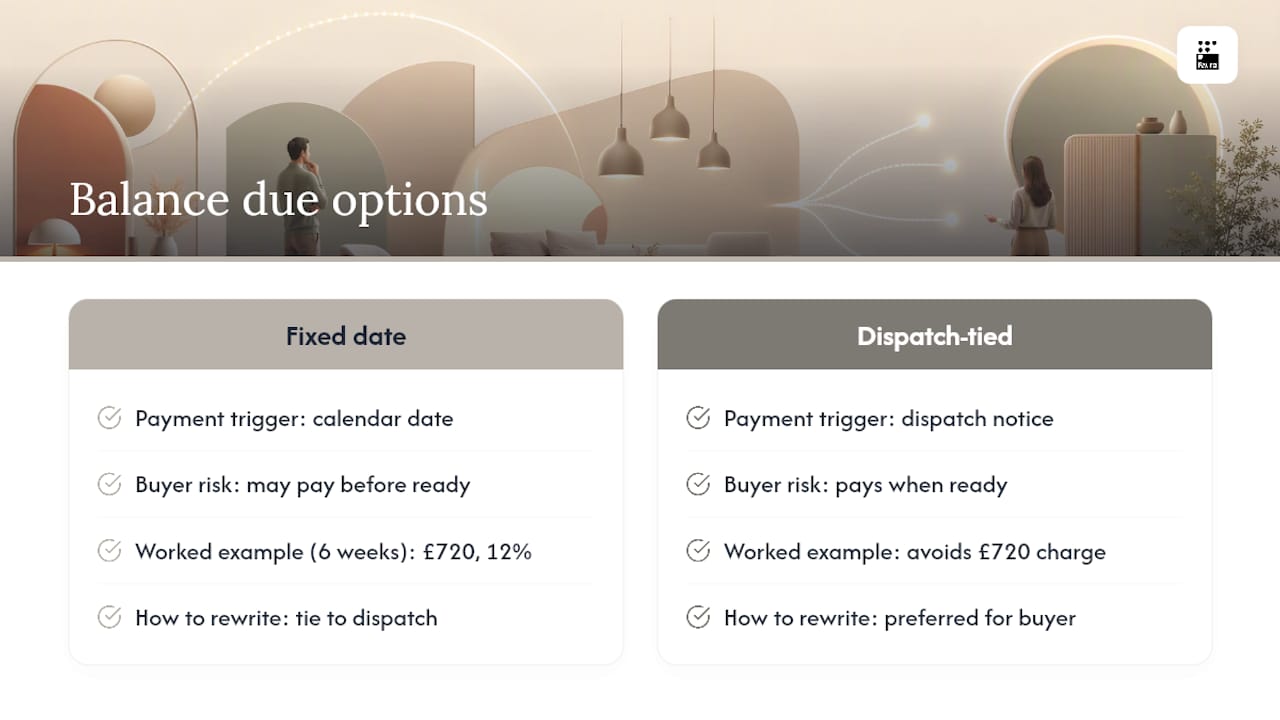
This is standard for made-to-order pieces. The negotiation lever here is not removing the deposit, it is tying the balance due date to a dispatch notification rather than a fixed calendar date, so you are not paying for goods that are not yet ready to ship.
Worked example: on a £6,000 order, a storage charge of 2% of order value per month left running for six months adds £720, or 12% of the original order value. Ask for a cap, or a longer free collection window, before signing.
When a supplier agrees to any change verbally, get it written into the purchase order line by line and have both parties initial the amendment. A verbal concession with no paper trail rarely survives a dispute.
Faura’s view on trade procurement for designers
Trade showrooms exist to remove exactly the friction described above. In practice, that can mean one trade account across many brands, with procurement, logistics and delivery handled by one team — one order, one invoice. Faura works with over 200 curated brands, so a designer can order across many of them through one relationship. The practical gain is time back for design work, not paperwork, and fewer surprises on payment schedules or storage fees buried in someone else’s terms sheet.
The clause that actually protects you isn’t the one you’d expect
Most first-time trade buyers focus their attention on price. That is understandable, discounts feel tangible, but it is the wrong priority. The clause that determines whether a bad order becomes an expensive mistake is title and risk transfer, not the unit cost.
Conventional advice tells buyers to “read the whole contract,” which is true but useless in practice, because nobody does it under deadline pressure. The better discipline is targeted: find the title clause, find the payment schedule, find the storage fee cap, and treat everything else as secondary until those three are settled. A generous discount on a piece you cannot return, and do not legally own until a balance clears months later, is not actually generous.
Designers preparing their first trade accounts should prioritise documentation readiness over negotiation charm. Suppliers respond to buyers who look organised, VAT number ready, trading history summarised, references lined up, far more favourably than to buyers who negotiate hard with nothing to back it up.
— Faura Editorial
An alternative to negotiating every supplier relationship alone
Faura gives designers one trade account across its brand network, rather than requiring a separate trade account with every individual supplier. That means ordering, invoicing and delivery coordination run through one relationship instead of dozens — one order, one invoice. It suits designers who would rather spend billable hours on a scheme than on invoice terms and collection deadlines. Faura’s trade showroom in Westminster is built specifically around this kind of operational support, alongside private client hosting and project execution help. Book a visit to the showroom through Faura’s trade page to see how procurement support works before your next order goes out.
This article is general information, not a substitute for advice from a qualified lawyer. Consult a qualified legal professional about your own circumstances before acting on anything here.