Stop 16 Week Delays: Interior Design Studio Operations for Owners
By Faura ·

Stop 16 Week Delays: Interior Design Studio Operations for Owners
Interior design studio operations are the repeatable systems that turn creative work into predictable, profitable projects: specification management, project visibility, financial tracking and knowledge retention. Get these right and firefighting drops sharply while margins improve. The first move for most studios is a single-process audit: pick the workflow causing the most delay, usually specification management, and fix that before touching anything else.
TL;DR:
- Fix specification management first, as it often causes the most hidden rework and delays across projects.
- Implement tools like a searchable product library, project dashboards, and integrated invoicing to streamline routine workflows.
- Build clear milestones and triggers into project phases, especially for procurement and installation, to prevent last-minute surprises.
- Add operational roles such as an operations manager or procurement lead before expanding staff to improve coordination and capacity.
- Consider third-party options like trade residencies to outsource sourcing and supplier admin without full-time hiring costs.
Table of Contents
- What design operations covers for an interior design studio
- The seven pillars that decide whether a studio scales or stalls
- The studio project workflow: phases, timing and checkpoints
- When to hire or assign operations roles
- Systems, tool categories and templates to implement first
- Procurement, logistics and an install-day playbook
- What actually moves the needle first
- A working base for the procurement and hosting side of your studio
- Sources
- FAQ
What design operations covers for an interior design studio
Design work is the creative act. Design operations is the infrastructure that lets that creative act happen on schedule and at a profit. The distinction matters because studios that blur the two end up with their most talented designer buried in supplier chases instead of client concepts.
Design ops covers specification management, project tracking, financial operations and institutional knowledge, according to Dot Studio’s guide to design operations. Each of those pillars maps to a distinct part of a studio’s daily rhythm:
- Specification management: the product library, cut sheets, finish schedules and version control that stop a sofa fabric being ordered twice in the wrong colourway.
- Project flow: the visibility into what stage every job sits at, and who is blocking the next step.
- Financial operations: estimates, purchase orders, deposits and invoicing, all tied back to the project they belong to.
- Institutional knowledge: the documented processes that survive a staff change rather than walking out the door with one employee.
When a principal designer spends their week chasing invoices and tracking shipments, that studio is misallocating its most valuable talent, according to Architectural Digest’s reporting on studio operations. A principal’s time is worth more in a client meeting or a mood board revision than in a spreadsheet reconciling purchase orders. The fix isn’t working longer hours. It’s building systems that hold the routine work so creative capacity stays protected.
The seven pillars that decide whether a studio scales or stalls
Studio management runs on a set of core functions, and StudioHero’s guide to studio management groups them as scheduling, resource tracking, financial management, project management, client management, team coordination and asset management. Weakness in any one creates a bottleneck the others can’t cover.
- Specification management and product libraries. A searchable, reusable spec library means a fabric or fixture sourced for one project doesn’t require re-research on the next.
- Project visibility. Dashboards showing milestones and blocking issues stop small delays turning into missed install dates.
- Financial operations. Estimates, purchase orders and invoices need to link directly to the project record, not sit in a separate inbox.
- Procurement and logistics. Lead times, order tracking and a live “hot list” of at-risk items keep surprises out of install week.
- Team coordination and role clarity. Someone has to own approvals and escalation, or every decision waits on the founder.
- Client communication and documentation. Standard proposal formats, change orders and meeting notes protect the studio if a client’s memory of an agreement drifts.
- Knowledge retention and SOPs. Written procedures mean a new hire can follow a process without shadowing someone for three months.
Pro Tip: Don’t try to systematise all seven pillars in one quarter. Fix the pillar causing the most client-facing pain first, usually specification management or procurement, and let the wins fund the next round of process work.
The studio project workflow: phases, timing and checkpoints
A dependable project follows a formalised sequence rather than an ad hoc one, and IDCO Studio’s process outline for successful studios sets out eight recognisable phases:
- Inquiry. A qualifying form or call filters fit before anyone’s time is spent.
- Discovery. A site visit or detailed questionnaire establishes scope, budget range and style direction.
- Paid consultation. Charging for this step filters out browsers and funds the early hours of strategic thinking.
- Proposal. A written scope, fee structure and timeline the client signs before design work starts.
- Design development. Concepts, drawings and specifications get built and refined against client feedback.
- Procurement. Orders are placed, tracked and chased against supplier lead times.
- Install. Furniture, fixtures and finishes arrive and get placed, styled and photographed.
- Handover. Final walkthrough, documentation handoff and warranty information close the project formally.
Build the procurement and install phases backward from your longest lead time, then add a buffer. DesignFiles’ project management process recommends exactly this approach because a single custom upholstery order with a 16 week lead time can dictate the entire back half of a schedule. Every phase transition should carry a defined trigger: a signed proposal before design development starts, a deposit before procurement begins, and a documented change order any time scope shifts mid-project. Map these gates into your project management software as milestones, not just calendar dates, so a blocked step is visible before it becomes a missed deadline.
When to hire or assign operations roles
A few signals reliably mean it’s time to add operational headcount rather than another junior designer. Watch for: missed order confirmations, a founder who hasn’t sketched anything in weeks because they’re chasing invoices, recurring install-day surprises, or a client asking for an update you can’t give without digging through email threads.
Scaling by adding junior designers often fails to relieve these pressures. Adding a dedicated operations or logistics hire tends to produce faster capacity gains, according to Architectural Digest, because the bottleneck usually sits in coordination, not design output. Priority roles worth defining, even before you’re ready to hire full-time:
- Operations manager. Owns systems, SOPs and the studio’s overall process health.
- Procurement or logistics lead. Tracks every order from confirmation to delivery and owns the hot list.
- Project manager. Runs day-to-day client and vendor coordination on a portfolio of active jobs.
- Finance lead. Manages invoicing, purchase orders and cash flow tied to specific projects.
You don’t need four full-time salaries to start. A part-time bookkeeper, a contract procurement coordinator, or one person covering two of these roles can unlock real capacity. When interviewing, look for candidates who ask about your current process gaps rather than describing generic experience, and build a first-week onboarding checklist that walks them through your spec library, project software and supplier contacts before they touch a live job.
Systems, tool categories and templates to implement first
Most studios improve operations by fixing their highest-pain workflow first, usually specification management, then expanding outward rather than rebuilding everything simultaneously, according to Dot Studio. That sequencing matters more than picking the perfect software on day one.
Five tool categories cover most of what a growing studio needs:
- A project management platform for timelines, tasks and client-facing status.
- A specification library to store product data, cut sheets and pricing in one searchable place.
- A procurement tracker for purchase orders, lead times and delivery status.
- Accounting integration so invoices and expenses tie back to individual projects automatically.
- A client portal for approvals, mood boards and communication history in one thread.
A platform like Forge is built around exactly this kind of project and business efficiency tracking, which is worth exploring if your current setup is spreadsheets and email. Automate client onboarding, invoicing triggers and order confirmations first. These are high-frequency, low-judgement tasks where a template saves hours every week.
Pro Tip: Build four templates before anything else: a client welcome pack, a procurement checklist, an install-day pack and a scope-change form. Together they cover the four moments where studios lose the most time to ambiguity.
The integration principle matters more than any single tool choice: connect project, procurement and financial data so nobody re-enters the same order three times across three systems.
Procurement, logistics and an install-day playbook
Procurement failures rarely announce themselves early. They surface on install day, when the wrong finish arrives or a vendor claims the order was never confirmed. A documented hot list and a named logistics owner prevent exactly this kind of crisis, according to Architectural Digest.
- Pre-order checks. Confirm full product payment before placing custom or non-returnable orders, and get written client sign-off on specifications.
- Supplier confirmation and tracking. Log expected ship dates the moment an order is placed, then track against them weekly on a shared hot list.
- Receiving and storage. Inspect every delivery on arrival, log damage claims immediately, and record warranty details before storage.
- Install-day run sheet. Assign roles clearly: who directs placement, who photographs, who walks the client through final sign-off.
A single named logistics lead who owns “where is it, when will it arrive, is it damaged” questions takes that reactive load off project managers and principals entirely.
What actually moves the needle first
Fix specification management before anything else. It’s the pillar most studios underrate, and it’s the one causing the most invisible rework. A shared, versioned product library pays back faster than any new hire.
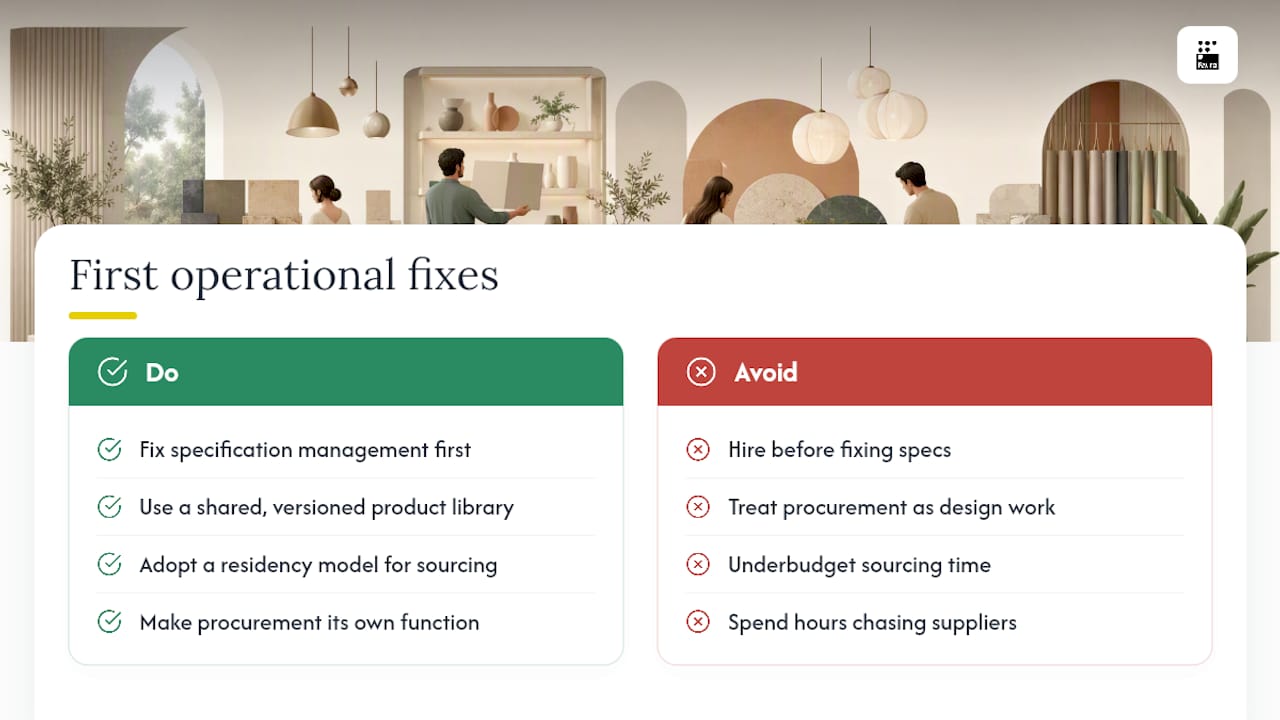
A residency model exists precisely because sourcing time is the operational drag most studios never budget for properly. Every hour spent chasing a supplier is an hour not spent on the work that actually built the studio’s reputation.
The single highest-leverage change for most owners: stop treating procurement as an extension of design work and start treating it as its own function, owned by someone other than the principal.
— Eugene
A working base for the procurement and hosting side of your studio
Some studios solve the operational drag by hiring internally: an operations manager, a procurement coordinator, a dedicated logistics lead. That route works, but it takes months to recruit, onboard and get right, and it adds fixed payroll cost before you know the volume of work to justify it.
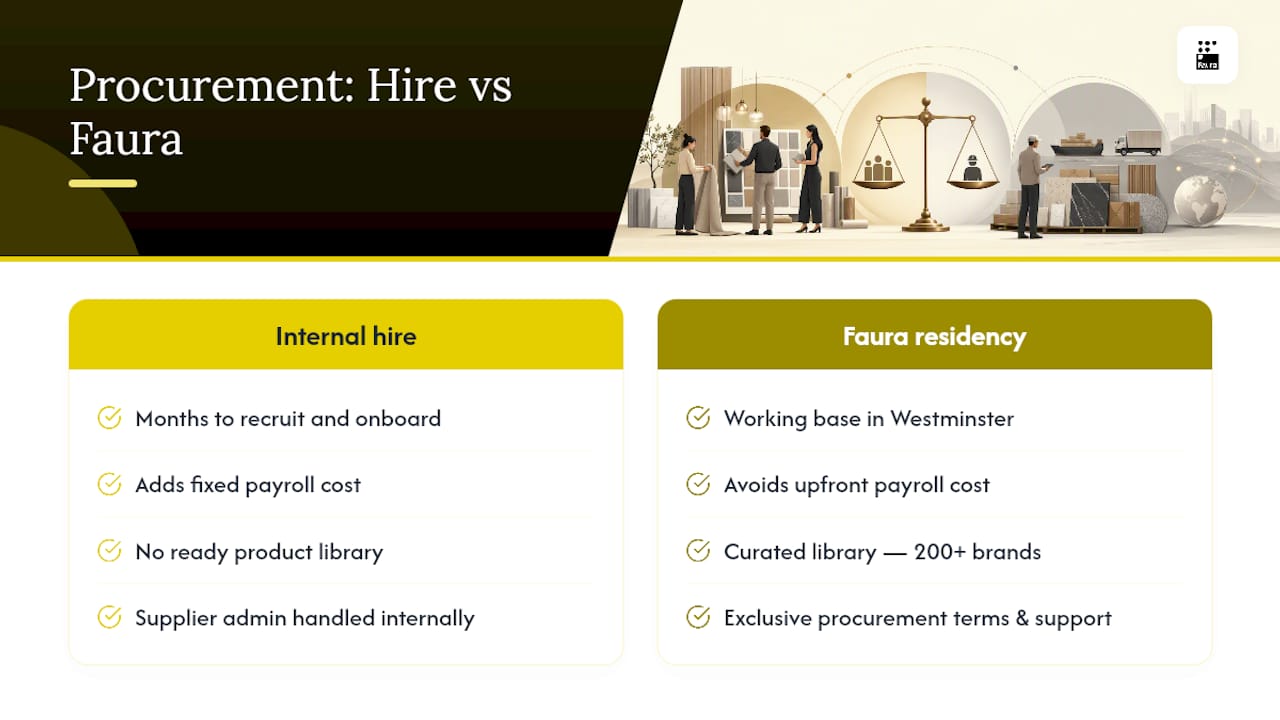
Faura offers a different route to the same outcome. As a trade residency in Westminster, it gives independent designers a working London base with a curated product library from over 200 brands, exclusive procurement terms, and project execution support. This way, sourcing and supplier admin stop consuming the hours you need for design development. Faura also hosts private clients directly in the showroom, which takes install-week coordination and client presentation logistics off your desk entirely. For a studio that isn’t ready to hire a full-time procurement lead but is tired of losing days to supplier chases, this is the more practical fix. View the trade showroom and book a discovery visit to see whether it fits your current workflow.
Sources
- What is design ops? — Dot Studio
- Want more creative freedom? Tighten up your operations — Architectural Digest
- The exact interior design process outline — IDCO Studio
- Studio management: the complete guide — StudioHero
FAQ
What is the 3-5-7 rule in interior design?
The 3-5-7 rule is a styling guideline for arranging objects in groups of three, five or seven items, used to create visually balanced vignettes on shelves, tables and mantels. It applies to design execution rather than studio operations, though a documented styling standard like this can sit inside a studio’s SOPs for consistency across projects.
What does an interior design studio do?
An interior design studio manages the full arc of a client project: discovery, concept development, specification, procurement, installation and handover. Beyond the creative work, a studio also runs the operational side, including budgeting, vendor coordination and financial tracking, that determines whether those projects land on time and on budget.
What are studio operations?
Studio operations are the systems and processes, covering specification management, project tracking, financial operations and procurement, that let a design studio deliver projects predictably rather than reactively. Strong studio management connects these functions so information doesn’t get lost between the design team, the finance side and the client.
What is the highest paying job in interior design?
Compensation varies widely by market, specialism and business ownership, but principal designers and studio owners who run their own practice and manage high-value residential or commercial projects typically earn the most in the field. Senior operations and project management roles within larger studios can also command strong salaries, since they directly protect a studio’s margins.
How do I start improving my studio’s operations?
Audit your workflows and fix the single process causing the most delay first, which is usually specification management, rather than trying to overhaul every system at once. Studios that take this staged approach tend to see faster, more sustainable improvement than those attempting a full operational rebuild in one go.