Faura cuts a London sourcing day to one stop for independent designers
By Faura ·

Faura cuts a London sourcing day to one stop for independent designers
The most reliable London sourcing day picks one district, books two or three decision-grade appointments before midday, and leaves genuine buffer time for sample handling and paperwork. Success looks like a shortlist of vendor options, confirmed lead times, and a clear list of next-step procurement actions, not a bag full of swatches with no plan behind them. A trade showroom such as Faura can compress the whole exercise into a single stop when time is short.
TL;DR:
- Book only two or three decision-grade appointments in the morning to maintain focus and allow sufficient time for sample handling and paperwork.
- Send detailed appointment briefs in advance, specifying project details, measurements, finish references, and documentation to ensure samples are ready and relevant.
- Concentrate your day in one district, such as Pimlico or Shoreditch, to minimize travel and maximize decision-making time; build in travel slack and avoid rush hours.
- Request specific, well-defined samples with clear parameters, as vague requests often lead to unusable results and slow approval processes.
- Have a contingency plan with backup suppliers and flexible scheduling to accommodate cancellations or no-shows without losing momentum.
Table of Contents
- Prepare: a pre-day checklist and appointment brief template
- Route and timing: building a clustered London itinerary that minimises travel
- Specifying and requesting samples: exact brief language and a sample pack checklist
- Running supplier meetings and showrooms: meeting script, confirmations and red flags
- Logistics, procurement and next steps: converting the day into progress
- Recommended transport options and best travel times between sourcing locations
- Key markets, trade shows and supplier types to prioritise in London sourcing days
- Tips for negotiating and building rapport with suppliers during visits
- Budgeting for sample purchases and incidental expenses during sourcing
- Recommendations for meal and rest breaks within the day to maintain productivity
- Contingency planning for appointment cancellations or no-shows
- Practitioner perspective and quick mental models for high-quality decisions
- Faura: how a trade showroom and residency can compress your sourcing day
- Sources
- FAQ
Prepare: a pre-day checklist and appointment brief template
A sourcing day without a defined outcome tends to drift. Before you book a single appointment, choose one focus, a specific room or a single material category, and decide what “done” looks like by 5pm. That single decision keeps you from wandering into showrooms that look interesting but don’t move the project forward.
Every appointment needs a brief. Send it ahead so the supplier has samples pulled and answers ready when you arrive, rather than discovering mid-meeting that what you need isn’t in stock.
Your appointment brief should cover:
- Project code and client reference
- Exact measurements and quantities required
- Finish references (Pantone, RAL or BS colour codes)
- Sample dimensions needed for client presentation
- Required documentation (fire certificates, technical data sheets)
- Contact name and direct line at the supplier
Confirm your trade account status and sample cost policy with each supplier in advance. Some issue swatches free of charge; others charge for anything beyond a standard cutting, particularly for bespoke textiles or cut stone.
Pack list for the day:
- Neutral sample board for laying out swatches
- Phone charger and a portable battery
- A retractable tape measure and a folding rule
- Flat sample boxes or a portfolio case
- Photography consent forms if you’re shooting a client’s existing space
Order priority samples that take longer to prepare, such as bespoke upholstery or cut stone, at least a week before your visit so they’re ready on arrival.
Pro Tip: Call each supplier the afternoon before to reconfirm the appointment and check that anyone you specifically need to see (a technical specialist, a stock manager) will actually be on site.
Route and timing: building a clustered London itinerary that minimises travel
Concentrating your day in one compact district beats spreading appointments across the city. Design-buying days work best when kept to a small, walkable area rather than stretched across distant postcodes, because every crossing of London eats decision time you can’t get back. Three clusters cover most sourcing needs:
- Pimlico, Belgravia and Chelsea: strong for furniture, fabric houses and high-end finishes, and compact enough to walk between most stops
- South Kensington and Brompton: good for a museum reference stop alongside showroom visits
- Shoreditch and Clerkenwell: better suited to lighting, contemporary furniture and smaller design studios
A workable structure looks like this: book your two hardest decisions, the ones that need technical answers or sign-off, for 9.30am and 11am, when your attention is sharpest. Leave midday free for admin, lunch and photographing the morning’s samples while details are still fresh. Use the afternoon for follow-up visits or looser discovery appointments where a firm decision isn’t required.
If you’re using a museum stop, such as the V&A, to check proportion or historical detail, scope it tightly to a single gallery and a fixed thirty or forty minutes, otherwise it swallows the day.
On transport: the Underground is faster for single trips, but a taxi or rideshare is worth the fare on sample-heavy legs, since London’s tube barriers and stairs are unforgiving on anyone carrying boxes. Build in courier pickup windows for anything too large to carry, and add fifteen minutes of slack to every crossing for traffic or service disruption.
Pro Tip: Book your first appointment no earlier than 9.30am. Anything earlier risks a supplier team that hasn’t finished pulling your samples yet.
Specifying and requesting samples: exact brief language and a sample pack checklist
Vague sample requests are the single biggest cause of wasted follow-up visits. A request that simply asks for “some tile options” will come back unusable; one that specifies exact parameters produces samples you can actually put in front of a client. Vague sample requests typically produce unusable results, while precise ones speed up approval considerably.
Include these fields in every sample request:
- Intended use (floor, wall, worktop, upholstery)
- Cut size or format required
- Substrate or backing material
- Finish reference (colour code, sheen level, texture name)
- Adjacent components that need to coordinate, such as edgeband, grout colour or trim
- Preferred delivery date
Lead times vary sharply by material. Laminates and small textile swatches are often ready the same day. Cut stone, bespoke joinery finishes and made-to-order textiles can take one to three weeks, so request these before your sourcing day rather than on it.
Trade professionals often receive standard swatches free of charge, but larger or bespoke samples can carry a fee and longer production time, so ask about cost before requesting oversized boards for a client presentation.
Label and photograph every sample the moment you receive it, including the supplier name, product code and price band, while the context is still fresh in your mind.

Pro Tip: Mount loose swatches on a neutral board and strip off supplier branding before photographing them. Clients respond to the material, not the marketing sticker.
Running supplier meetings and showrooms: meeting script, confirmations and red flags
A good supplier meeting follows a set order: confirm the scope of what you need, check sample availability and lead times, ask about custom options and minimum order quantities, clarify delivery and installation constraints, then move to pricing and terms. Working through it in that sequence stops you leaving with a lovely swatch and no idea what it actually costs to specify.
Four confirmations to leave with, every time:
- Exact lead time in writing, not “a few weeks”
- Confirmed availability of the specific finish shown, not a similar one
- Minimum order quantity, especially for tile, textile and stone
- Delivery and installation terms, including whether the supplier handles site delivery
Watch for red flags worth noting and escalating later: a supplier who won’t commit to a delivery date, sample production that looks inconsistent with what was promised on the phone, or reluctance to put pricing in writing. These are the meetings that come back to bite a project schedule months later.
Document outcomes before you leave the building. A quick photo index of samples shown, a few annotated notes on your phone, and a same-day follow-up email confirming what was discussed keep the meeting’s value from evaporating by the time you’re on the next appointment.
Pro Tip: Send your follow-up email from the showroom doorstep, not that evening. Details fade fast once you’re on to the next stop.
Logistics, procurement and next steps: converting the day into progress
The value of a sourcing day disappears if the information sits in a notebook for a week. Convert it into action the same evening while decisions are still sharp.
Order sequencing to work through:
- Request provisional quotes from your shortlisted suppliers
- Confirm deposit requirements before committing a client’s budget
- Flag contract checkpoints where the client needs to sign off before you proceed
Build a sample library rather than a pile. A searchable library with photographs, approval records and supplier contacts reduces repeat ordering and speeds up the next client meeting considerably.
Manage the physical logistics:
- Photograph, index and label every sample against its supplier and project code
- Store approved samples separately from ones awaiting client sign-off
- Return anything on loan to suppliers within their stated window
- Consolidate deliveries where possible, one courier collection beats five separate ones for both cost and site coordination
Before you close the day out, prepare a short client presentation checklist: a shortlist with lead times attached, a price range for each option, and a clear list of unresolved questions that need a client decision before you can proceed. For larger fit-out projects, the same logistics discipline applies well beyond furniture.
Recommended transport options and best travel times between sourcing locations
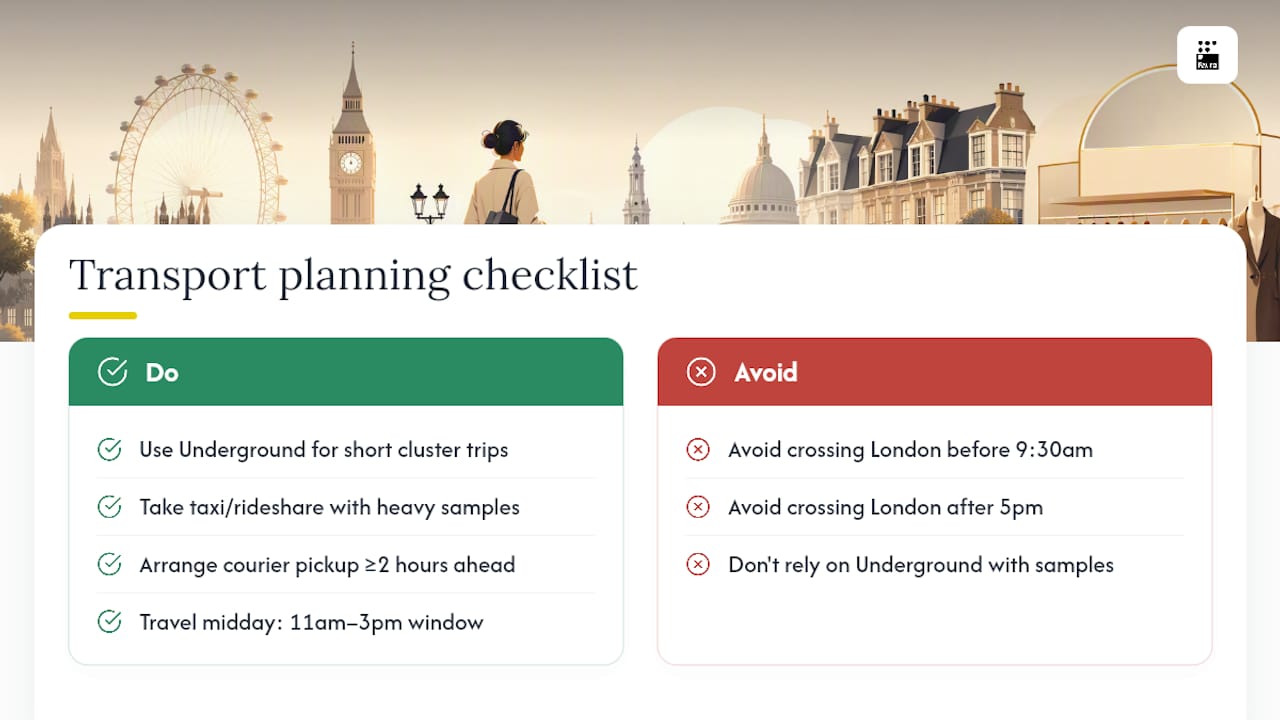
London’s transport network rewards planning around it rather than against it. The Underground is fastest for single point-to-point trips within a cluster, but stairs and barriers make it a poor choice once you’re carrying sample boxes or a portfolio case.
For sample-heavy days, budget for taxis or a rideshare between at least two of your stops, particularly straight after a meeting where you’ve picked up boards or boxed materials. The fare is a fraction of the cost of a wasted return trip.
Avoid scheduling appointments that require crossing London during the morning rush before 9.30am or the evening rush after 5pm; both add unpredictable delays to what should be a ten-minute hop. Midday travel, between about 11am and 3pm, tends to be the most reliable window across the Underground and by road alike.
If a showroom or supplier needs to send something on to you or to a client site, agree a courier pickup window before you leave rather than after. Same-day couriers in central London typically need at least two hours’ notice, and same-day slots fill quickly on Fridays.
Build fifteen minutes of slack into every journey between appointments. It rarely gets wasted, and it absorbs the small delays, a delayed train, a supplier running ten minutes behind, that otherwise cascade through the rest of your day.
Key markets, trade shows and supplier types to prioritise in London sourcing days
London’s design trade is concentrated into recognisable pockets, and a disciplined route through them rewards preparation over wandering. Furniture and upholstery houses cluster around Chelsea and Pimlico. Lighting and contemporary furniture studios lean towards Clerkenwell and Shoreditch. Stone, surfaces and kitchen specialists are more scattered but often maintain trade showrooms worth booking ahead rather than walking into cold.
A trade showroom and residency, such as Faura’s base in Westminster, groups multiple categories under one roof, furniture, lighting, textiles, stone and hardware among them, which can replace several separate cross-town appointments with a single visit.
Annual events are worth building into your calendar rather than your single sourcing day. London Design Festival and Clerkenwell Design Week bring concentrated access to makers and showrooms that don’t always keep public hours the rest of the year, though festival dates and district programming shift annually, so always confirm against the current schedule before planning a visit around them. Treat festival timing as an addition to your sourcing calendar, not the backbone of it. A single sourcing day works better built around standing trade relationships and pre-booked appointments than around a festival’s crowded, unpredictable footfall.
Tips for negotiating and building rapport with suppliers during visits
Rapport with suppliers is built over repeat visits, not won in a single meeting, but you can still improve your position on day one. Arrive with a specific quantity and timeline rather than an open-ended enquiry; suppliers respond faster and more favourably to a designer who clearly has a live project than to a browser gathering options.
Ask about trade pricing directly and early in the conversation, before you’ve fallen for a specific finish. It’s harder to negotiate once you’ve shown your hand.
Note the name of whoever helps you and follow up with them by name next time, rather than going through a general enquiry line. Suppliers remember designers who return, and repeat business tends to loosen pricing and lead times over several projects, not one.
Be straightforward about budget constraints rather than vague. A supplier who knows your ceiling can suggest an alternative finish or format that fits it; one left guessing will often quote you their top tier by default.
Where a supplier hesitates on a delivery date or a minimum order quantity, ask directly what would need to change for them to commit, more notice, a larger order, a different specification, rather than accepting a soft “we’ll see”. That question alone often surfaces the real constraint.
Treat every visit as a relationship, not a transaction. The showroom staff you build rapport with today are the ones who’ll fast-track your next urgent sample request in three months.
Budgeting for sample purchases and incidental expenses during sourcing
A sourcing day carries real costs beyond your time, and it’s worth budgeting for them upfront rather than discovering them on the invoice. Standard swatches are often free to trade accounts, but larger format boards, cut stone samples and bespoke textile cuttings frequently carry a charge, sometimes recoverable from the client, sometimes absorbed by your practice depending on how your contract is structured.
Set aside a working budget for the day covering sample fees, courier costs for anything too large to carry, parking or congestion charge if you’re driving, and taxi fares between clusters. None of these individually break a project budget, but they add up quickly across a full day of appointments.
Decide before you leave the studio whether sample costs are billable to the client or absorbed as a cost of doing business. Practices that specify this in their engagement letter avoid awkward conversations later. If you’re requesting expensive bespoke samples purely for a pitch that hasn’t yet been won, weigh that cost against the likelihood of securing the project.
Keep receipts and invoices for every sample purchase and courier charge on the day. A simple running note on your phone, supplier, item, cost, project code, saves an hour of reconstruction work when you’re reconciling project expenses at the end of the month.
Recommendations for meal and rest breaks within the day to maintain productivity
A sourcing day is cognitively demanding, closer to a day of client presentations than a day of shopping, and treating it that way protects the quality of your decisions. Concentrating decision-heavy meetings into the morning preserves your sharpest thinking for the negotiations and technical questions that matter most, which is exactly why the itinerary in this guide front-loads them before midday.
Build a genuine lunch break into the middle of the day, not a sandwich eaten while walking between appointments. Thirty to forty-five minutes away from a showroom floor gives you space to review the morning’s photographs and notes while they’re still fresh, rather than letting three appointments blur into one another by the time you write them up that evening.
If your afternoon includes four or more further stops, add a short pause, even ten minutes with a coffee, between the third and fourth. Decision fatigue is real by mid-afternoon, and a rushed final appointment tends to produce vaguer notes and weaker follow-up than the ones earlier in the day.
Avoid scheduling your most important supplier meeting last. If the day has overrun even slightly, that’s the appointment that gets cut short, and it’s usually the one you can least afford to rush.
Contingency planning for appointment cancellations or no-shows
Appointments fall through, a supplier reschedules, a contact is called into another meeting, and a sourcing day with no slack collapses the moment the first one does. Build one flexible slot into your afternoon that isn’t tied to a firm booking, so a cancellation becomes an opportunity rather than a hole in the day.
Keep a shortlist of two or three backup suppliers within your chosen district who could fill an unexpected gap, particularly ones offering categories you know you’ll need across multiple projects, so the substitute visit still produces useful material rather than wasted time.
Confirm every appointment again the morning of your visit, not just the day before. A short message asking “still good for 11am?” surfaces a cancellation while you can still restructure the rest of your route, rather than discovering it standing outside a locked door.
If a showroom does no-show on you, don’t treat it as wasted time. Use the gap to catch up on photographing and labelling samples from the previous stop, work that otherwise gets pushed to the evening and done less carefully for it.
Practitioner perspective and quick mental models for high-quality decisions
The designers who get the most from a sourcing day treat it like a client meeting, not a shopping trip. Put the hardest conversations first, while your judgement is sharpest, and save open browsing for when decision fatigue no longer matters. Resist the urge to hoard samples: a curated library beats a drawer of forgotten swatches, and production samples should only be ordered once a finish is genuinely close to approval. When a decision isn’t ready to be made, say so on the record, note it, flag the open question to the client, and move on rather than letting the whole day stall around one unresolved choice.
— Eugene
Faura: how a trade showroom and residency can compress your sourcing day
A single-district itinerary still means multiple stops, multiple sample handoffs, and multiple sets of terms to track. Faura removes several of those steps at once by putting a curated library from over 200 brands, trade account access, and procurement support under one Westminster roof, so a morning that might otherwise mean four separate showroom visits can become one appointment with consolidated sample handling and exclusive procurement terms attached.
For designers hosting clients, Faura’s showroom and residency also works as a presentation space, meaning the scheme you built during your sourcing day can be shown to the client without a second venue to arrange. Bring your project brief, finish references and measurements, and the residency team can help narrow the library to what’s relevant before you arrive. Booking details are available on the trade showroom’s website to see how much of a district-wide day it can fold into one stop.
Sources
- Sample Approval Process Best Practices
- London for design buyers: Pimlico, Chelsea and South Kensington without shopping-day sprawl
- Interior Designer’s Guide To Samples
FAQ
How many supplier appointments should I book in a single sourcing day?
Two or three decision-grade appointments in the morning is usually the practical limit, with looser follow-up or discovery visits filling the afternoon. Cramming in more tends to produce rushed decisions and thinner notes by the end of the day.
What should I include in a sample request to avoid unusable results?
Specify intended use, cut size, substrate, finish reference and any coordinating components such as edgeband or grout colour. Precise requests produce evaluable samples and speed up approval considerably compared with a vague enquiry.
Which London districts work best for a clustered sourcing day?
Pimlico, Belgravia and Chelsea suit furniture and high-end finishes, South Kensington and Brompton work well alongside a museum reference stop, and Shoreditch and Clerkenwell favour lighting and contemporary studios. Concentrating a day in one compact district reduces travel time and protects decision energy.
Does Faura offer sourcing appointments for independent designers?
Faura runs a trade showroom and residency in Westminster for independent designers and architects, offering a curated product library, trade account access and client hosting. Current details and how to book are available on Faura’s page for interior designers.
How do I handle a supplier cancellation on a sourcing day?
Keep one flexible slot in your afternoon and a shortlist of two or three backup suppliers in the same district. Reconfirm every appointment the morning of your visit so a cancellation surfaces early enough to restructure your route.