Turn One Visit into Ready Specs at Faura's Showroom for Designers
By Faura ·
Turn One Visit into Ready Specs at Faura’s Showroom for Designers
Visiting design showrooms is the trade-level way to evaluate, specify and procure products, and to host clients, with procurement-ready documentation to follow. A visit to a showroom such as Faura combines verified trade access, hands-on material evaluation and exclusive procurement terms with the chance to present schemes on-site. Done properly, a single well-planned visit should leave you with confirmed specifications, sample commitments, and clear next steps for the buying process, not just a folder of brochures.
TL;DR:
- A well-planned showroom visit provides confirmed specifications and sample commitments, requiring clear objectives and prior research to avoid wasting time.
- Carry a detailed project brief, existing samples, and accurate documentation to facilitate procurement decisions and ensure samples are properly recorded and returned.
- Ask specific questions about lead times, customisation, warranties, and technical files to obtain firm technical answers critical for project specifications.
- Organise all notes, photos, and follow-up requests immediately after the visit to convert more interactions into confirmed orders and keep procurement on track.
- A showroom residency model, like Faura’s curated library of over 210 brands, streamlines sourcing, reduces overhead, and turns showroom visits into procurement-ready handoffs.
Table of Contents
- How do you prepare for and book a design showroom visit?
- What should you bring to a showroom appointment?
- How do you get useful technical answers from showroom staff?
- What should you do after visiting a showroom?
- How a showroom residency changes a designer’s working week
- Bring your next project to Faura’s showroom
- Sources
- FAQ
How do you prepare for and book a design showroom visit?
Trade access is the first gate. Most showrooms ask for proof of professional status before granting entry or an account, and having that paperwork ready saves you turning up to a locked door. Carry a business registration document, a trade account confirmation, professional membership evidence (BIID, RIBA or equivalent), or a resale certificate, ideally as a digital folder you can produce on your phone as well as paper copies.
Once access is sorted, define what the visit needs to achieve before you book anything. A vague browse wastes a slot that could have produced firm specification decisions.
- Sample checking — confirming fabric hand, true colour and finish quality against a client brief.
- Specification — narrowing a shortlist to final choices with dimensions and lead times confirmed.
- Client presentation — using the showroom floor to walk a client through options in person.
- Procurement follow-up — chasing quotes, samples or order confirmations from a previous visit.
Research before you go rather than on the day. Trade shows and showroom clusters can involve dozens of exhibitors, and prioritising appointments against a tiered list stops you wasting a morning on brands that were never going to fit the brief. A useful split, borrowed from experienced trade show attendees, is roughly 70% time with existing vendors and 30% with new ones, which keeps momentum on live projects while still leaving room to scout.
Practical scheduling points worth building into your diary:
- Block at least 90 minutes for a single showroom visit with genuine specification intent, longer for multi-brand appointments.
- Tier your target exhibitors into priority one (must-see for this project), priority two (good to see if time allows) and priority three (opportunistic).
- Reserve tier-one appointments in the morning when staff attention is freshest, and leave less critical walk-throughs for the afternoon.
- If a junior team member is attending on your behalf, brief them on the objective in writing beforehand, not verbally on the way there.
Guidance on opening a trade account is worth reading in advance if you are visiting a showroom for the first time, since some accounts take a few days to activate.
What should you bring to a showroom appointment?
Showroom staff can only act as procurement partners if you give them enough to work with. A one-page project brief, printed and digital, should cover the scope of the room or project, an approximate budget band, critical dimensions (door widths, ceiling heights, awkward alcoves), the client’s timeline, and any site constraints such as lift access or listed-building restrictions.
Alongside the brief, bring:
- Existing swatches or finish samples you are trying to match or complement.
- A mood board or reference images, physical or on a tablet.
- Floor plans and, where relevant, CAD or Revit extracts showing the specific area in question.
- A short note on client preferences and any items already ruled out.
On-site, photograph every sample you’re seriously considering and label the image immediately with the supplier name, product code and room reference, rather than trusting memory later. If you check out a sample, log it against the supplier and expected return date at the point of borrowing. Complete FF&E specifications need the item code, manufacturer, finish, dimensions and lead time captured accurately, and that only happens reliably if you record it while you’re standing in front of the product.
Pro Tip: Return borrowed samples in the condition and packaging they arrived in, and on the agreed date. Showrooms remember which designers respect the loan library, and that goodwill often shows up later as priority access to new ranges.
How do you get useful technical answers from showroom staff?
Treat the showroom rep as an extension of your studio’s back office, not a shop assistant. The questions you ask determine whether you leave with a firm specification or another brochure to chase up later.
Ask directly about:
- Lead times for the specific finish and quantity you need, not the generic range quoted on the price list.
- Customisation options — bespoke sizing, finish variations, minimum order quantities (MOQs) for bespoke runs.
- Warranty terms and installation constraints, particularly for stone, bathroom fittings and anything with mechanical or smart-home components.
- Technical documentation — CAD or Revit files, test certificates, and finish samples large enough to photograph accurately for a client presentation.
Trade pricing is a commercial structure, not just a discount. In exchange for preferential rates, you typically take on responsibilities: minimum order commitments, sole handling of client-facing communication, and sometimes exclusivity within a project. Understanding how trade pricing and invoicing work in practice helps you keep your own bookkeeping consistent when several suppliers quote in different formats.
A showroom that functions well as a back office will flag potential lead-time conflicts before you discover them at order stage, and agree a follow-up cadence so production updates land in your inbox rather than requiring you to chase. Trade shows and showroom appointments compress months of supplier research into a few concentrated days, largely because reps can answer customisation and pricing questions on the spot that would otherwise take a week of email exchanges.
If a product is central to a scheme, ask for a finish sample big enough to sit in the client presentation, not a swatch chip. Client-facing images and technical data sheets should arrive from the showroom, not require you to source them separately afterwards.
What should you do after visiting a showroom?
The value of a visit evaporates quickly if the notes and photos sit untouched for a week. Organise everything on the day you return, or the next morning at the latest.
- Tag every photograph with the supplier, product code and room reference while the visit is still fresh in your memory.
- Transcribe handwritten notes into your specification spreadsheet or design software the same day.
- Match physical samples to their supplier paperwork so nothing ends up unidentified in a drawer.
- Send follow-up requests for quotes, lead-time confirmations and sample return dates within a few days, while the rep still remembers the conversation.
Attendees who organise photos and vendor details immediately after a showroom visit, matching them to supplier names and logging requests within the week, convert far more of that visit into confirmed orders. Build a procurement-ready handoff before passing anything to a purchasing team: approval status, confirmed finish, verified lead time, vendor contact and a purchase order template, so nothing stalls at the point of sign-off. For larger commissions, this is also the moment to schedule a factory visit or an installation check, timed against the confirmed lead time rather than an assumed one.
How a showroom residency changes a designer’s working week
Sourcing is where independent practice hours disappear fastest. A residency model that pairs a curated product library with genuine procurement support removes a good chunk of that overhead, because the groundwork of vetting suppliers has already been done before you walk in.
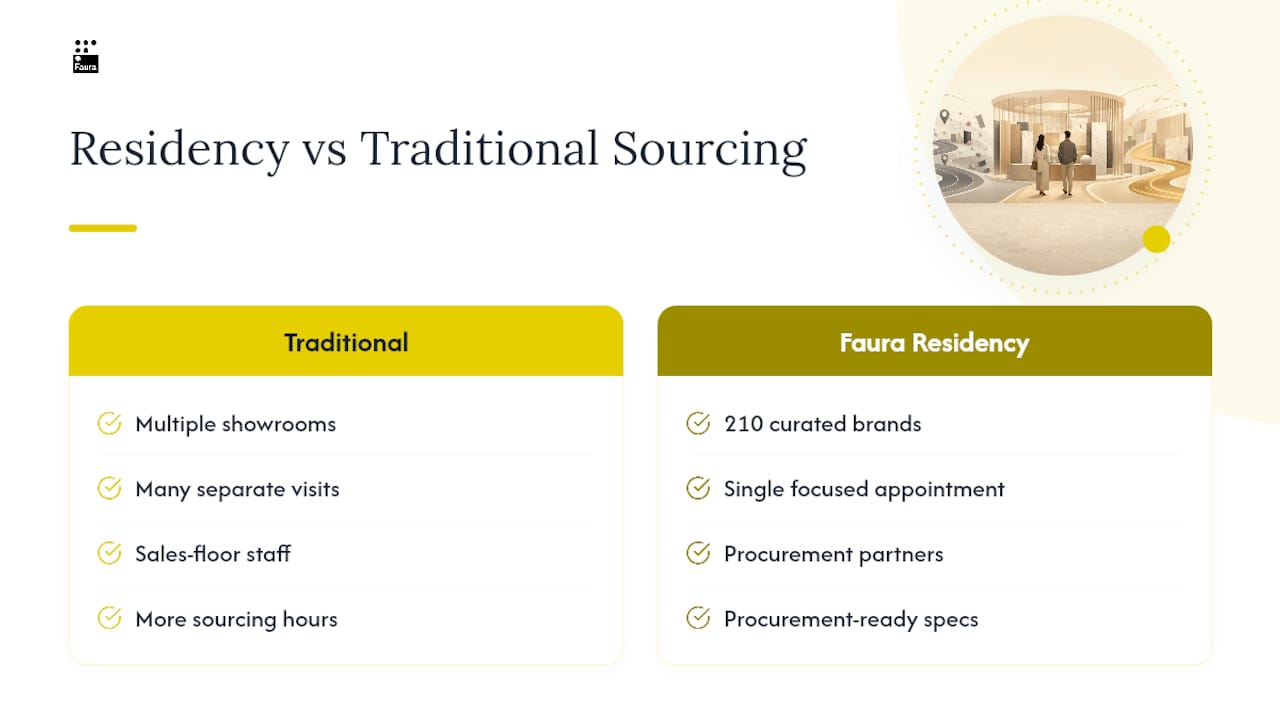
Faura represents over 210 curated brands under one roof in Westminster, which turns a multi-showroom trek across London into a single, focused appointment. That matters more than it sounds: a design centre where staff work as genuine procurement partners rather than sales floor staff changes the pace of a project noticeably.
Picture presenting a scheme to a client on-site, then leaving with procurement-ready specifications rather than a stack of business cards. That shift, from browsing to booking, is what a showroom residency is actually for.
— Eugene
Bring your next project to Faura’s showroom
Faura offers a central London base with a curated library of many brands, exclusive procurement terms, and a team oriented toward supporting designers as clients rather than as visitors. The residency and trade account gives independent designers a working London base for client hosting, sample evaluation and specification, backed by specification support and FF&E procurement that turns a showroom visit into a procurement-ready handoff rather than another to-do list.
If your practice is spending too many hours sourcing and not enough designing, book a visit to the showroom or explore trade access at Faura to see how membership fits your next project.
Sources
- Furniture trade show strategies for design and construction professionals
- Interior design workflow management: from concept to procurement
- Exhibition guide: maximise trade show value
FAQ
What documents do I need for trade showroom access?
Most showrooms ask for proof of professional status, typically a business registration, a trade account confirmation, or professional membership evidence. Carrying a digital folder of these speeds up account setup considerably.
How long should I book for a showroom appointment?
Block at least 90 minutes for a visit with genuine specification intent, and longer if you’re covering multiple brands. Tiering your priority exhibitors beforehand keeps that time focused rather than scattered.
Does Faura offer trade accounts for independent designers?
Yes. Faura’s trade account and residency give independent designers access to a curated library of over 210 brands, exclusive procurement terms and client hosting facilities in Westminster.
What should I ask suppliers during a showroom visit?
Ask about lead times for your specific finish and quantity, customisation options, minimum order quantities, warranty terms and installation constraints. These are the details that separate a firm specification from a guess.
How soon should I follow up after visiting a showroom?
Send follow-up requests for quotes, lead-time confirmations and sample returns within a few days of the visit, while the conversation is still fresh with the supplier. Waiting longer than a week noticeably reduces response rates.