3 Event Types That Win Commissions for Interior Designers in London
By Faura ·
3 Event Types That Win Commissions for Interior Designers in London
Prioritise curated showroom gatherings and B2B industry days over general meetups; use festival weeks for exposure, not primary relationship-building. Faura’s Westminster showroom, SBID’s Industry Day, and London Design Festival each play a different role in a designer’s calendar, and the professionals who win commissions treat them accordingly rather than chasing every open invitation.
TL;DR:
- Attending accredited B2B industry days offers more reliable business-building opportunities than festival weeks, especially when they include CPD credits and procurement focus.
- Curated showroom events produce higher-value professional leads because they vet attendees and emphasize procurement, unlike open or general meetups.
- Repeated visits to the same showroom or CPD session build recognition and trust, leading to more consistent referrals and long-term client relationships.
- Digital platforms like LinkedIn and Membership communities support ongoing contact but cannot replace the value of curated in-person interactions and showroom access.
- Following up with specific project details, lead times, and scheduling concrete next steps within weeks significantly improves the chances of turning contacts into commissions.
Table of Contents
- Curated calendar: event types, when they run and where to look
- How to choose which events actually move your business forward
- Turning contacts into commissions through showroom access
- Practical checklist and a 3-month calendar template
- Which digital platforms matter for designers networking online
- Getting networking etiquette right in London’s design scene
- What works: real patterns from London’s networking circuit
- The professional bodies and groups worth knowing
- Keeping a network alive after the event ends
- Author perspective: what actually produces work in London
- How Faura fits into your networking calendar
- Sources
Curated calendar: event types, when they run and where to look
London’s interior design networking scene splits into three distinct categories, and confusing them wastes time. B2B industry days, curated showroom gatherings, and district or festival programming each serve a different purpose in building a client pipeline.
B2B industry days are structured, often accredited events built around panel discussions, CPD seminars, and networking breakfasts or lunches for designers, architects, and suppliers. SBID’s Industry Day is the clearest example: it curates a business environment with talks, CPD accreditation, and exhibitor access, and offers free tickets to SBID-registered designers. BIID members have access to similar accredited sessions through their own events programme. These days run throughout the year, not just during festival season, which makes them a more reliable foundation for a working calendar.
Curated showroom gatherings happen inside trade-only spaces or brand-hosted evenings, where attendance is vetted and conversations tend towards procurement rather than small talk. Industry commentators note that curated, vetting-led events consistently produce higher-value professional leads than open, general-interest meetups, largely because everyone in the room is a verified trade contact.
District and festival programming concentrates activity geographically. London Design Festival runs across multiple venues each September, with Shoreditch, Brompton, Soho, and the Tottenham Court Road design district all hosting parallel activations. Shoreditch Design Week alone programmes more than 60 partner events, from workshops to product launches to invite-only networking lunches. Brompton Design District takes a different tack, favouring research-led installations and residencies over stand-alone trade stands, which tends to produce deeper material conversations than a typical fair floor.
For ad-hoc listings outside the big names, three sources cover most of what’s available:
- SBID’s events page for accredited B2B days and CPD sessions
- BIID’s calendar for member-only and open professional development events
- Eventbrite’s London interior design filter for smaller trade breakfasts and one-off meetups that don’t always make the major calendars
How to choose which events actually move your business forward
Not every event on a curated calendar deserves your time. The right filter comes down to six questions, and asking them before you register saves hours you’d otherwise lose to low-value chat.
- Who is the expected attendee mix? A room full of fellow designers is good for referrals; a room with procurement managers and brand reps is better for commissions.
- Is this trade-only or open to the public? Trade-only events, including most Faura-hosted evenings, filter out casual attendees automatically.
- Does it carry CPD accreditation? SBID and BIID-linked sessions count towards professional development hours, which adds tangible value beyond the networking itself.
- What’s the procurement angle? Ask whether brands attending offer trade terms, sample access, or on-the-spot account setup.
- Does the district or venue fit your specialism? A Brompton residency suits a designer working in materials and research; a Shoreditch product launch suits someone sourcing contemporary lighting or furniture.
- What’s the cost and time ratio? A £15 breakfast that runs 90 minutes with a tight attendee list often outperforms a £200 all-day festival pass.
The strongest approach combines both: use festival weeks for discovery and exposure, then book one or two targeted showroom appointments around the busiest days rather than trying to attend everything.
Pro Tip: Email organisers a week ahead and ask for the exhibitor or speaker list. Most will share it, and knowing who’s in the room before you arrive turns a cold introduction into a warm one.
Turning contacts into commissions through showroom access
Festival-only networking generates business cards. Membership and showroom-led strategies generate repeat commissions, and the difference comes down to what happens between events.
A showroom that hosts private clients, curates a product library, and supports procurement gives designers something a one-off networking evening can’t: a working base to bring clients back to. Faura’s model in Westminster illustrates this. Designers use the space for private client hosting, draw from a curated product library spanning many brands, and negotiate on exclusive procurement terms rather than retail pricing. That combination turns a single introduction into an ongoing relationship, because the follow-up meeting has somewhere concrete to happen.
The tactical sequence after a good showroom conversation matters more than the conversation itself. A useful follow-up checklist includes:
- Confirming lead times on any product discussed
- Establishing trade-account terms before requesting samples
- Requesting samples within the first week, while the conversation is still fresh
- Scheduling a procurement call within two weeks to avoid the contact going cold
Faura has represented curated brands and serves clients internationally, a scale that reflects how a single well-run trade showroom can substitute for dozens of individual supplier relationships a designer would otherwise have to build and maintain alone.
Practical checklist and a 3-month calendar template
Preparation decides whether an event produces work or just small talk. Three phases cover it.
Before: set three specific goals for the event (a supplier introduction, a CPD credit, a client lead), prepare a one-page portfolio leave-behind, and identify three named people you want to meet.
During: open with a project-specific question rather than “what do you do”, keep notes on your phone immediately after each conversation, and capture contact details digitally rather than relying on a stack of cards you’ll lose by Friday.
After: send a follow-up email within 48 hours referencing the specific thing you discussed, move any procurement conversation to a concrete next step, and book a showroom appointment if a supplier relationship looks promising.
A simple monthly template keeps this manageable:
- One showroom visit or client-hosting session
- One CPD-accredited industry day (SBID or BIID)
- One membership or year-round community event
- Targeted festival activity only in September, layered on top of the above rather than replacing it
Which digital platforms matter for designers networking online
In-person events still drive the strongest leads, but digital platforms fill the gaps between them. LinkedIn remains the default for professional visibility among UK designers, particularly for sharing completed projects and connecting with the architects and contractors who refer work. Instagram functions differently, working better for brand discovery and initial supplier contact than for direct business development.
Eventbrite deserves a second mention here beyond its listings function: many organisers use it as their registration and attendee-communication tool, which means checking an event’s Eventbrite page before you arrive often tells you who else has registered. Membership platforms such as Business & Interiors extend this further, running online forums and masterclasses alongside physical events, so members get continuity between the in-person gatherings rather than starting from zero each time they attend one.
None of these replace a showroom relationship or a CPD-accredited session. They work best as the layer that keeps a contact warm between the physical meetings that actually produce commissions, a sourcing enquiry sent after a LinkedIn exchange, a follow-up booked through an Eventbrite contact list.
Getting networking etiquette right in London’s design scene
London’s design scene runs slightly more formal than its reputation suggests. Arriving on time at a showroom appointment matters more here than at a casual meetup. Trade events, in particular, expect punctuality because hosts often schedule back-to-back appointments through the day.
Conversation openers work best when they’re specific. Asking about a current project or a particular product line lands better than a generic “how’s business”, and designers who lead with specifics tend to get remembered. Business cards haven’t disappeared, but the more effective move is asking to connect on LinkedIn on the spot, since it guarantees the connection survives even if a card gets lost.
Dress code varies by event type. B2B industry days and CPD sessions tend towards smart-casual professional dress, while brand-hosted showroom evenings often lean a little more polished, reflecting the retail environment. When in doubt, checking recent photos from the same organiser’s past events gives a reliable read.
One London-specific point worth flagging: trade-only spaces take discretion seriously. Discussing a client’s project in detail within earshot of other attendees, even at a networking event, tends to be viewed poorly. Save specifics for one-to-one conversations or scheduled procurement calls instead.
What works: real patterns from London’s networking circuit
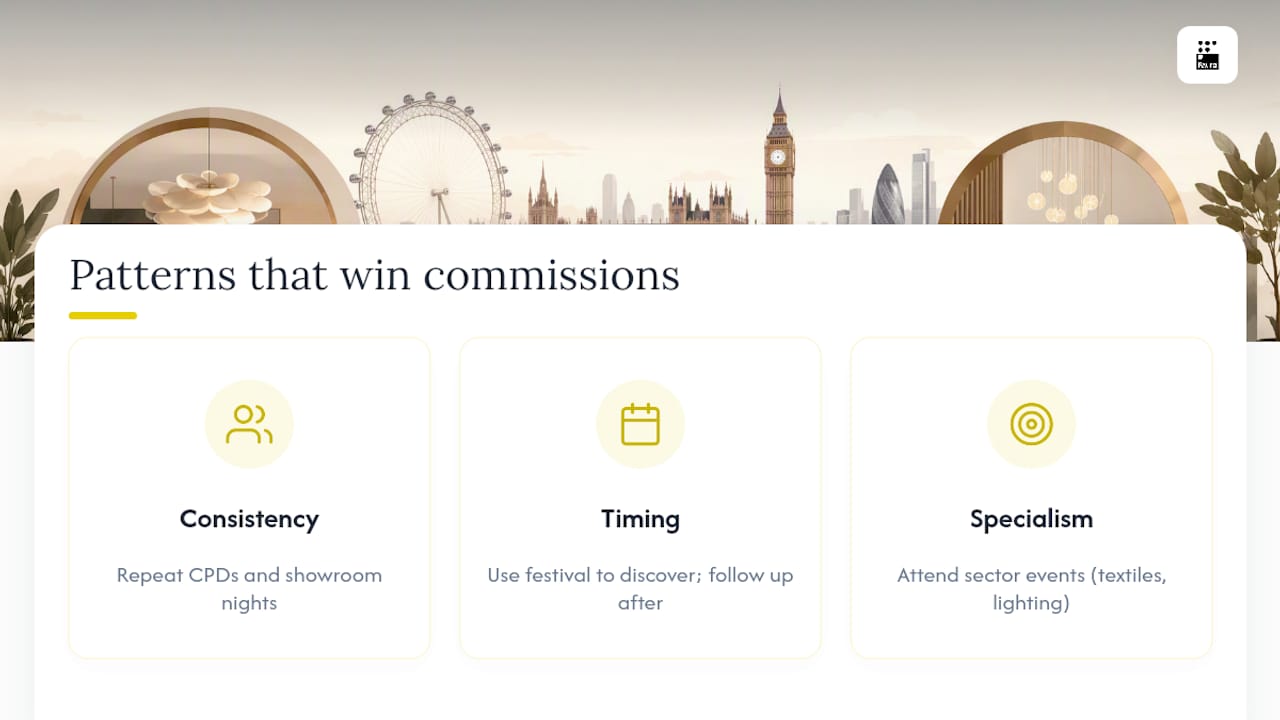
The clearest pattern among designers who network successfully in London isn’t attendance volume. It’s consistency with a small number of curated touchpoints. Designers who show up to the same CPD sessions or showroom evenings repeatedly build recognition that a one-off festival appearance never produces, because organisers and suppliers start to remember faces and projects rather than treating every encounter as a first meeting.
A second pattern involves timing. Designers who use London Design Festival for discovery, browsing new brands and installations, then book individual showroom appointments in the weeks immediately after, report better follow-through than those who try to close relationships during the festival itself, when everyone in the room is stretched across a dozen events a day. The festival’s own programming structure supports this: most district activations are built for browsing and discovery rather than deep one-to-one conversation, which is exactly what showroom appointments are designed for.
A third involves specialism. Designers working in a specific material or category, textiles, lighting, sustainable finishes, tend to get more out of narrower, sector-specific gatherings than broad general design events, simply because the room is more likely to contain the right supplier or collaborator.
The professional bodies and groups worth knowing
Two organisations anchor professional interior design in the UK, and both function as networking infrastructure as much as accreditation bodies. The Society of British and International Design (SBID) runs CPD-accredited events including its flagship Industry Day, and membership grants free or discounted access to most of its programming. The British Institute of Interior Design (BIID) offers a comparable calendar with its own CPD sessions and member events, and the two bodies’ overlapping but distinct membership bases mean many established designers hold both.
Beyond the accreditation bodies, membership communities like Business & Interiors fill a different niche: recurring breakfasts, online forums, masterclasses, and sourcing support designed to keep members connected between the bigger industry days. These tend to suit designers earlier in their client-building phase, since the format prioritises frequency over prestige.
District organisations round out the picture. Shoreditch Design Week and the Brompton Design District both operate as informal networks in their own right, with participating venues and brands often collaborating across multiple years of programming. Getting known within one district’s ecosystem tends to open doors within it faster than trying to be visible everywhere at once.
Keeping a network alive after the event ends
Most networking value gets lost in the three weeks after an event, not during it. A contact made at an SBID Industry Day or a Faura showroom evening cools quickly without a specific reason to reconnect, and a generic “great to meet you” email rarely provides one.
The stronger approach ties every follow-up to something concrete: a sample request, a procurement question, a specific project detail mentioned in conversation. Designers who reference the exact thing discussed, a lead time, a finish, a fabric pattern, get response rates that a generic follow-up simply doesn’t. Setting a calendar reminder to check in again after roughly six weeks, rather than leaving contact entirely open-ended, keeps relationships from going cold without becoming intrusive.
Recurring touchpoints matter more than any single brilliant follow-up email. Attending the same CPD sessions, returning to the same showroom for client visits, and staying active in one or two membership communities all create natural, low-pressure reasons to keep a relationship moving. Contacts built this way tend to convert into referrals and joint projects over months, not after a single exchange.
Author perspective: what actually produces work in London
Eugene’s honest read: festival week photographs well, but curated introductions and repeat showroom meetings are what actually build a client book. The most productive pattern is dull sounding, seeing the same faces at CPD sessions, then following up with a specific procurement question rather than a vague “let’s catch up”. One showroom conversation about a fabric’s lead time, followed within two weeks by a trade account and a sample order, does more for a business than a week of festival badges. London’s design scene rewards designers who show up consistently in a few well-chosen rooms rather than everywhere, once.
— Eugene
How Faura fits into your networking calendar
Faura is the alternative to chasing festival-week crowds for London-based designers who want fewer, better introductions. Rather than sourcing suppliers cold or hosting clients from a rented meeting room, you get a Westminster base built for exactly that: private client hosting, a curated product library spanning over 200 brands, and procurement terms negotiated on trade rather than retail rates. Faura has represented clients across 42 countries, so the operational support around sourcing and project execution is built for designers running real client work, not casual browsers.
If your calendar this quarter includes a showroom visit alongside your CPD and festival activity, book time at Faura’s trade showroom and see how a curated base changes your follow-up rate.
Sources
- SBID Industry Day 2026 - Premium B2B Networking Event | SBID
- London Design Festival
- MEET UP London • Hotel Designs
- Shoreditch Design Week programme
- Refine and grow your interior design business - Business & Interiors