6 Step London Design Week Strategy for UK Designers Using Showrooms
By Faura ·
6 Step London Design Week Strategy for UK Designers Using Showrooms
The most effective London Design Week strategy is narrow, not broad: pick trade-focused days, book three to five outcome-driven meetings anchored to the Global Design Forum or a district hub such as Shoreditch, then push follow-up specification work into a showroom appointment. Trying to see everything is the single biggest reason designers leave the festival with contacts but no commissions.
TL;DR:
- Focusing on three to five outcome-driven meetings in key districts like Shoreditch or Chelsea maximizes the chance of securing specifications or samples, rather than trying to see everything.
- Booking meetings around fixed events such as the Global Design Forum or trade hours enables more efficient use of time and ensures productive follow-ups.
- Follow-up within two weeks and recording clear next steps in a structured system significantly increases the likelihood of converting contacts into commissions.
- Prioritizing districts based on objectives, with Shoreditch for rapid specification conversations and Chelsea for luxury projects, ensures the best return on time spent.
- Using digital participation strategically, such as streaming talks or virtual showroom walkthroughs, allows remote stakeholders to stay engaged without sacrificing key in-person meetings.
Table of Contents
- What is a London Design Week strategy and why does it need one?
- Which design districts should you prioritise for specification and networking?
- How should you use the Global Design Forum and Material Matters?
- A 6-step framework for turning attendance into commissions
- How do you turn a casual conversation into a real lead?
- How Faura hosts festival follow-up meetings
- Marketing and branding opportunities during London Design Week
- Digital and hybrid participation options
- Sponsorship and partnership opportunities
- Post-event analysis and measuring ROI for attendees
- Author perspective: measurable success metrics and common mistakes
- How Faura supports your festival follow-through
- Sources
- FAQ
What is a London Design Week strategy and why does it need one?
A London Design Week strategy is simply a plan that decides, in advance, which meetings, talks and showrooms actually earn your time during the festival. Without one, the week becomes a sightseeing exercise. With one, it becomes a pipeline.
The London Design Festival runs its 24th edition from 12 to 20 September 2026, structured city-wide around Landmark Installations, Special Projects, Design Districts and a Partner Programme. That structure matters more than most attendees realise: some elements are built for public footfall and press coverage, others exist purely for trade conversations, and mixing the two up wastes days.
- Landmark Installations and Special Projects draw the biggest crowds and media attention, useful for brand visibility but rarely for one-to-one specification talks.
- Design Districts (Shoreditch, Chelsea, Brompton, Mayfair, Bankside and others) concentrate showrooms and trade activity, with distinct trade and public hours.
- The Global Design Forum, held 12 to 14 September at the V&A South Kensington, runs a guest-curated, largely free talks programme that draws design leaders in one room at fixed times, which makes it an efficient anchor for pre-booked meetings around the sessions themselves.
- The Partner Programme links brand-led events to the wider festival calendar, often where sponsorship and marketing activity clusters.
Treat the trade-focused mornings as meeting time and the public evenings as relationship-building time. Confusing the two is where most schedules fall apart.
Which design districts should you prioritise for specification and networking?
Not every district serves the same purpose, so match your route to your objective rather than trying to walk the whole map.
- Shoreditch is the festival’s largest dedicated district, uniting more than 60 showrooms, galleries and creative spaces, with a trade-focused first half of the week giving way to a broader public programme at the weekend. This is where specification conversations happen fastest, because showroom density means multiple meetings can be booked within walking distance of each other.
- Chelsea and Brompton carry the highest concentration of established luxury and heritage brands, better suited to high-end residential specification and long-standing supplier relationships.
- Soho leans creative and media-adjacent, useful for launches and press-facing brand activity rather than volume sourcing.
- Bankside has grown around cultural institutions and newer studios, good ground for discovering emerging talent and cross-disciplinary collaborations.
- Mayfair suits gallery-style presentations and high-value private client introductions.
For pure specification output, Shoreditch and Chelsea/Brompton deliver the highest return per hour spent. Build your day around one district in the morning and a second only if travel time between them is under 20 minutes.
How should you use the Global Design Forum and Material Matters?
The Global Design Forum and Material Matters serve two different jobs during the week, and confusing them wastes meeting slots.
The Global Design Forum at the V&A gives you fixed talk times you can build meetings around: arrive early, attend one session relevant to your sector, then use the break to meet a contact who is guaranteed to be in the same building at the same time. It works as an anchor precisely because the timing is published and reliable, unlike an open showroom crawl.
Material Matters, meanwhile, relocated to a large warehouse format for 2026, presenting biomaterials and advanced manufacturing at scale. This is a sourcing platform, not a talks programme, so treat it as a specification stop rather than a networking one.
- Book Global Design Forum sessions for thought leadership and warm introductions.
- Book Material Matters slots specifically to request samples or discuss material specification.
- Avoid trying to combine both in one afternoon; the travel time between South Kensington and most warehouse venues eats meeting time.
A 6-step framework for turning attendance into commissions
Most designers arrive at London Design Week with good intentions and no structure. This framework fixes that by forcing outcome decisions before you set foot on site.
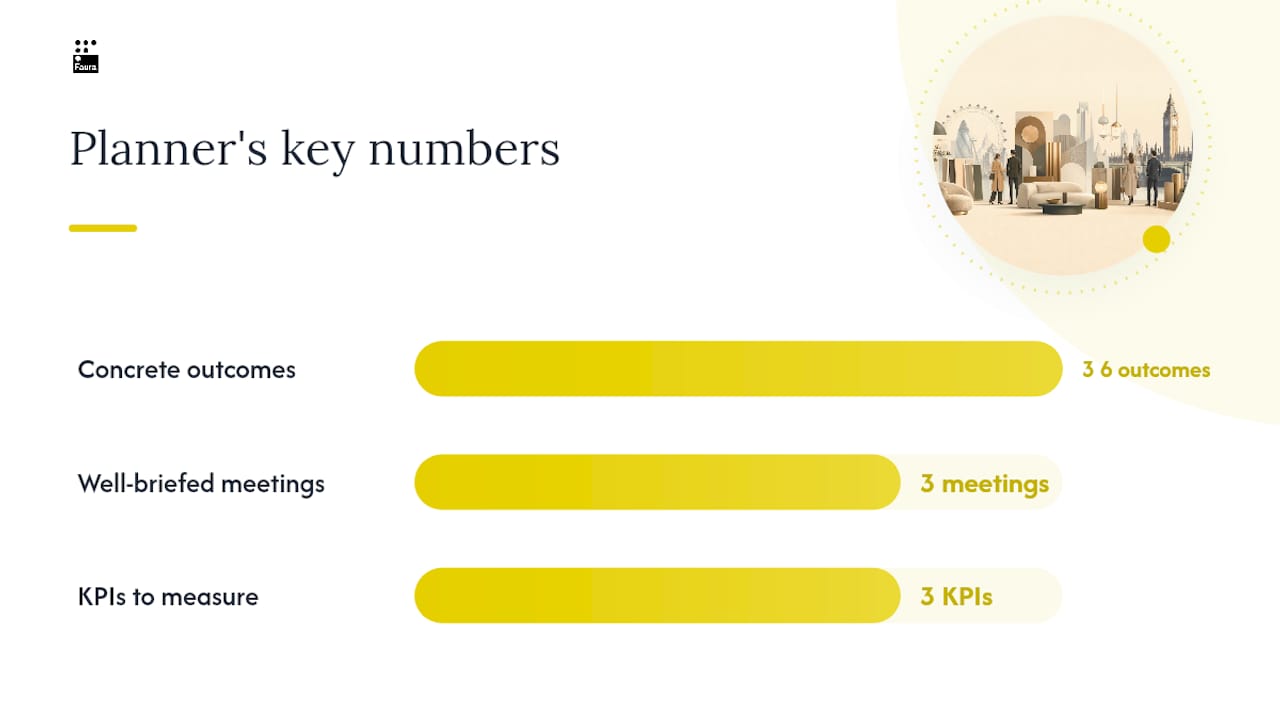
- Set 3 to 5 concrete outcomes before the week starts. Decide exactly what you want: a sample request fulfilled, a specification meeting secured, a brand partnership discussed, or a private client hosted at a showroom. Vague goals like “network more” produce nothing measurable.
- Map your anchor meetings to fixed events. Slot each meeting around a Global Design Forum talk or a district’s trade hours, so your calendar has structure rather than gaps.
- Book showroom appointments early and reserve longer slots for specification work. Showroom teams get the best results from booked conversations early in trade hours, saving open evening events for informal relationship building rather than detailed procurement talks.
- Use a short lead-capture template at every meeting. Record sector, project stage, product needs, decision timeline and the agreed next step. A badge scan alone rarely produces a project lead; a written note does.
- Schedule follow-up meetings within 7 to 14 days of the festival ending. Momentum from a face-to-face conversation drops fast once the week is over, so the follow-up needs to land while the context is still fresh.
- Measure success with three simple KPIs: qualified leads captured, sample orders placed, and specification meetings actually won.
Pro Tip: Treat each conversation, not each stand visited, as the unit you’re planning. Three well-briefed meetings with a clear next step will outperform a full day of casual badge-scanning.
This structure works because it forces decisions before the noise of the week arrives, when it is far easier to think clearly about what you actually need.
How do you turn a casual conversation into a real lead?
A festival conversation only becomes useful if you capture the right details and follow a script that gets to the point quickly.
For a specification ask, keep it to roughly 60 seconds: name the project, the stage it’s at, the product category you need, and ask directly whether a showroom appointment could work in the next fortnight. For an elevator pitch, 20 seconds is enough: who you are, what you specify, and one sentence on what makes your current project interesting enough to warrant a follow-up.
At first contact, capture five things: project type, timeline, decision-maker, specific product needs, and the agreed next step. If a contact has an active project with a defined timeline, push for an in-person showroom appointment rather than a vague “let’s stay in touch.” If the project is early-stage or the timeline is unclear, a remote follow-up call is the more realistic next move.
- Record every contact in a simple spreadsheet with columns for date, contact name, project, product needs, next step and deadline.
- A structured follow-up system like this considerably improves the conversion rate from contact to commission during a dense festival week.
Pro Tip: Set a deadline for every “next step” you write down. A next step without a date rarely gets actioned once the week’s momentum fades.
How Faura hosts festival follow-up meetings
A trade-focused residency can provide a professional space to present schemes without the need to rent a venue or manage supplier logistics.
- Designers with a trade account can move straight from a festival meeting into a hosted client presentation, using Faura’s showroom to display schemes drawn from over 210 curated brands.
- Preparing for a hosted visit means bringing a defined scheme, a shortlist of specification priorities, and clear procurement questions, so the appointment produces a decision rather than another round of browsing.
- Handling sourcing and back-office coordination allows a trade showroom conversation that starts at the festival to move to signed specification in fewer steps than independent sourcing.
Marketing and branding opportunities during London Design Week
Brands and showrooms treat the festival as a stage for visibility, not just sales, and the districts themselves are built to support that. A launch timed to coincide with Shoreditch’s trade-focused opening days reaches buyers before the public crowds arrive, while a Landmark Installation or Special Project reaches press and a wider public audience later in the week.
The 2026 programme is framed around themes of exchange spanning East and West, past and future, human and non-human. This gives brands a narrative hook that resonates with curators and partners looking for a coherent story rather than a product dump. A showroom that ties its launch to that framing, rather than presenting it in isolation, tends to attract stronger press and partner interest.
Smaller brands and independent designers can also use the festival’s emerging-talent platforms, such as LDF’s Launch Pad, which offers sponsored presentation slots and networking support to under-represented designers who might otherwise struggle to secure stand space.
Beyond the physical week, festival timing is increasingly used to launch coordinated social and digital campaigns. Planning that activation properly, including audience targeting and channel sequencing, is its own discipline. Guidance on building an effective social advertising plan is worth reading before the week starts, since a campaign launched without a plan behind it rarely outperforms organic word of mouth generated on the ground.
Digital and hybrid participation options
Not every stakeholder can be in London for the full week, and the festival’s structure increasingly accommodates that. Talks at the Global Design Forum are frequently recorded or streamed in part, giving remote teams access to thought-leadership content even without a V&A ticket. This matters for practices with distributed teams, where a junior designer might attend in person while a director follows key sessions online.
Showrooms and brands are also using the week to run hybrid follow-up: a physical meeting during the festival, followed by a virtual walkthrough of a fuller product range for colleagues who couldn’t attend. This is particularly useful for procurement categories like lighting or surfaces, where a video call showing finish samples can substitute for a second in-person visit.
For international clients, digital participation also solves a timing problem. Designers serving overseas clients across dozens of countries often can’t fly every stakeholder in for a single week, so a hybrid approach, in-person specification meetings backed by digital presentations for absent decision-makers, keeps projects moving without losing the value of face-to-face contact where it counts most.
The practical takeaway: don’t treat digital participation as a lesser substitute. Use it deliberately, for the parts of your process that genuinely benefit from remote access, and reserve in-person time for the specification conversations that need a room, a sample and a decision.
Sponsorship and partnership opportunities
Sponsorship during London Design Week works on two levels: festival-wide partnerships tied to Landmark Installations or the Partner Programme, and district-level sponsorship tied to a specific hub’s events.
Festival-wide sponsorship suits larger brands with budget for high-visibility placement, since Landmark Installations and Special Projects draw the broadest public and press audience of the week. District-level sponsorship, by contrast, tends to suit mid-sized brands and showrooms better, because it reaches a more concentrated trade audience at a lower cost of entry. Shoreditch Design Week’s growth, and the movement of established trade exhibitions into the district, has created concentrated opportunities for buyer-supplier meetings during trade days specifically.
Partnerships between brands and designers are equally worth considering outside formal sponsorship packages. A showroom hosting a joint presentation with a designer, or a manufacturer sponsoring a Launch Pad slot for an emerging talent, both generate goodwill and press interest without the cost of a standalone Landmark Installation.
Before committing budget, weigh the audience against your objective. A brand looking for trade specification meetings gets more value from a district partnership than a festival-wide sponsorship aimed at public footfall, even though the latter carries more prestige.
Post-event analysis and measuring ROI for attendees
The value of a London Design Week strategy shows up in the weeks after the festival, not during it, so measurement has to happen deliberately rather than informally.
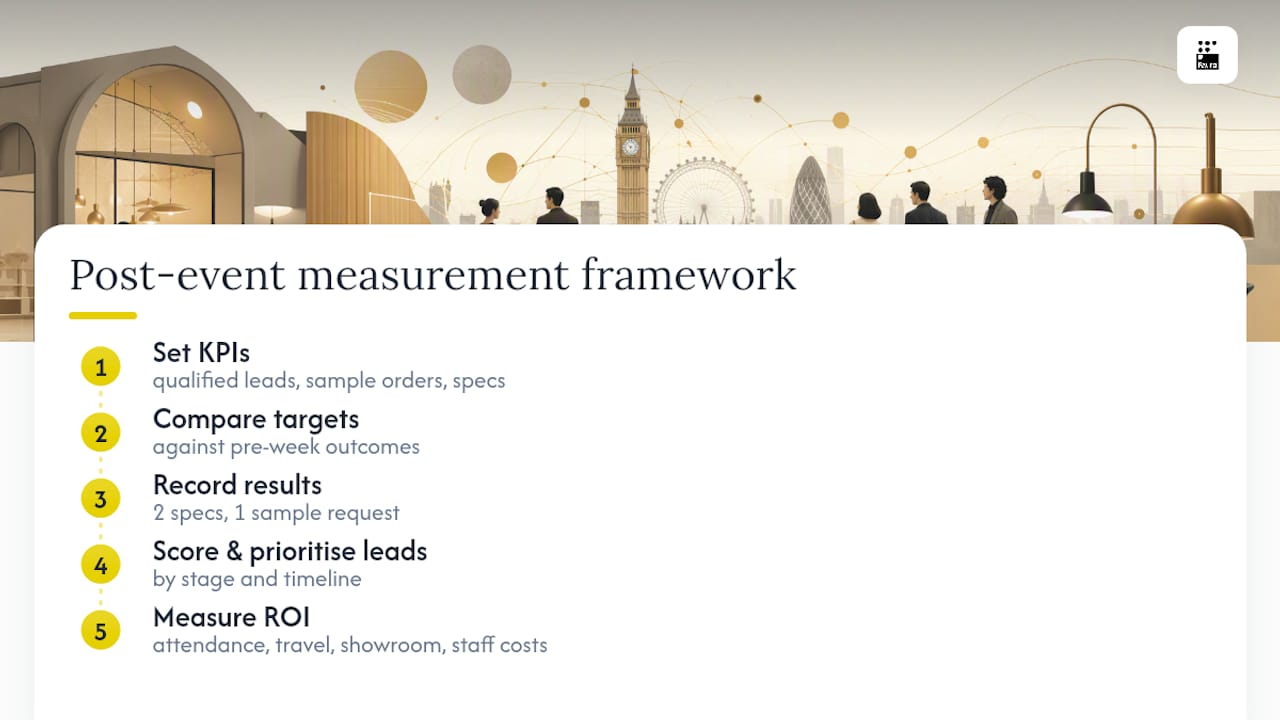
Start with the KPIs set out in the planning framework above: qualified leads captured, sample orders placed, and specification meetings actually won. Compare those numbers against the outcomes you defined before the week began. If you set five target outcomes and secured two specification meetings and one sample request, that’s a concrete result you can weigh against the cost of attending, travel, showroom time and staff hours.
London’s design economy generated £27.2 billion in GVA in 2019, a reminder that the concentration of clients and suppliers in one city, for one week, is a genuinely rare commercial opportunity rather than a networking nicety. That scale is exactly why a scatter gun approach underperforms: with that much activity compressed into nine days, only a filtered, outcome-led plan captures a meaningful share of it.
Review your lead-capture spreadsheet within a week of the festival ending, while contacts still remember the conversation. Score each lead by project stage and timeline, prioritise follow-up accordingly, and note which district or event produced your strongest contacts. That last detail compounds: knowing that Shoreditch’s trade mornings outperformed a Mayfair evening reception for your practice specifically means next year’s plan starts smarter, not from scratch.
Author perspective: measurable success metrics and common mistakes
The number that matters isn’t attendance, it’s specification meetings won against the three to five outcomes set beforehand. The recurring error is trying to see everything: designers who walk every district end most days too exhausted to run a proper follow-up. Weak or missing follow-up within two weeks is the second-biggest cause of lost commissions. Plan less, follow up harder.
— Eugene
How Faura supports your festival follow-through
Faura is the practical next step for designers who leave London Design Week with strong contacts but no venue or procurement route to move them forward. Rather than chasing suppliers across multiple districts after the festival ends, designers with a trade account can bring a scheme straight to Faura’s Westminster residency, present it to a client in a dedicated hosting space, and source across more than 210 curated brands under one roof with exclusive procurement terms.
If a festival meeting produced a live project, the fastest route to a decision is a hosted presentation: bring your shortlist, your priorities and your procurement questions, and let Faura’s operational support handle the sourcing logistics while you focus on the design. Explore the residency and trade account details to see how a hosted appointment could convert your next festival contact into a signed specification.
Sources
- A first look at LDF26 — London Design Festival
- LDF Sept 2026 Global Design Forum — V&A
- Your complete city-wide guide — Livingetc
FAQ
When is London Design Week 2026?
The London Design Festival’s 24th edition runs from 12 to 20 September 2026, structured around Landmark Installations, Special Projects, Design Districts and a Partner Programme. The Global Design Forum runs within that window, from 12 to 14 September at the V&A.
Which district should I focus on for specification meetings?
Shoreditch offers the highest showroom density, with over 60 showrooms and creative spaces concentrated in one district and a trade-focused first half of the week. Chelsea and Brompton suit high-end residential specification and established brand relationships better.
How many meetings should I actually book?
Three to five outcome-driven meetings per day is realistic and far more productive than trying to visit every stand. Each meeting should have a defined goal, such as a sample request or a specification conversation, decided before the week starts.
How quickly should I follow up after the festival?
Follow up within 7 to 14 days while the conversation is still fresh in the contact’s mind. A structured system recording project, product needs and next step considerably improves conversion into signed work.
Can Faura help after a London Design Week meeting?
Yes. Faura’s trade account and residency let designers bring a festival contact straight into a hosted showroom presentation in Westminster, with procurement support across more than 210 curated brands. Current pricing and access terms are listed on the Faura site.